End-of-Season Grill & Smoker Grate Rust Removal
Rust you put away in October is twice the rust you pull out in April. Strip it now, season it now, and the grates go into storage protected instead of decaying.
Grates rust for one reason: bare iron plus moisture. A season of high heat burns off seasoning, grease and salty marinades trap moisture against the metal, and a cover that holds condensation finishes the job. By fall most cast iron and carbon steel grates have orange bloom along the bar edges and flaking scale under the carbon crust.
This guide covers how to strip that rust with power tools without wrecking the grate: which grate materials can take an abrasive at all, which abrasive matches which rust condition, how to reach between bars, and how to get the seasoning back on before the metal flash-rusts. The two abrasive formats that do this job well are bristle discs and non-woven discs. Wire wheels are deliberately not on the list, for reasons covered in section 02.
01Identify the Grate Material First
The material decides everything. Half the grates on the market should never see a power abrasive, and grinding the wrong one turns a cleanable grate into scrap. Check the owner's manual or the manufacturer's parts listing if you are not sure. A magnet sticks to all of these except some stainless grades, so it is not a reliable test on its own.
| Grate Material | How to Recognize It | Power Abrasive? | What to Do |
|---|---|---|---|
| Bare cast iron | Heavy, thick bars, dull black or rust-orange, no glossy coating | YES | Best candidate. Strip to clean metal, re-season same day. |
| Carbon steel (rod, flat bar, expanded metal) | Common on offset smokers and drum smokers; lighter than cast iron, rusts fast | YES | Strip, re-season. Expanded metal: non-woven or drill-mounted strip disc, light pressure. |
| Stainless steel rod | Bright silver under the grime, rust appears as surface staining rather than scale | YES (non-woven) | Non-woven only for most jobs. No seasoning needed. |
| Porcelain-enameled cast iron or steel | Glossy, glass-like coating, often black or matte black; rust shows only at chips | NO | An abrasive strips the enamel. Clean with a nylon brush; replace when chipping is widespread. |
| Chrome or nickel-plated wire | Thin, shiny wire grates, usually on entry-level grills | NO | Plating is microns thick. Once it is through, rust comes back immediately. Replace. |
02Why Bristle Discs and Non-Woven, Not Wire
Wire wheels and wire grill brushes shed steel bristles. On a grinder those bristles fly. On a grate they can stay lodged in the casting and end up in food. A study published in Otolaryngology-Head and Neck Surgery estimated 1,698 U.S. emergency department visits from swallowed wire grill-brush bristles between 2002 and 2014, with injuries concentrated in the mouth, throat, and tonsils, and some requiring surgery.
The two formats in this guide avoid that failure mode:
- Bristle discs use molded polymer bristles loaded with a ceramic and aluminum oxide grain blend. The abrasive is in the bristle tips, they cut faster than wire on scale, and they conform over bar edges and casting ribs. Full background: Bristle Discs vs Wire Wheels.
- Non-woven discs are an open nylon web impregnated with abrasive grain. They flex, run cool, will not gouge, and leave a uniform scratch pattern that seasoning grips well. Background: What Surface Conditioning Discs Do and Non-Woven Grades Explained.
Any abrasive leaves debris. That is why the process below ends with a wash, a wipe-down until the towel comes away clean, and a seasoning burn before food touches the grate.
03Match the Abrasive to the Rust Condition
Start as fine as the rust allows and only step coarser when the finer tool stops making progress. Coarse grit removes rust fast and also removes iron fast. On cast iron that is recoverable; on thin carbon steel rod it is not.
| Rust Condition | What It Looks Like | First Choice | Finish With |
|---|---|---|---|
| Flash rust | Even orange bloom, wipes partly off on a rag | Non-woven medium (maroon AMED / red) | Done. Season. |
| Light rust | Orange with some texture, no flaking | 80 grit bristle disc or non-woven coarse (brown ACRS) | Non-woven medium |
| Moderate rust | Crusty, early pitting, some flakes lift with a scraper | 50 grit bristle disc | 80 grit bristle disc |
| Heavy scale under carbon | Thick flaking layers, black carbon cake fused on top | 36 grit bristle disc or strip & clean disc | 80 grit bristle disc, then non-woven medium |
| Between bars and corners | Rust in the gaps where a 4-1/2" disc cannot reach | 2" or 3" Type R bristle disc on a die grinder | 2" or 3" Type R non-woven, medium |
| Round rod grates | Rust wrapping the full circumference of each rod | 4" strip & clean disc on a drill, or 3" Type R non-woven coarse | Non-woven medium |
Do not go finer than 120 grit on cast iron or carbon steel. Seasoning bonds better to a fine, even scratch pattern than to polished metal, and the time spent polishing a grate is time it spends flash-rusting. For the broader grit logic, see the grit selection chart and which abrasive for light, medium, or heavy rust.
04Which Tool Reaches Which Surface
A grate is not a flat panel. It has bar tops, bar sides, the gaps between bars, and on cast grates, ribs and a perimeter frame underneath. One tool will not reach all of it.
| Format | Tool | Mount | Max RPM (listing) |
|---|---|---|---|
| 4-1/2" bristle disc | Angle grinder | Threads directly onto 5/8"-11 spindle | 12,000 |
| 2" Type R bristle disc | Die grinder | Type R quick-change holder | 25,000 |
| 3" Type R bristle disc | Die grinder | Type R quick-change holder | See product listing |
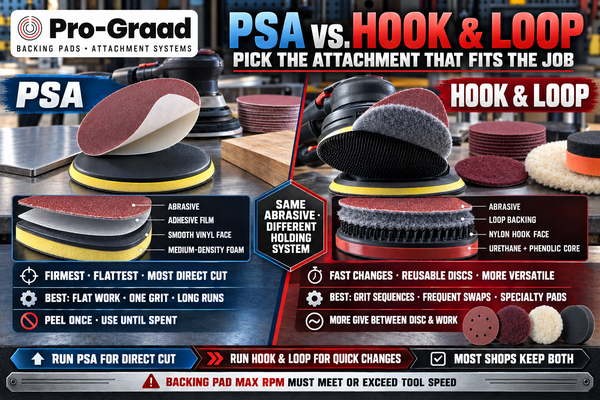
| 4-1/2" / 5" H&L non-woven | Angle grinder or drill | Hook & loop backing pad, 5/8"-11 | See product listing |
| 2" / 3" Type R non-woven | Die grinder | Type R quick-change holder | See product listing |
| 4" strip & clean disc | Drill | Integrated 1/4" shank | Stay under 4,500 |
Check your tool's nameplate against the disc rating before you start. Most 4-1/2" angle grinders run 10,000 to 12,000 RPM; a strip & clean disc on an angle grinder would be badly over-speed, which is why the 4" version ships with a drill shank. Speed limits by diameter are covered in the RPM and SFPM chart. Type R mounting is explained in Quick-Change Disc Systems, Decoded, and if a hook & loop disc wobbles on the pad, see Backing Pad Selection & Why Your Disc Wobbles.
05The Process, Start to Seasoned
- Pull the grates and confirm the material. Use the table in section 01. If they are enameled or plated, stop here.
- Remove the carbon and grease first. Scrape the carbon cake with a plastic or wood scraper, then soak and scrub with hot water and a degreaser. Abrasives load up on grease and stop cutting within seconds. Dry completely before grinding.
- Clamp the grate. A loose grate on a bench will grab a spinning disc and throw. Clamp it flat to a bench or hold a section in a vise with soft jaws. Never hand-hold a grate while running a grinder on it.
- Strip the heavy rust. Run the coarse bristle disc or strip & clean disc with light pressure. Bristle discs cut with the tips; pushing harder folds the bristles over and cuts slower, not faster. Keep the disc rotating off bar edges, not into them, so it cannot catch.
- Get into the gaps. Switch to a 2" or 3" Type R disc on a die grinder for bar sides, the spaces between bars, and casting ribs underneath.
- Refine. Step to 80 grit bristle or a medium non-woven to even out the scratch pattern. Stop at clean, uniformly gray metal. Shallow pits that stay dark are fine; chasing them to the bottom removes metal you need.
- Wash it. Blow off dust, then wash with hot water and dish soap and scrub with a nylon brush. Wipe every bar with paper towel and repeat until the towel comes away without gray residue.
- Dry it with heat immediately. Bare cast iron and carbon steel can flash-rust within an hour in humid air. Put the grates back on a lit grill or in a 200°F oven for 10 to 15 minutes.
- Season the same day. While warm, wipe on a very thin coat of high smoke point oil or shortening, then wipe it off as if you made a mistake. Bake at 450 to 500°F for one hour, let cool, and repeat two to three times. Thick oil coats turn sticky instead of hardening.
- Store it dry. Indoors if possible. Outdoors, use a breathable cover and leave the vents cracked so condensation can escape.
06Smoker-Specific Notes
- Cooking grates on offset and drum smokers are usually carbon steel rod or expanded metal. Expanded metal has sharp diamond openings that catch disc edges; use non-woven discs flat on the face with light pressure, and a 3" Type R non-woven for the edges.
- Charcoal and firebox grates run far hotter than cooking grates and burn seasoning off anyway. Knock off the loose scale with a 36 grit bristle disc and skip seasoning. If the bars are thin or warped, replace them.
- Cook chamber interiors should not be ground to bare metal. The carbon and polymerized grease layer protects the steel. Spot-treat only flaking rust, then wipe with oil and run the smoker hot.
- Exterior rust is a different job: strip to sound metal and recoat with high-temperature paint rated for the surface temperature. Never paint the interior or cooking surfaces.
07Safety
- Safety glasses or a face shield. Bristle discs and strip discs throw rust flakes and spent abrasive.
- A dust mask or respirator rated for fine particulate. Work outdoors or with strong ventilation; rust and carbon dust is fine and gets everywhere.
- Gloves, and keep the grinder guard on.
- Do not grind enameled grates. Porcelain enamel is glass, and the chips are sharp.
- Match disc RPM to the tool every time, especially when switching between grinder, die grinder, and drill.
08Common Mistakes
- Grinding before degreasing. The disc glazes over in seconds and you blame the abrasive.
- Using 36 grit on everything. Fast on scale, but it leaves deep scratches and removes metal from thin rods. Step up in grit as soon as the rust breaks.
- Heavy pressure on bristle discs. It folds the bristles and slows the cut. Let the tips work.
- Leaving bare grates overnight. They will be orange by morning. Strip, wash, dry, and season in one session.
- One thick coat of oil. It stays tacky and goes rancid. Several very thin coats harden properly.
- Trying to save enameled or plated grates. The abrasive does the opposite of what you want. Replace them.
- Cross-contaminating stainless. Keep dedicated discs for stainless work.
09Products for Grate Rust Removal
Bristle Discs: 4-1/2" x 5/8"-11 for Angle Grinders
Thread directly onto the grinder spindle. For bar tops, perimeter frames, and the flat underside of cast grates.
4-1/2" x 5/8"-11 Bristle Disc, 36 Grit, Brown
4-1/2" x 5/8"-11 Bristle Disc, 50 Grit, Green
4-1/2" x 5/8"-11 Bristle Disc, 80 Grit, Yellow
4-1/2" x 5/8"-11 Bristle Disc, 120 Grit, White
Bristle Discs: Type R Quick-Change for Die Grinders
For bar sides, gaps between bars, and casting ribs. Requires a Type R holder. Full line details in the Type R Bristle Disc Guide.
Non-Woven Discs: 4-1/2" and 5" Hook & Loop
Aluminum oxide in an open nylon web. Best for flash rust, light rust, the final pass before seasoning, and stainless grates. Mount on a hook & loop backing pad.
4-1/2" Hook & Loop Backing Pad, 5/8"-11, 2 Pack with Drill Adapters
Non-Woven Discs: Type R Quick-Change for Die Grinders
The small-format non-woven option for gaps, rod grates, and expanded metal edges.
2" SE Coarse Type R Non-Woven Disc, Brown (ACRS), 25 Pack
3" SE Coarse Type R Non-Woven Disc, Brown (ACRS), 25 Pack
Non-Woven Strip & Clean Discs
Extra coarse silicon carbide in an open non-woven web. Strips heavy rust and scale fast without changing the shape of the bar. More on the format in Strip Discs: Removing Paint, Rust, and Coatings.
4" x 1/2" Strip & Clean Disc, 1/4" Drill Shank, Purple, 2 Pack
4-1/2" S XCS Hook & Loop Strip Disc Kit with 5/8"-11 Holder & Drill Adapter
10FAQ
Can I use a power abrasive on porcelain-enameled grill grates?
No. Porcelain enamel is a glass coating fused to the metal, and any bristle disc or non-woven disc will strip it. Once the enamel is breached, the steel underneath rusts and the coating keeps chipping. Clean enameled grates with a nylon brush and hot soapy water, and replace them when chipping is widespread.
What grit bristle disc should I use to remove rust from cast iron grill grates?
Match the grit to the rust. Use 80 grit for light rust, 50 grit for moderate rust with early pitting, and 36 grit only for heavy flaking scale. Finish with 80 grit or a medium non-woven disc, and do not go finer than 120 grit, because seasoning bonds better to a fine scratch pattern than to polished metal.
Why not use a wire wheel to clean grill grates?
Wire wheels and wire grill brushes shed steel bristles that can lodge in the grate and end up in food. A study in Otolaryngology-Head and Neck Surgery estimated 1,698 U.S. emergency department visits from swallowed grill-brush bristles between 2002 and 2014. Bristle discs and non-woven discs remove rust without steel wire, and the grate is washed and seasoned before food touches it.
How do I clean rust from between the bars of a grill grate?
A 4-1/2" disc on an angle grinder only reaches bar tops. For the sides of bars, the gaps between them, and casting ribs underneath, use a 2" or 3" Type R bristle disc or Type R non-woven disc on a die grinder. For round rod grates, a 4" strip and clean disc on a drill wraps over each rod.
How soon do I need to season grill grates after removing rust?
The same day. Bare cast iron and carbon steel can flash-rust within an hour in humid air. Wash the grates, dry them with heat on the grill or in a low oven, then apply a very thin coat of high smoke point oil and bake at 450 to 500°F for one hour. Repeat two to three times.
Do stainless steel grill grates need to be seasoned after rust removal?
No. Stainless grates do not need seasoning. Rust on stainless is usually surface staining from carbon steel contamination or trapped salt. Use non-woven discs that have never touched carbon steel or cast iron, wash and dry thoroughly, and consider passivation for persistent staining.
Related Guides
- Angle Grinder Bristle Disc Guide
- Type R Quick Change Bristle Disc Guide
- Removing Rust from Metal: Light, Medium, or Heavy
- What Surface Conditioning Discs Do That Sandpaper Cannot
- Bristle Discs vs Wire Wheels
- Abrasive RPM and SFPM: Maximum Safe Speed by Disc Diameter
Bristle-brush injury figure: Chang CWD et al., University of Missouri School of Medicine. "Epidemiology of Wire-Bristle Grill Brush Injury in the United States, 2002-2014." Otolaryngology-Head and Neck Surgery, 2016. Maximum RPM figures are taken from Pro-Graad product listings; always confirm the rating printed on the product and on your tool before use.