Passivating Stainless Steel
You cleaned the heat tint and got back to sound metal. Passivation is what actually restores the corrosion resistance — the chemical step that removes free iron and rebuilds the stainless armor. Here's what it is, when you need it, and how it's done.
Stainless steel isn't rust-proof because of what it's made of — it's rust-resistant because of a microscopically thin, self-healing layer of chromium oxide on its surface. Fabrication wrecks that layer in spots and leaves behind free iron that will rust. Passivation cleans off the contamination and drives that protective layer back to full strength. Skip it on a corrosion-critical part and you've built a rust problem with a delay timer.
01What Passivation Actually Does
Passivation is a chemical treatment that does two things to a stainless surface:
It removes free iron and surface contamination. Cutting tools, forming dies, grinding wheels, and even carbon-steel work tables leave microscopic iron particles embedded in the stainless surface. That free iron rusts — and it's the source of the brown "tea staining" that shows up on stainless weeks or months after fabrication. Passivation acid dissolves the free iron while leaving the chromium and nickel largely untouched.
It restores and strengthens the passive layer. With the contamination gone and a clean surface exposed to the acid and then air, the chromium-rich oxide layer reforms uniformly and at full strength. The result is consistent corrosion resistance across the whole part — not a patchwork of strong and weak spots.
Passivation is not a coating, a plating, or a paint. It adds nothing and changes no dimensions — it cleans the surface and lets the stainless do what stainless does. If a process is building up a layer or changing the color, that's not passivation.
02Passivation Is Not Pickling
This is the single most common point of confusion, and getting it wrong wastes chemicals and leaves parts that still rust. Pickling and passivation are different processes that do different jobs.
Pickling
An aggressive acid treatment — typically nitric plus hydrofluoric acid — that dissolves a thin layer of the metal itself, taking heat tint, weld scale, and the chromium-depleted layer with it. It's a removal process. Use it to strip heavy heat tint and scale off welds.
Passivation
A milder treatment — nitric or citric acid, no hydrofluoric — that removes free iron and contamination and boosts the passive layer without significant metal removal. It does not remove heat tint or scale. The surface has to be clean before you passivate.
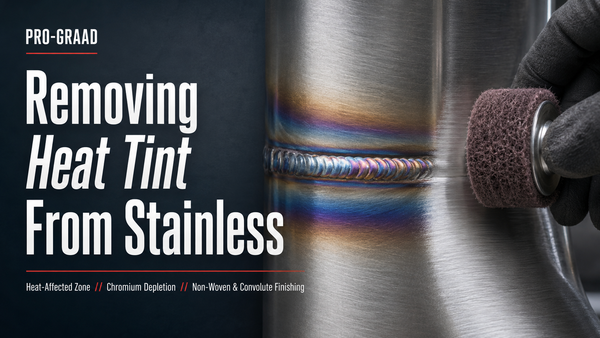
Remove the heat tint and depleted layer first — mechanically with abrasives, or chemically by pickling. Then passivate the clean surface. Passivation will not fix a tinted weld, and running it over scale is wasted acid.
03Nitric vs. Citric Acid
Two acids dominate passivation, and both are recognized by the governing standard (ASTM A967). Nitric is the traditional route; citric has taken significant ground for good reasons. Neither is simply "better" — it depends on the part, the spec, and the shop.
| Factor | Nitric Acid | Citric Acid |
|---|---|---|
| Track record | The long-established, proven standard. Decades of specs and data behind it. | Newer but now widely accepted and spec-recognized. Rapidly adopted in food, pharma, and aerospace. |
| Safety & handling | Strong oxidizer. Aggressive fumes, burn hazard, careful handling required. | Mild, biodegradable, far lower fume and burn hazard. Easier and safer to work with. |
| Waste & disposal | Hazardous waste stream with strict disposal and neutralization rules. | Much simpler disposal — a key reason shops switch. |
| Effect on the metal | Can flash-attack sensitive grades (free-machining, high-sulfur, some 400 series) if not controlled. | Gentler and more forgiving on sensitive grades. Lower risk of etching. |
| Best for | Shops with established nitric processes and specs that call it out specifically. | Most new work, sensitive grades, and shops prioritizing safety and disposal. |
Citric is safer and greener, and for a lot of work it performs every bit as well. But if a customer's print or a spec calls out nitric specifically, you follow the print — the spec wins over your preference every time.
04When You Actually Need To Passivate
Not every stainless part needs passivation. A dry, benign indoor bracket may never care. But the moment corrosion resistance is functional — or specified — it becomes mandatory:
Food, dairy, beverage, and pharmaceutical. Corroded stainless is a contamination point. These industries routinely require passivation and documentation.
Medical, aerospace, and semiconductor. Spec-driven work where passivation is called out on the print and verified by test.
Marine and architectural. Salt and weather find free iron fast. Passivation is what prevents the tea-staining that ruins stainless railings and fittings.
If a print, standard, or customer requirement names it, it's not optional. And even when it isn't required, passivation is cheap insurance against rust on any part that will see moisture, salt, or chemicals.
The Standards You'll See Referenced
The core passivation spec. Covers nitric and citric treatments and the tests used to verify them.
The practice for cleaning, descaling, and passivating stainless parts, equipment, and systems.
The aerospace passivation specification — referenced on aviation and defense prints.
05The Passivation Process, Step By Step
Whether it's a bath at a plating house or a citric gel on a large weldment in the field, the sequence is the same. Miss a step and the whole thing fails.
Clean & Degrease
Remove all oil, grease, cutting fluid, and dirt first. Passivation acid cannot work through an oil film — a greasy surface passivates unevenly or not at all. Alkaline clean or solvent-wipe until the surface is truly clean.
Remove Heat Tint & Scale
Passivation does not remove tint, scale, or the chromium-depleted layer. Take those off first — mechanically with dedicated stainless abrasives, or by pickling. This is the prep step that makes or breaks the result.
Passivate
Immerse in — or apply — nitric or citric acid at the concentration, temperature, and dwell time called for by the process or spec. Bath for parts that fit; brush-on gel or paste for large weldments and field work.
Rinse Thoroughly
Rinse off every trace of acid with clean water — deionized water for critical and high-purity work. Residual acid left on the surface causes staining and defeats the point.
Dry Clean
Dry fully with clean, oil-free air or lint-free wipes. Let the passive layer finish forming in clean air before handling.
Verify
For spec work, test it — and don't re-contaminate it afterward. Handling a passivated part with dirty gloves or setting it on a carbon-steel bench can undo the work.
06The Prep Step Is Abrasive Work
Here's where honesty matters: Pro-Graad makes abrasives, not acids. We don't sell passivation chemicals, and anyone who tells you a sanding disc "passivates" stainless is selling you something. But passivation lives or dies on the surface it's done to — and getting to that surface is abrasive work.
A proper passivation result starts with a clean, uniform, iron-free surface: heat tint removed, depleted layer gone, no embedded contamination, a consistent finish for the acid to work on evenly. That's exactly what non-woven surface conditioning does — and doing it with abrasives dedicated to stainless is critical, because the wrong tool embeds the very free iron that passivation then has to fight.
If you prep stainless with an abrasive, wheel, or brush that has touched carbon steel, you drive iron into the surface — giving passivation more to remove, or causing outright failure. Keep your stainless abrasives dedicated and separate. This is the number-one cause of "passivated" parts that still rust.
Prep Tools For Passivation-Ready Stainless
Non-Woven — Medium Red
R-Type quick-change surface conditioning discs to remove the last of the tint and contamination and open up a clean, uniform surface. Cuts cool without gouging. Keep dedicated to stainless.
Non-Woven — Super Fine Gray
The finishing grade for a consistent satin surface the acid can work on evenly. A uniform finish passivates uniformly — patchy prep gives patchy corrosion resistance.
07How You Know It Worked
Passivation is invisible — you can't see it, so on spec work you test it. ASTM A967 and A380 list the recognized methods. The common ones:
Copper sulfate test. A copper sulfate solution is applied to the surface. If free iron is present, copper plates out as a visible pink/copper spot — that's a fail. A clean surface shows no deposit. Fast and common for shop verification (not used on parts where copper contact is prohibited).
High-humidity and water-immersion tests. The part is held in controlled humidity or immersed and cycled, then inspected for rust. No rust after the specified period is a pass.
Salt spray (fog) test. The part sits in a salt-fog chamber for a specified time. Used for more demanding corrosion-resistance verification.
Ferroxyl / free-iron tests. Chemical tests that reveal free iron on the surface for a direct check of contamination.
08The Mistakes That Cause Failures
Do
Degrease before you passivate. Remove tint and scale first. Keep stainless abrasives dedicated and iron-free. Rinse completely. Handle the finished part clean. Follow the spec's acid, time, and temperature. Test critical work.
Don't
Passivate over oil, tint, or scale. Prep with carbon-steel-contaminated tools. Assume passivation removes discoloration. Leave acid residue on the surface. Set the clean part on a steel bench. Substitute nitric for citric — or the reverse — when the print names one.
09Do It In-House Or Send It Out?
Straight answer: it depends on whether you need a certificate.
Send it out when the spec requires documented, tested passivation to a standard — a passivation or plating house controls the bath chemistry, temperature, and testing, and gives you the cert your customer or inspector wants. For critical food, pharma, aerospace, and medical work, that paper trail is the deliverable.
Handle it in-house when you want general corrosion insurance without a certification requirement, or when the part is too big to ship or dip. Brush-on citric passivation gels let you treat large weldments and field-welded assemblies on site. The prep — clean, degrease, remove tint with dedicated stainless abrasives — is the same either way, and it's the part that determines the outcome.
10Passivation FAQ
What does passivation actually do to stainless steel?
It removes free iron and surface contamination and strengthens the chromium-oxide passive layer that gives stainless its corrosion resistance. It's a cleaning-and-protecting step — it doesn't add any coating or change the part's dimensions.
Is passivation the same as pickling?
No. Pickling is an aggressive acid treatment that removes metal — including heat tint, scale, and the chromium-depleted layer. Passivation is milder, removes free iron and contamination without significant metal removal, and does not remove heat tint. You remove tint first, then passivate the clean surface.
Does passivation remove heat tint or weld discoloration?
No. Passivation won't remove tint or scale, and running it over a discolored weld is wasted acid. Remove the tint mechanically with abrasives or by pickling first, then passivate.
Nitric or citric acid — which should I use?
Both are recognized by ASTM A967. Citric is safer, greener, easier to dispose of, and gentler on sensitive grades, which is why many shops have switched. Nitric is the long-established standard. If a print or spec names one specifically, follow the print.
Do I have to passivate every stainless part?
No. Dry, benign, non-critical parts often don't need it. But for food, pharma, medical, aerospace, marine, and anything spec-driven or corrosion-critical, passivation is required — and it's cheap insurance against rust on any part that will see moisture, salt, or chemicals.
Why do stainless parts still rust after passivation?
Usually bad prep. The most common cause is iron contamination from abrasives or tools that touched carbon steel, which embeds free iron the passivation can't fully overcome. Others: passivating over oil or tint, incomplete rinsing, or re-contaminating the finished part by handling it with dirty gloves or setting it on a steel bench.
Built For The Work. Priced For The Worker.
Passivation is only as good as the prep. Clean, uniform, iron-free stainless starts with the right abrasives.
Shop Stainless Prep Abrasives