Flap Disc vs. Fiber Disc vs.
Non-Woven Disc
Three discs. One grinder. Completely different jobs. Pick the wrong one and you either spend an hour removing a weld that should've taken five minutes — or gouge a part you were only supposed to clean up. Here's how to tell them apart, and when each one earns its place.
All three mount on the same grinder. That's the entire source of the confusion.
They look interchangeable in the rack. They're not. Each one is built to do a fundamentally different thing to metal, and the difference between them isn't quality or price — it's how much material leaves the part.
Get that straight and the choice makes itself every time.
It's a Spectrum, Not a Menu
Everything below is a footnote to this. These three discs sit at three points on a single axis: how aggressively they remove metal.
Single abrasive layer, maximum bite. Takes metal off fast and leaves a coarse scratch behind.
Layered flaps that renew as they wear. Grinds and blends in one pass. The compromise that usually wins.
Open nylon web. Cleans, blends, and finishes without meaningfully changing the dimension of the part.
The Question That Decides It
Does material need to leave the part? A lot of it — fiber disc. Some of it, and it needs to look decent after — flap disc. None of it, you're just cleaning or finishing the surface — non-woven.
Fiber Disc: The Blunt Instrument
Resin Fiber Disc
Also called: sanding disc, resin fiber disc, RFDA single layer of abrasive grain resin-bonded to a stiff vulcanized fiber backing. That's it. No plies, no flaps, no web — just grain on a disc, mounted over a backing pad and locked down with a retainer nut.
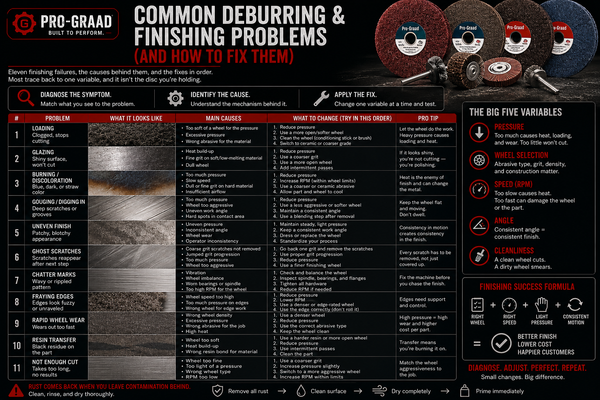
Because there's only one layer of mineral, a fiber disc gives you everything it has immediately and then it's done. There is no reserve. When the grain dulls or wears through, the disc is spent — you're now rubbing fiber backing against steel, generating heat and nothing else.
What you get in exchange is the highest cut rate of the three, and the lowest cost per disc. On a heavy weld or a casting flash line, nothing else in this comparison is close.
Reach for it when
- You're knocking down a heavy weld bead and appearance doesn't matter yet.
- You're removing casting flash, parting lines, or gate stubs.
- You're stripping heavy scale, mill scale, or thick coating from structural steel.
- Speed of removal is the only metric that counts, and another step is already planned.
Leave it in the box when
- The part is thin, cosmetic, or dimensionally tight. A fiber disc does not forgive.
- The finish is the deliverable. You'll just be making work for the next disc.
- You're on stainless and heat control matters — the cut rate that makes it fast also makes it hot.
The Backing Pad Is Half the Disc
Fiber disc performance is a function of the pad behind it as much as the mineral on it. A firm pad concentrates pressure and cuts harder. A flexible pad spreads pressure and conforms to contours, but cuts slower. A ribbed or turbine pad moves air and helps with heat. Most people never change the pad and then blame the disc. Match the pad to the job.
Flap Disc: The One-Step Answer
Abrasive Flap Disc
Also called: flap wheel disc, blending discOverlapping strips of abrasive cloth bonded radially to a rigid backing plate. As the exposed edge of each flap wears away, the layer behind it comes forward. The disc is continuously exposing fresh mineral to the work.
That single design decision changes everything. A fiber disc has one layer to spend. A flap disc has a stack, and it feeds them to you as needed. The result is a disc that grinds and finishes in the same pass — aggressive enough to take down a weld, controlled enough that what's left behind is often good enough to coat.
It costs more per disc than a fiber disc. It also lasts longer, runs cooler, chatters less, and frequently eliminates an entire downstream step. That's the trade, and for most shop work it's the right one.
Type 27 or Type 29?
This is the only spec choice that really trips people up, and it's simple:
| Type | Profile | Work Angle | Built For |
|---|---|---|---|
| Type 27 | Flat | 0° – 15° | Flat surfaces, blending, finishing, working into corners and up against edges. More disc face on the work. |
| Type 29 | Conical / angled | 15° – 25° | Aggressive stock removal, edge grinding, weld knockdown. Concentrates pressure on a smaller contact area. |
Short version: Type 29 removes more. Type 27 finishes better and reaches into places the cone can't. If you're buying one, buy the one that matches the angle you naturally hold the grinder at.
Reach for it when
- You need to grind a weld and the surface has to look right afterward.
- You're blending, contouring, or working an edge and control matters.
- You want to collapse a two-disc job into one disc.
- You're on stainless or aluminum and heat is a concern.
Leave it in the box when
- You've got a mountain of stock to remove and no finish requirement at all — a fiber disc gets there faster.
- The job is purely cosmetic conditioning on an already-flat surface. A flap disc will still cut metal; non-woven won't.
Non-Woven Disc: The Surgeon
Surface Conditioning Disc
Also called: SC disc, non-woven disc, quick-change discAn open, three-dimensional nylon web with abrasive grain distributed throughout it — not just on the surface. It's mostly air. That's the point.
The web flexes and conforms under load instead of digging. It cuts what's on the metal — oxide, tint, coating, rust, scratch — while leaving the metal itself essentially alone. You cannot gouge a part with a non-woven disc, and you cannot undercut a weld toe with one. You also can't remove a weld with one, and that's the trade.
Non-woven discs don't use grit numbers. They use grades: Coarse, Medium, Very Fine, Super Fine, Ultra Fine. Different construction, different language.
Reach for it when
- You're removing heat tint or weld discoloration from stainless without touching the base metal.
- You need a uniform satin or brushed finish, and it has to match the panel next to it.
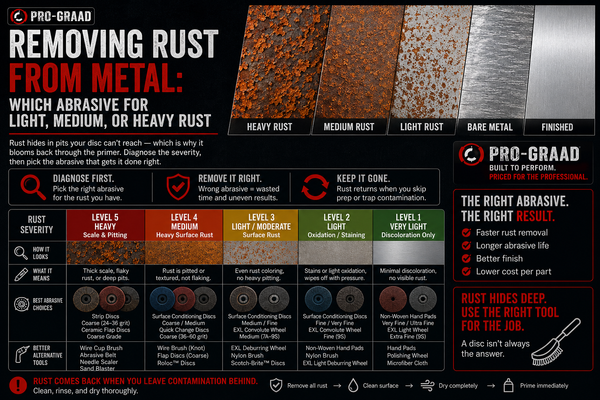
- You're cleaning rust, oxide, coating, or adhesive off a surface that has to stay dimensional.
- The part is finished and you're conditioning it, not shaping it.
- Edge break and light deburring — where a flap disc would round the edge too far.
Leave it in the box when
- Anything needs to actually come off the part. Non-woven is not slow stock removal — it's not stock removal.
- There's a weld bead standing proud. Knock it down first with something that cuts, then condition.
Check the RPM Before You Mount It
Non-woven discs frequently carry a maximum safe speed below what a standard angle grinder spins at. The web is not a bonded wheel, and it doesn't tolerate overspeed. Read the rating on the disc, read the rating on your tool, and never assume that because it fits, it's rated. Use a variable-speed tool where the job calls for it.
The Comparison Table
| Fiber Disc | Flap Disc | Non-Woven Disc | |
|---|---|---|---|
| Primary job | Remove metal | Remove metal + blend | Condition the surface |
| Construction | Single abrasive layer on fiber backing | Overlapping cloth flaps on a backing plate | Open nylon web, abrasive throughout |
| Cut rate | HIGHEST | MODERATE – HIGH | MINIMAL |
| Finish left | Coarse — needs follow-up | Blended — often coat-ready | Uniform satin |
| Renews as it wears | No — one layer, then done | Yes — flaps expose fresh mineral | Yes — web breaks down to fresh grain |
| Backing pad needed | Yes — pad + retainer nut | No — mounts direct | Holder or pad, by attachment type |
| Heat generated | High | Moderate | Low |
| Can it gouge? | Easily | With carelessness | Very difficult to |
| Graded by | Grit number | Grit number | Grade name (Coarse → Ultra Fine) |
| Cost per disc | Lowest | Higher | Higher |
| Best on | Heavy welds, flash, scale, structural steel | Weld blending, edges, contours, one-step work | Heat tint, satin finish, rust, coating, edge break |
↔ Scroll table horizontally on mobile
Which One, Right Now
Look at the part in front of you and answer honestly.
-
"There's a weld bead standing proud and I need it gone." → Fiber disc, 36–60 grit
Then follow with a flap disc to blend. Two steps, but the fast step is genuinely fast.
-
"There's a weld bead and the customer sees this surface." → Flap disc, 60–80 grit
Slower to knock down than a fiber disc, but you skip the blending step entirely. Usually the faster path to done.
-
"The stainless is blue and rainbow-colored around the weld." → Non-woven, Medium → Very Fine
Heat tint is on the surface, not in it. Don't grind — condition. A flap disc here removes metal you didn't need to lose.
-
"I need to break a sharp edge on a machined part." → Flap disc (Type 27) or non-woven, by tolerance
If the edge break is called out on the print, flap disc. If it's just "don't cut anybody," non-woven won't overshoot.
-
"This panel needs to match the brushed finish next to it." → Non-woven, Very Fine, straight-line passes
Match grain direction. Test on scrap first — every time, no exceptions.
-
"There's mill scale on 200 feet of structural steel." → Fiber disc, 36–50 grit
Volume job, no finish requirement, cost per disc matters. This is exactly what fiber discs are for.
-
"Light surface rust, and the dimension has to hold." → Non-woven, Coarse → Medium
Strips oxide, leaves the steel. If the rust is pitted, that's a different job — see the grit guide.
Cheapest Disc ≠ Cheapest Job
Fiber discs cost the least per disc. That's a real advantage and it's why they still dominate heavy fab. But cost per disc is the wrong number to optimize when the disc isn't the expensive part of the operation.
Run the actual math on your own work:
- How many discs does the job consume? A disc with no reserve gets changed more often. Every change is downtime.
- How many steps does the job require? If a flap disc eliminates a blending pass, it just bought back more labor than it cost.
- What's the rework rate? One gouged part scrapped on a cosmetic panel erases a lot of savings on discs.
- What does the operator cost per hour? On most jobs, labor dwarfs consumables. Optimize the labor.
The honest conclusion isn't that one disc wins. It's that the cheapest disc for the job is the one that gets the part to spec in the fewest operator-minutes — and that answer changes with the part.
Four Ways This Goes Wrong
- Using a flap disc as a fiber disc. Leaning hard on a flap disc to make it cut faster crushes the flaps against the plate, loads them, and burns through the disc without cutting any quicker. If you need a fiber disc, use a fiber disc.
- Expecting non-woven to remove material. It won't. Grinding away on a non-woven disc for ten minutes waiting for the weld to go down just cooks the part and wastes the disc.
- Running a fiber disc without the right pad — or without the retainer nut. The pad is a functional component, not packaging. The nut is a safety component.
- Ignoring the max RPM on the disc. Especially on non-woven. It fits the grinder; that does not mean it's rated for the grinder's speed.
Non-Negotiables
Guard on. Eye and face protection. Respiratory protection appropriate to the material. Verify the disc's maximum safe speed against your tool's rated speed before every mount. Never use an abrasive on stainless that has touched carbon steel — embedded iron will rust the part weeks after it ships.
Answers, Short Version
Can a flap disc replace a grinding wheel?
For a lot of blending and weld work, yes — and it leaves a far better surface. For heavy notching, deep stock removal, or anything needing a rigid edge, a bonded grinding wheel still has its place. A flap disc is a finishing-capable grinder, not a hog.
Do I need a backing pad for a flap disc?
No. The backing plate is built into the disc. That's one of the practical advantages over fiber discs — nothing extra to buy, nothing to wear out, one less thing to get wrong.
Why does my fiber disc stop cutting so fast?
Usually because it's done. There's one layer of mineral and no reserve behind it. If it's dying sooner than it should, the likely causes are too much pressure, wrong mineral for the material, the wrong backing pad, or a loaded disc. Zirconia needs real pressure to self-sharpen; run it light and it just glazes.
Will a non-woven disc remove a weld?
No. It'll clean the weld, remove the tint, and blend the toe — but it will not take the bead down. Knock the bead down with a fiber or flap disc first, then condition with non-woven.
Type 27 or Type 29 flap disc — which should I buy?
What grit should I start with?
Depends on the material and the finish you need — that's a whole guide of its own. Rough rule: 36–60 for heavy removal, 60–80 for weld knockdown with a flap disc, 80–120 for blending, and non-woven grades for anything that's about surface rather than substance.
Can I use these on aluminum?
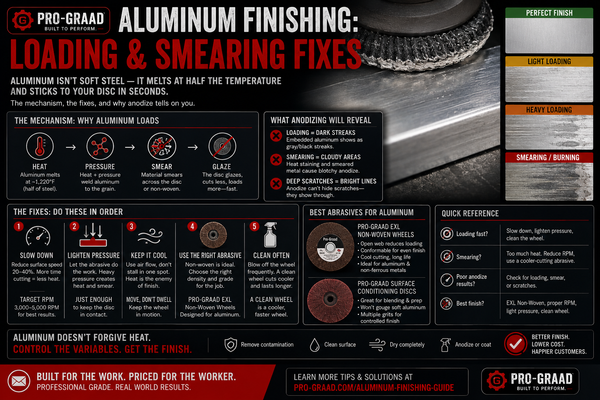
All three, with care. Aluminum loads abrasive fast — look for open-coat or stearated product, ease off the pressure, and slow the tool down. Aluminum smears when it gets hot instead of cutting cleanly.
Built for the Work.
Priced for the Worker.
Pro-Graad is an independent brand making flap, fiber, and non-woven discs for shops that measure performance in parts finished, not in logos on the box. Full range, honest specs, no premium tax.
Shop the Full RangeNot sure which disc fits your operation? Tell us the material and the finish.
info@pro-graad.com