Non-Woven Abrasive
Grades Explained
Coarse. Medium. Very Fine. Super Fine. Ultra Fine. Five words doing the job that grit numbers do everywhere else in the abrasive world — and they're not interchangeable with grit numbers, no matter what the cross-reference chart tells you. Here's what each grade actually means, and what it doesn't.
Every other abrasive on the shelf has a number. Non-woven has a word. There's a reason.
A coated disc is a sheet of backing with mineral glued to one face. Every grain sits at roughly the same height, presented rigidly to the work. Measure the grain, print the number, done — 120 grit means 120-grit particles standing in a row.
Non-woven abrasive isn't built that way at all, and a grit number would lie about how it behaves. So the industry uses grades instead. This guide explains what's behind each one — and the two other variables that matter just as much as the grade, which almost nobody shops for.
Why It's Graded, Not Numbered
Start with what the material physically is: an open, three-dimensional web of nylon fibers, with abrasive grain adhesively bonded to the fibers throughout the entire thickness — not just on the face.
It's mostly air. That is the entire design.
Three consequences follow, and all of them explain why a grit number wouldn't work:
- The grain isn't presented rigidly. Each fiber flexes independently under load. The abrasive rides over the surface and conforms to it rather than plowing into it. Same particle, completely different scratch.
- The web is the reserve. Fibers break down and wear away, exposing grain that was buried in the depth of the web. It's self-renewing until it's used up — there's no "wearing through to the backing" because there is no backing.
- Cut depth is a function of pressure, not just grain. Push harder and you compress the web, engaging more grain at greater depth. The same disc at two pressures behaves like two different products.
Put a grit number on that and you'd be promising a scratch depth the product can't guarantee. The grade tells you the character of the cut. That's an honest claim. A number wouldn't be.
What Non-Woven Is Actually For
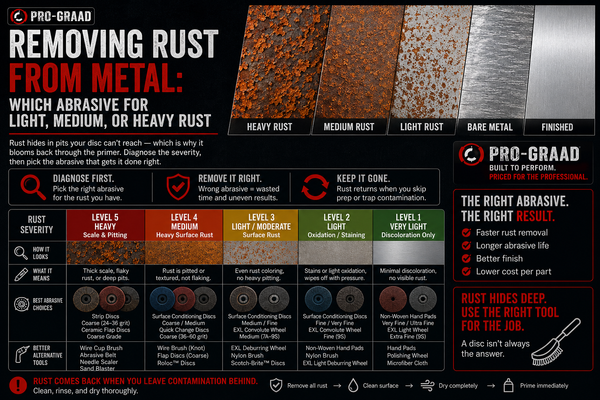
It cuts what's on the metal — oxide, tint, coating, rust, scratch pattern — while leaving the metal itself essentially alone. You will not gouge a part with it. You also will not remove a weld bead with it. Grade selection happens inside that envelope. If you need material gone, you need a different abrasive entirely.
The Five Grades, Coarse to Ultra Fine
Read top to bottom. The bar on the left shows relative aggression — it shortens as the grade gets finer, because that's the only thing the grade is telling you.
Coarse
≈ 80 – 100 grit characterThe aggressive end. Large grain in an open web that clears debris fast and resists loading. This is the grade you reach for when there's something substantial on the part — thick rust, scale, paint, mill finish, weld spatter, adhesive.
It leaves a visible, directional scratch. Coarse is a starting grade, not a finishing grade — plan a step after it unless the part is genuinely rough-service.
Rust & scale removal · Coating & paint stripping · Weld cleaning · Heavy blending · Adhesive removal
Medium
≈ 120 – 180 grit characterThe workhorse. If a shop stocks one grade of non-woven, it's this one. Enough bite to clean a weld zone and pull heat tint off stainless, controlled enough that it doesn't leave a scratch you'll have to chase.
Medium is where most general deburring and blending lives. It's also the honest starting point for heat tint — Coarse works, but takes more surface than the job needs.
General deburring · Heat tint & discoloration · Scratch blending · Light rust · Surface prep
Very Fine
≈ 220 – 320 grit characterThe finishing grade. This is what produces a clean, uniform satin — the finish most people actually mean when they say "brushed." Straight-line passes, consistent pressure, and it delivers a grain that repeats across panels.
Also the right grade for light deburring on parts where a coated abrasive would round the edge too far, and for scuffing ahead of paint where the coating spec allows it.
Satin & brushed finishing · Light deburring · Edge break · Paint scuffing · Final blend
Super Fine
≈ 400 – 600 grit characterPast the point of removing anything meaningful. Super Fine refines a finish that's already there — tightening the grain, evening out the sheen, cleaning up a Very Fine pass that came out uneven.
Common on decorative work, architectural metal, and anything headed for compound. If you're using it to remove a defect, you're using it wrong.
Fine satin · Decorative & architectural finishing · Pre-polish conditioning · Sheen control
Ultra Fine
≈ 800 – 1000 grit characterThe last step before compound. Ultra Fine is conditioning in the purest sense — it's barely cutting at all, just knocking the tops off the previous grade's scratch pattern and leaving a surface that takes polish evenly.
Narrow use case, but where it belongs, nothing substitutes for it. Skip it and the polish stage inherits scratches it wasn't designed to remove.
Final conditioning before polish or compound · Highest-sheen satin · Cleanup between coats
A Note on "Fine"
Some product lines include a plain Fine grade sitting between Medium and Very Fine. Others jump straight from Medium to Very Fine. Neither is wrong — grade naming is an industry convention, not a standard, and manufacturers build the ladder their line needs. If a chart shows a grade you can't find, that's usually why. Match on the described application, not on the word.
Grit Equivalents — And Why They're Approximate
Everyone wants the cross-reference chart. Here it is. Read the caveat under it before you trust it with a part.
| Grade | Approx. Grit Character | Cut Behavior | Leaves |
|---|---|---|---|
| Coarse | ~80 – 100 | Aggressive, fast-clearing | Visible directional scratch |
| Medium | ~120 – 180 | Balanced cut and control | Moderate grain, clean |
| Very Fine | ~220 – 320 | Light cut, high control | Uniform satin |
| Super Fine | ~400 – 600 | Refining, minimal removal | Fine satin, tight grain |
| Ultra Fine | ~800 – 1000 | Conditioning only | Polish-ready surface |
↔ Scroll table horizontally on mobile · Equivalents are approximate by nature
The Caveat That Matters
This chart maps scratch character, not particle size. A Medium non-woven disc and a 150-grit coated disc will not leave the same surface — the non-woven cuts softer, runs cooler, conforms to contour instead of flattening it, and won't undercut an edge. The finishes look different side by side, and a customer comparing panels will see it.
If the finish has to match an existing surface, test on scrap. Every time. No chart replaces that.
Read the Grade, Not the Color
Non-woven products are color-coded, and the coding is manufacturer-specific. There is no industry standard assigning a color to a grade. A color that means Medium in one line can mean something else entirely in another — and identical colors across brands are coincidence, not compatibility. Buy on the printed grade and the described application. The color on the box tells you who made it, not what it does.
Grade Is One of Three Variables
Here's where most non-woven buying goes wrong. People shop the grade, ignore the other two, and then wonder why two "Medium" products behave nothing alike.
Grade
The size of the scratch. Coarse through Ultra Fine. This is the one on the label, and it's the one everybody buys on.
Density
How hard the web pushes back. A soft product conforms to contour. A dense one holds an edge and cuts flat. Same grade, opposite behavior.
Mineral
How the grain cuts. Aluminum oxide or silicon carbide — different cut character, different materials, different resulting sheen.
Grade sets the ceiling on how coarse the scratch can be. Density decides how much of that ceiling you actually reach, and where on the part you reach it. Mineral decides how the surface looks when you're done.
Two Medium products — one soft and open, one dense and firm — are not substitutes for each other. The soft one wraps a radius and leaves the profile intact. The dense one flattens the radius and leaves a crisper grain. Order the wrong one and the grade on the label won't have been your problem.
Density: The Second Number
On hand pads and surface conditioning discs, density is mostly baked in — the format is what it is. On wheels, density becomes an explicit purchasing decision, and it's at least as important as the grade.
Convolute and unitized wheels are built by compressing non-woven web — wound around a core for convolute, layered and pressed for unitized. How tightly it's compressed determines how the wheel behaves:
| Density | Behavior | Right For |
|---|---|---|
| Low / soft | Conforms readily, cuts gently, runs cool | Contours, radii, delicate parts, finishing where the profile must survive |
| Medium | Balanced — some conformity, some edge retention | General-purpose deburring and finishing across mixed work |
| High / hard | Holds its shape and edge, cuts faster, generates more heat | Aggressive deburring, flat work, tight corners, high-volume production |
Density Codes Aren't Universal
Manufacturers express density with their own systems — typically a number paired with a hardness letter, but the scales don't map cleanly across brands, and the same code from two suppliers can mean two different wheels. Cross-reference against the manufacturer's own published data, not against a code that looks familiar. When you're switching suppliers, this is the specification most likely to bite you.
Mineral: Aluminum Oxide or Silicon Carbide
Two minerals cover essentially all non-woven work. Same grade, different mineral, genuinely different result.
| Mineral | Character | Best On | Leaves |
|---|---|---|---|
| Aluminum Oxide | Tough and blocky. Durable, forgiving, holds up under pressure. | Carbon steel, stainless, general shop work, heat tint, coating removal | A warmer, softer-looking satin |
| Silicon Carbide | Harder and sharper, but friable — it fractures rather than dulls. | Aluminum, brass, copper, titanium, plastics, glass, stone, painted surfaces | A brighter, crisper, cooler-looking finish |
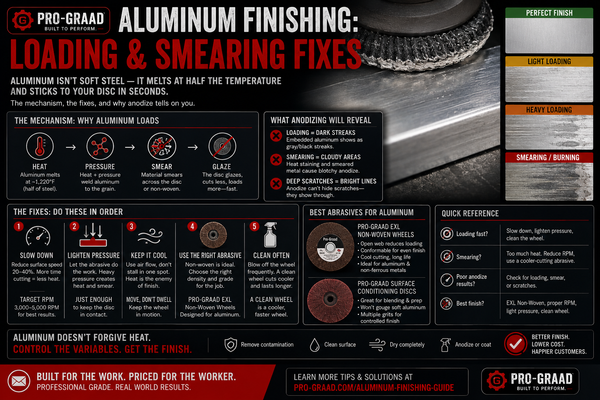
Rule of thumb: ferrous and general-purpose, aluminum oxide. Non-ferrous, soft metals, or anywhere you want a bright finish, silicon carbide. If a supplier lists both in the same grade, that's not redundancy — that's two different products.
The Stainless Rule
Never use a non-woven product on stainless that has touched carbon steel. The open web traps particles, and embedded iron transfers straight to the stainless surface — where it rusts, sometimes weeks after the part has shipped. Dedicate your stainless non-woven and keep it physically separated. This is a housekeeping failure, not a product failure, and no abrasive on the market prevents it for you.
Where the Grades Show Up
The same grade ladder runs across every non-woven format. What changes is how much pressure the format lets you apply — which, per Section 04, changes how the grade behaves.
| Format | Grades Available | Notes |
|---|---|---|
| Hand pads | Full ladder | Hand pressure only, so the grade behaves close to its nominal character. Good for touch-up, tight spots, and testing a grade before committing a disc to it. |
| Surface conditioning discs | Typically Coarse → Very Fine | Quick-change or backing-pad mount. The workhorse format. Fine grades exist but see less use — hand pads usually own that end. |
| Belts | Coarse → Super Fine | Consistent, repeatable finish across large flat areas. Platen pressure is the variable that matters. |
| Convolute wheels | Full ladder, plus density | Web wound around a core. Density is a separate spec and drives behavior as much as grade does. |
| Unitized wheels | Full ladder, plus density | Pressed layers. Denser options available than convolute. Small-diameter work and precision deburring. |
| Flap brushes / interleaf | Typically Medium → Very Fine | Conforming by construction. Good on irregular profiles where a wheel can't follow the shape. |
↔ Scroll table horizontally on mobile
Picking a Grade Without Guessing
Work it backwards from the finish, not forwards from the defect.
- Name the finish you need first. Satin? Ultra Fine isn't it — Very Fine is. Just clean? Coarse or Medium and stop. The end state picks the last grade.
- Then pick the coarsest grade that removes what's on the part. That's your start. If Medium takes the tint off, don't run Coarse to feel productive — you'll pay for it in the next step.
- Bridge the gap one rung at a time. Same logic as coated abrasives: each grade removes the scratch the one before it left. Coarse straight to Super Fine leaves ghosting that shows up under light at exactly the wrong angle.
- If start and finish are the same grade, you're done in one step. That's common with non-woven and it's a real advantage. Don't invent a progression the job doesn't need.
- Let the product cut. Non-woven responds to pressure, but past its window you're just compressing the web, generating heat, and burning the disc without cutting faster. Light and steady beats hard and fast.
Check the RPM Before You Mount It
Non-woven discs and wheels frequently carry a maximum safe speed below a standard angle grinder's rated speed. The web is not a bonded wheel and does not tolerate overspeed. Read the rating on the product, read the rating on the tool, and never assume that because it fits, it's rated.
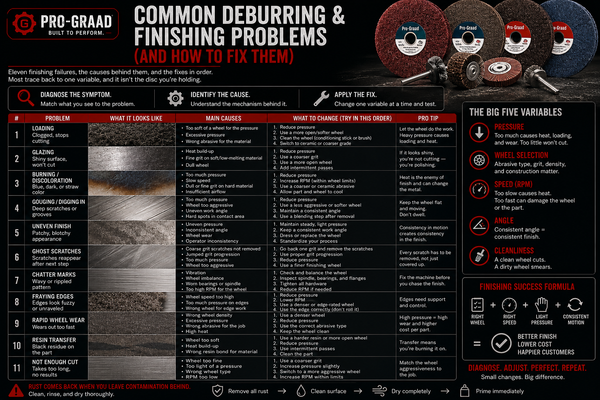
Five Ways Grade Selection Goes Wrong
- Treating the grit equivalent as a conversion. It's a character map, not a substitution table. A Medium non-woven does not replace a 150-grit disc, and the finish will show the difference.
- Buying on color. Color coding is per-manufacturer. Two identical-looking products from different suppliers can be two grades apart.
- Ignoring density on wheels. Grade gets all the attention; density is doing half the work. A soft Medium and a hard Medium are different tools.
- Reaching for a finer grade to fix a defect. Fine grades don't remove defects — they refine surfaces. If something's still there at Very Fine, going to Super Fine won't help. Go back a rung.
- Expecting non-woven to remove material. It doesn't. That's the whole premise of the product category. If stock has to come off, that's a different disc.
Answers, Short Version
What grit is a Medium non-woven pad?
Roughly 120–180 grit in scratch character — but it isn't a 120–180 grit product. The web conforms and cuts softer than a coated abrasive of the same nominal grain, so the finishes look different side by side. Use the equivalent to pick a starting point, not to substitute a product.
What's the order of non-woven grades?
Coarse → Medium → Very Fine → Super Fine → Ultra Fine, aggressive to fine. Some lines add a plain "Fine" between Medium and Very Fine. Grade naming is convention, not a standard.
Is Very Fine finer than Super Fine?
No — Super Fine is finer. The naming is counterintuitive and it trips people up constantly. The ladder runs Coarse, Medium, Very Fine, Super Fine, Ultra Fine. "Very" comes before "Super."
Which grade for a satin or brushed finish?
Very Fine, with straight-line passes and steady pressure. Medium if you want a more open, visible grain. Super Fine for a tighter, finer sheen. Match the grain direction of the surrounding surface and test on scrap before you touch the part.
Which grade removes heat tint from stainless?
Start at Medium and step to Very Fine to blend. Coarse works but takes more surface than the job requires. Keep the tool moving — the point of non-woven here is that you lift the tint without losing base metal.
Do non-woven colors mean the same thing across brands?
No. There's no industry standard. Color coding is per-manufacturer, and matching colors across brands is coincidence. Buy on the printed grade.
Can I skip grades?
One rung, sometimes. Two or more, no — the finer grade can't efficiently remove the coarser one's scratch, and you'll spend more time and product than the skipped step would have cost. Often you don't need a progression at all: if one grade gets you to spec, stop.
Will non-woven remove a weld or heavy stock?
No. It cleans, blends, and conditions — it does not remove base metal in any meaningful quantity. Knock the bead down with something that cuts, then condition with non-woven.
Built for the Work.
Priced for the Worker.
Pro-Graad is an independent brand making non-woven discs, pads, and wheels for shops that measure performance in parts finished, not in logos on the box. Full grade ladder, honest specs, no premium tax.
Shop Pro-Graad Non-Woven AbrasivesNeed help matching a grade to an existing finish? Tell us the material and the target.
info@pro-graad.com