A practical guide to selecting, setting up, and operating convolute finishing wheels for professional-grade surface finishing
Introduction
Whether you're finishing stainless steel kitchen equipment, architectural panels, or food-processing components, achieving a consistent #3 or #4 surface finish is a core skill in metal fabrication. Non-woven convolute multi-finishing wheels are among the most reliable tools for reaching these finishes — delivering uniform, repeatable results with minimal risk of gouging or distorting your workpiece.
This guide walks you through understanding finish standards, choosing the right wheel, setting up your equipment, and executing the finishing pass safely and effectively.
Understanding #3 and #4 Metal Finishes
Before picking up a wheel, it's important to understand exactly what you're aiming for. Metal surface finishes are defined by their visual appearance and measurable surface roughness (Ra — roughness average, expressed in microinches or micrometers).
| Finish | Description | Typical Ra Value | Common Uses |
|---|---|---|---|
| #3 | Intermediate semi-polished finish; visible short, uniform grain lines produced with 50–80 grit abrasive | ~60–80 µin (1.5–2.0 µm) | Preparation for further finishing; decorative structural components |
| #4 | General-purpose brushed/satin finish with fine, uniform grain lines; produced with 100–180 grit abrasive | ~32 µin (0.8 µm) | Kitchen equipment, food processing, architectural panels, dairy & sanitary applications |
| #4 Dairy/Sanitary | Finer variant of #4; must meet strict hygiene requirements | 12–16 µin (0.3–0.4 µm) | Dairy, pharmaceutical, food-contact surfaces |
What Are Non-Woven Convolute Multi-Finishing Wheels?
Non-woven convolute wheels are constructed by wrapping layers of nylon fiber web — impregnated with abrasive grain and resin bond — convolutely around a center core. This winding method creates a dense, stable, unidirectional wheel that maintains consistent cutting performance throughout its entire service life.
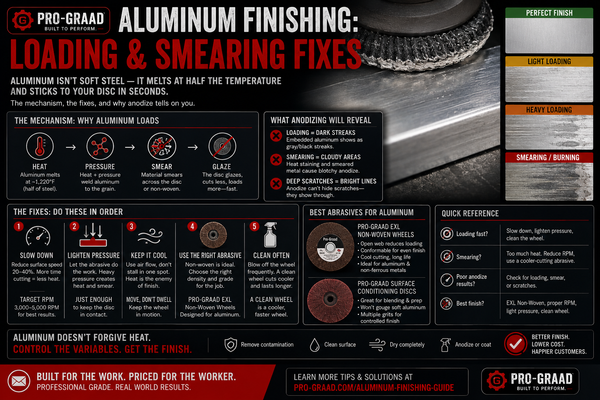
Unlike conventional grinding wheels, the open, non-woven structure promotes cooler running, minimizes the risk of thermal warping or discoloration, and provides a smooth, blended surface without deep scratches. As the wheel wears, it continuously exposes fresh abrasive grain, delivering predictable finish quality from the first use to the last.
Key Advantages Over Conventional Abrasives
Controlled cutting action: Removes material consistently without excessive stock loss, preserving part dimensions and geometry. Uniform finish: Produces smooth, blended surfaces ideal for parts requiring fine finishes or preparation for coating. Reduced heat buildup: Open web construction keeps the wheel running cooler, critical for stainless steel and other heat-sensitive metals. Self-renewing: Fresh abrasive grain is continuously exposed as the wheel wears, maintaining consistent finish quality throughout the wheel's life. Versatility: Suitable for ferrous metals, non-ferrous metals, stainless steel, aluminum, and composites.
Multi-Finishing Wheels: Built for #3 and #4 Results
Within the family of non-woven convolute wheels, multi-finishing wheels are specifically engineered for conformability and surface blending. Their highly conformable construction allows them to follow the contours of a workpiece surface, delivering the uniform directionality needed for #4 and food-grade finishes. These wheels are particularly well-suited for:
Achieving #4 RMS "food grade" finishes on stainless steel. Blending weld seams and machined surfaces. Removing light surface discoloration or oxidation while preserving base metal. Creating consistent hairline or satin finishes on flat sheet, tubing, and fabricated components.
Selecting the Right Wheel: Grain, Density & Grit
Choosing the correct wheel specification is the most critical factor in achieving your target finish. Three variables determine the result: abrasive grain type, density, and grit size.
Abrasive Grain Type
| Grain Type | Best For | Finish Character |
|---|---|---|
| Silicon Carbide (SiC) | Non-ferrous metals — aluminum, brass, titanium, composites | Brighter, shinier finish; sharper cut at lower pressure |
For stainless steel #3 and #4 finishing, silicon carbide is the standard recommendation.
Density
Density describes how tightly the non-woven web is wound around the core. Lower density wheels are softer and more conformable; higher density wheels are harder and more aggressive.
| Density | Characteristics | Best Application |
|---|---|---|
| 2 (Soft) | Highly conformable; follows contours; gentle cut | Final blending, light finishing, contoured parts |
| 3 (Medium) | Good conformability with moderate cut rate | #4 finishing, general blending on flat and curved surfaces |
For a #3 finish, use a density 2–3 wheel with medium grit. For a #4 finish, use a density 2–3 wheel with fine grit.
Grit Size
| Grit | Grade | Target Finish |
|---|---|---|
| 100–150 mesh | Medium | #3 finish; moderate stock removal, visible grain lines |
| 180–240 mesh | Fine | #4 finish; minimal stock removal, fine uniform grain lines |
Equipment Setup
Non-woven convolute wheels are used on stationary bench grinders, backstand machines, feed-through machines, or straight-shaft portable tools. Follow these setup steps before beginning work.
- Check maximum RPM. Every convolute wheel is rated for a maximum operating speed. Never exceed this rating. Exceeding maximum RPM can cause wheel failure and is a serious safety hazard. Confirm the RPM rating printed or labeled on the wheel matches your machine's operating speed.
- Mount the wheel correctly. Convolute wheels are unidirectional — they must rotate in the direction of the arrow marked on the wheel. Running the wheel in reverse will damage it and produce inferior results. Secure the wheel to the arbor or spindle using the appropriate flange and nut system.
- Dress the wheel face (optional but recommended). Before first use, briefly dress the wheel face to open the surface, expose fresh abrasive grain, and align the fiber direction. This produces a smoother, more consistent finish from the very first contact.
- Select lubricant if applicable. For semi-automatic or automatic operations, a water-soluble coolant or straight cutting oil is highly recommended. Lubricant helps reduce heat buildup, washes away swarf and debris, and enhances the surface finish and luster. Dry operation is acceptable for many finishing applications but may increase heat on thin-gauge material.
- Don personal protective equipment (PPE). Always wear: safety glasses or a face shield, hearing protection for extended use, a dust mask or respirator (fine metallic dust and abrasive particles can irritate the respiratory system), and leather or cut-resistant gloves when handling workpieces.
Step-by-Step: Finishing to #3 and #4
For a #3 Finish
- Select a density 2–3 silicon carbide wheel in medium grit (100–150 mesh).
- Set machine speed within the wheel's rated RPM. Run at low to medium pressure — let the wheel do the work.
- Hold the workpiece (or guide the tool) so the wheel contacts the metal surface uniformly across its face width.
- Work in one consistent direction, parallel to the desired grain line direction. Do not use a circular or random motion — this will destroy finish uniformity.
- Make multiple light passes rather than one heavy pass to avoid overheating or gouging.
- Inspect the surface regularly. The #3 finish should show visible, relatively uniform grain lines with a semi-polished, silver appearance.
For a #4 Finish
- If starting from a rougher surface, first achieve a #3 finish as described above, then switch to a finer wheel.
- Select a density 2–3 silicon carbide Multi-Finishing wheel in fine grit (180–240 mesh).
- Apply light, consistent pressure. The open web construction of the multi-finishing wheel will conform naturally to the workpiece — excessive pressure reduces wheel life and can smear the surface on softer metals.
- Continue working in a single, consistent direction. For flat sheet, move the workpiece or tool linearly. For cylindrical parts, maintain consistent wheel-to-part contact around the circumference.
- Apply lubricant as needed to keep the surface cool and aid finish clarity, especially on stainless steel.
- Check finish uniformity. A proper #4 finish is a fine, tight, uniform satin with consistent grain lines and an Ra of approximately 32 µin (0.8 µm). There should be no visible scratch variations or cross-grain marks.
- For food-grade or dairy (#4 sanitary) specifications, a second finishing pass with a very fine wheel or surface conditioning pad may be required to bring Ra down to 12–16 µin (0.3–0.4 µm).
Common Mistakes to Avoid
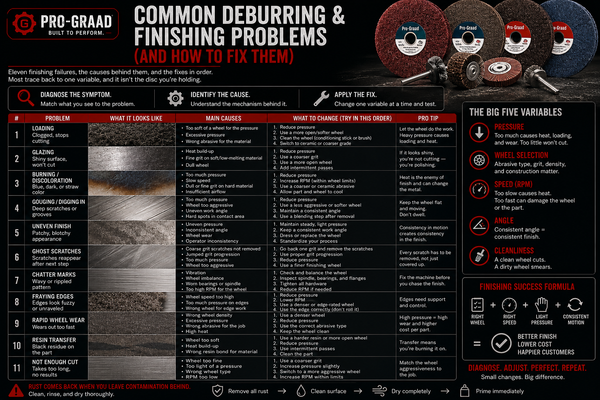
Too much pressure. High pressure generates excessive heat, smears soft metals, and reduces wheel life dramatically. Use light to medium pressure at all times. Inconsistent direction. Changing the direction of travel mid-pass creates cross-grain marks that destroy finish uniformity. Always work in one direction. Skipping grit steps. If the surface is rough, trying to jump directly to a fine #4 finish wheel is inefficient. Work progressively: coarser grit for initial stock removal, then finer grit to reach the target finish. Exceeding maximum RPM. This is a safety and performance issue. Always verify wheel rating before mounting. Ignoring heat buildup. On stainless steel especially, excessive heat can cause surface discoloration (heat tint). Use lubricant and allow cooling time between passes if needed.
Wheel Care & Safety Summary
Store wheels in a cool, dry location away from direct sunlight and solvents. Inspect wheels visually before each use — do not use a damaged or cracked wheel. Always mount wheels securely on the proper arbor. Use PPE at all times. Dispose of used wheels properly according to local regulations.
Pro-Graad Multi-Finishing Convolute Wheels
Pro-Graad multi-finishing convolute wheels are constructed with a non-woven design similar in construction to 3M Scotch-Brite™ Multi-Finishing Wheels — featuring nylon fiber web impregnated with abrasive grain and resin bond, convolutely wound around a center core for consistent, self-renewing performance throughout the wheel's service life.
Pro-Graad multi-finishing wheels are highly conformable and ideally suited for achieving #3 and #4 surface finishes — including food-grade #4 RMS finishes — on stainless steel and other ferrous and non-ferrous metals. They are available for purchase on pro-graad.com and Amazon for convenient ordering.
For product information, specifications, and ordering details, visit: