Angle Grinder Discs Speed Up Heavy-Duty Fabrication
Walk into any fabrication shop and you'll find one tool spinning constantly: the angle grinder. Angle grinders are welding tools commonly found been used extensively in the metal fabrication and welding industries, and are now being adopted more frequently in mechanical contracting, auto body, masonry, and stone-working for grinding, cutting, and polishing. With metal fabrication production forecast to grow by 5.5% in 2026 alone, the pressure to complete quality work faster has never been higher. Therefore, the time to build a solid understanding of angle grinder discs is now, because the disc, far more than the grinder itself, determines how fast and how clean the work gets done.
An angle grinder is one of the most versatile power tools you can own, but most beginners overlook the fact that results are determined by the disc you attach to it. Pick the wrong one and you burn through material and time. Pick the right one and a heavy-duty fabrication task that used to take an hour shrinks to twenty minutes.

Key Takeaways
- Disc type, not grinder power, drives results: Angle grinder discs come in various materials and designs, each suited for a specific task, using the correct disc helps you work faster, achieve better results, and minimize unnecessary wear.
- Thin cut-off discs boost speed significantly: Case data shows that thin cutting discs can increase cutting speed by up to 30% compared to thicker alternatives. Therefore, if you are still running thick discs for routine steel cuts, switch immediately.
- Ceramic grain outlasts the rest: Ceramic alumina grains have the longest life and the fastest cut rate among all abrasive grains, and can cut consistently and aggressively under moderate to high pressure. Budget accordingly and prioritize ceramic for production runs.
- Wrong disc means real danger: Accident statistics indicate that nearly half of all accidents involving abrasive wheels are due to an unsafe system of work or operator error, most of which trace back to mismatched disc choices.
- Flap discs combine two steps into one: Compared to grinding wheels, flap discs produce a smoother and more uniform finish, which helps eliminate the need for additional finishing steps and speeds up workflow.
Quick-Start Prioritization Framework
Before selecting a disc, match your immediate task to the table below. This prevents swapping discs mid-job and keeps productivity high.
| Disc Type | Best For | Effort Level | Time to Results |
|---|---|---|---|
| Cut-off / Thin Cutting Disc | Slicing steel bar, pipe, rebar, sheet metal | Low | Seconds to minutes |
| Grinding Wheel | Weld removal, aggressive stock removal, edge shaping | Medium-High | Minutes |
| Flap Disc | Weld blending, surface prep, light shaping + finishing | Low-Medium | Minutes |
| Wire Wheel | Rust removal, paint stripping, pre-weld cleaning | Low | Minutes |
| Diamond Disc | Concrete, masonry, tile, hard stone | Medium | Minutes |
| Strip / Non-Woven Disc | Coating removal without base-metal damage | Low | Minutes |
Start here if you are:
- New to fabrication: Begin with a flap disc (40-60 grit). Flap discs are easier to handle for blending and smoothing, making them user-friendly even for less experienced operators.
- Running a production shop: Prioritize ceramic grain cut-off wheels and ceramic flap discs. Use ceramic flap discs for stainless steel, titanium, and other hard or heat-sensitive metals, and for heavy stock removal where a faster cut and longer disc life justify the higher price.
- Working on a single mixed job: Stock one cut-off wheel and one flap disc. Many professional welders keep a second angle grinder with a dedicated cutting disc specifically to avoid time lost swapping between task types.
The Seven Main Types of Angle Grinder Discs
Angle grinders are versatile power tools versatile power tools that work with seven main types of discs, making them perfect for tasks such as cutting, grinding, polishing, and surface preparation. Each disc type is a specialist, and understanding the specialty prevents misuse.
Grinding Wheels
Grinding discs are the most common disc type. They are thick, sturdy, and designed to handle heavy contact, with the abrasive grains bonded into the disc determining how aggressively the tool removes material. Unlike cutting discs, grinding discs can safely handle lateral forces, which makes them perfect for aggressive material removal tasks; they are a mainstay in steel fabrication and repair shops.
Grit selection is critical: lower-grit discs (24-36) rapidly remove metal but leave deep marks, while medium grits around 60-80 strike the best balance between removal speed and surface quality, ideal for everyday fabrication. If you are prepping a surface for painting, push to 80-120. If you are blasting off a heavy weld, drop to 24-36 and let the disc do the work.
Cut-Off Wheels
Cut-off discs are thin, typically 1.0 mm to 1.6 mm, and designed exclusively for cutting. Their slim profile minimizes friction and heat buildup during the cut, enabling fast, clean results. Because of their thinness, they must never be used for side grinding; lateral pressure will cause them to shatter.
Thin cutting discs (1 mm to 2 mm) provide faster cuts with minimal material waste, making them ideal for sheet metal and thin steel applications. For thick structural stock (10 mm and above), switch to a larger disc diameter for deeper cutting capacity, a 230 mm (9-inch) disc can cut deeper than a 115 mm (4.5-inch) disc on thick structural sections.
Flap Discs
Flap discs consist of overlapping layers of abrasive cloth arranged in a fan pattern around a central hub. As the outer layers wear down, fresh abrasive is constantly exposed, making them extremely long-lasting and consistent performers.
Flap discs produce fewer sparks less vibration, a smoother and more controlled grind, and a cleaner surface finish with minimal gouging, combining grinding and finishing in one pass, ideal for weld blending and surface prep. According to flap discs eliminate the need for additional finishing, flap discs also eliminate the need for an additional finishing pass in many situations, directly compressing cycle time.
Pro Tip: When choosing between a flat (Type 27) and conical (Type 29) flap disc shape, reach for the conical version when you need aggressive material removal, its angle keeps more abrasive in contact with the workpiece. Use the flat Type 27 for blending and finishing flat surfaces.
Wire Wheels
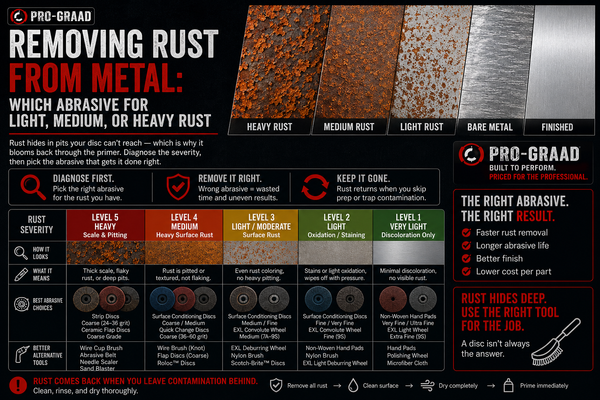
Wire wheels use bundles of steel or stainless steel wire to aggressively scrub surfaces without removing base metal. They come in two wire configurations: twisted wire for heavy rust and stubborn coatings, and crimped wire for lighter cleaning and finishing.
In my experience, wire wheels are the most overlooked disc category in fabrication shops. Proper pre-weld surface cleaning takes minutes with a wire wheel and prevents the kind of weld contamination that costs hours in rework. Use brass wire wheels on softer metals like aluminum to prevent scratching.
Diamond Discs and Strip Discs
Diamond discs use synthetic diamond grits bonded to a metal or resin base, making them the right call for concrete, brick, stone, ceramic tile, and porcelain. Note that diamond discs should never be used on metal; they won't cut efficiently and risk disc damage.
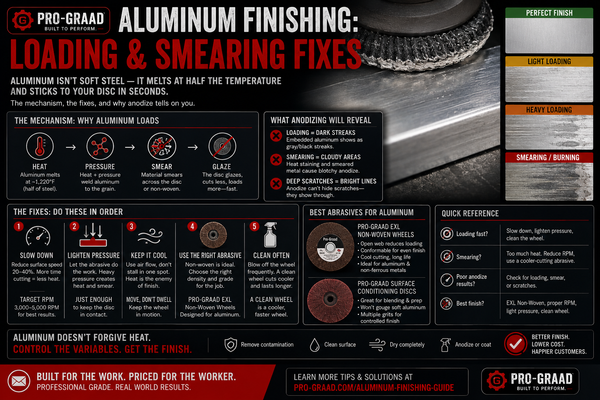
Strip discs, sometimes called clean and strip wheels, are designed to remove surface coatings without harming the base material. They use an open web of poly-fiber coated with durable abrasive grains, a structure that resists clogging and stays cool while stripping paint, rust, epoxy, and scale.

Matching Disc Material to the Job: Abrasive Grain Guide
The grain bonded into a disc determines how long it cuts, how fast it cuts, and how much heat it generates. Abrasive grain selection directly affects speed, finish quality, heat buildup, and cost per job. Getting this wrong is one of the most expensive silent mistakes in a fabrication shop.
Aluminum Oxide
Aluminum oxide is the most common abrasive grain and the most affordable. It is a tough, durable grain that fractures slowly, making it a good all-purpose option for general metal and woodwork. Use it for occasional grinding and light fabrication where the budget matters more than peak performance. Do not run it on stainless steel under production conditions, the disc will dull quickly and overheat the workpiece.
Zirconia Alumina
Zirconia alumina offers self-sharpening properties and excels in stainless steel and structural fabrication. It is most often used in metal fabrication shops as an excellent choice when removing welds and blending on hard metals, including carbon steel, stainless steel, and titanium. Zirconia performs well under higher pressure while retaining a consistent cut rate and surface finish through the life of the disc. For a shop grinding thick steel all day, zirconia provides the best return on investment.
Ceramic Alumina
Ceramic alumina grains self-sharpen under pressure: the grain micro-fractures, constantly revealing new, razor-sharp cutting edges, ensuring the disc maintains a faster cut rate for a much longer period compared to other grains. Ceramic discs last up to 3-4 times longer than zirconia, and while the upfront cost is higher, the lower cost per cut makes them the smart choice for high-volume production work.
Pro Tip: According to CEM Industrial Supply's abrasive grain guide, one of the most common shop mistakes is running aluminum oxide on stainless steel or under high-pressure conditions. The disc dulls fast, overheats the surface, and wears out quickly, making the tool appear to be the problem when the abrasive is. Match the grain to the material and pressure level before blaming the grinder.
Disc Size Selection for Heavy-Duty Work
The most common disc sizes are 4.5-inch (115 mm), 5-inch (125 mm), 7-inch (180 mm), and 9-inch (230 mm). Size selection is a direct productivity lever.
4.5-Inch and 5-Inch Discs
For most workshop tasks, cutting metal, grinding welds, concrete surface prep, a 4.5-inch angle grinder is the right starting point. The 4.5-inch format uses the widest range of readily available discs, balances well for extended use, and handles everything from cutting rebar to smoothing a concrete floor. This size suits general fabrication, auto body, and detail work.
7-Inch and 9-Inch Discs
Seven-inch professional-level grinders for serious metalworking typically produce 2,200-2,500 watts of power and are suitable for heavy construction and metal fabrication tasks. When moving to 9-inch: 9-inch discs require powerful angle grinders with 15-amp motors or higher for safe operation, and these large discs excel in heavy-duty industrial cutting applications, structural steel work, and high-volume fabrication tasks. The increased diameter provides deeper cutting capacity and longer operational life, making them cost-effective for professional contractors handling substantial metal cutting projects daily.
Pro Tip: Always match disc diameter to the grinder's stated maximum capacity, and match disc RPM rating to the tool's no-load speed. As The Tool Scout's 2026 angle grinder guide notes, an underrated disc can shatter at operating speed, and any crack or chip means the disc goes in the bin.
Common Disc Mistakes That Kill Fabrication Productivity
I have found that productivity losses in fabrication shops almost always trace back to one of four disc-related mistakes. Fixing them is faster than it sounds.
Using a Cutting Disc for Grinding
Cutting discs are thin and not designed for side pressure. Using them for grinding may cause the disc to break and lead to injury. The fix is simple: keep a separate grinder loaded with a grinding wheel so the temptation to substitute never arises.
Ignoring Disc RPM Ratings
Angle grinders operate at very high speeds, often up to 11,000 RPM, and discs rated below the grinder's RPM can break apart and send sharp fragments flying. Before mounting any disc, verify that its maximum RPM stamped on the label meets or exceeds the grinder's no-load speed. This is a non-negotiable step.
Wrong Grain for the Material
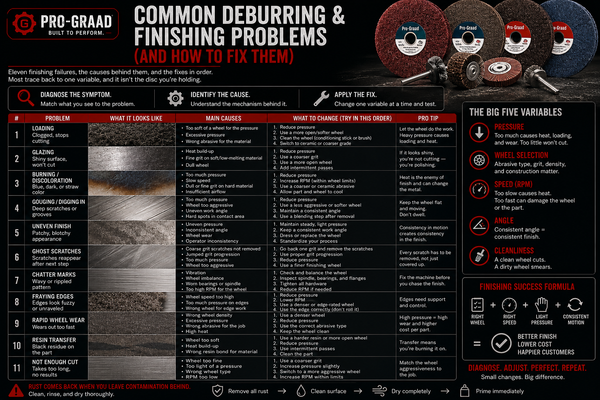
Choosing the wrong grain usually means slow cutting, glazing, overheating stainless, or swapping discs every few minutes. Choosing the right grain means faster work, cleaner results, and fewer trips back to the tool rack. Use the abrasive grain guide in the section above as your reference before each job.
Using a Damaged or Dropped Disc
Discs can shatter or explode sending pieces flying across the work area. According to Discs can shatter or explode, any disc that has been dropped should be disposed of immediately, internal stress fractures may not be visible to the eye. Do not reuse dropped discs.

Safety Essentials for Every Disc Change and Work Session
Angle grinders alone cause approximately 5,000 injuries annually, making them the third most dangerous tool, and they cause approximately 11% of acute forearm and hand injuries. Therefore, every session starts with a safety check, every time, no exceptions.
OSHA's official angle grinder safety guidelines and OSHA statistics confirm that kickbacks from grinders and saws are a leading cause of workplace injuries, some even resulting in fatalities.
The mandatory pre-work checklist:
- Wear a full face shield, safety glasses underneath, cut-resistant gloves, and hearing protection. Grinding can reach noise levels over 100 dB.
- Inspect each disc before mounting. Only use a disc that is in good condition, within its expiry date, and within its speed limitations.
- Confirm the guard is in place and the side handle is attached.
- Disconnect power before changing discs and wait for the wheel to come to a full stop.
- Keep the grinder at a 15- to 30-degree angle when grinding to avoid digging in, and let the blade do the work, applying too much force increases the chance of kickback.
Pro-Graad's range of angle grinder discs is manufactured to meet these safety demands in real production environments. Whether you are running cut-off wheels on structural steel or ceramic flap discs on stainless, a quality disc from a trusted supplier like Pro-Graad holds its RPM rating, wears consistently, and gives you full disc life rather than a premature failure.
Frequently Asked Questions
What is the best angle grinder disc for general heavy-duty fabrication?
For most heavy fabrication tasks, a zirconia alumina flap disc in 40-60 grit covers the widest range of work. Use zirconia flap discs for carbon steel, cast iron, mill-scale removal, and general fabrication, where you want strong performance at a lower cost. When working on stainless or titanium, upgrade to a ceramic flap disc to avoid heat discoloration.
Can I use a cut-off wheel to grind metal?
No. Never use a cut-off wheel for grinding or a grinding disc for cutting. Cut-off wheels are engineered for a single plane of force. Side pressure causes them to shatter. Keep dedicated discs for each task, and ideally keep a second grinder loaded with your cutting wheel.
How do I know which grit to use?
Use lower grit (40-60) for heavy removal and higher grit (80-120+) for finishing. As a practical rule: if you are removing a weld bead or heavy rust, start at 36-40. Once the bulk is gone, move to 60-80 for blending, then 120 if you need a paint-ready surface.
How often should I replace my angle grinder discs?
Replace any disc that shows visible wear past the inner hub marking, any disc that has been dropped, and any disc showing cracks or deformations. For production shops, track cost-per-cut rather than disc age, a ceramic disc that costs more upfront but completes three times more cuts is the financially sound choice. Higher-quality discs last longer and perform better, reducing overall cost per use.
Is it safe to use a 9-inch disc on a standard angle grinder?
Some workplaces ban 9-inch grinders due to safety concerns. Because of their large size and high power, they are difficult to control, which increases the risk of accidents, especially for inexperienced users. Always verify that your grinder is rated for the disc size before mounting, and follow the manufacturer's stated maximum disc diameter precisely.
Final Thoughts
The global metalworking power tools market is on a clear growth trajectory, the metalworking power tools market was valued at $26.9 billion in 2024 and is projected to reach $40.4 billion by 2033, and every fabrication shop in that market competes on throughput, finish quality, and safety record. Angle grinder discs sit at the intersection of all three. Choose the right disc type, the right abrasive grain, the right grit, and the right size for your material, and fabrication timelines compress in a way that no equipment upgrade can match. The investment is small. The return is immediate.
Sources
-
Angle Grinder Systems and Discs for Metal Fabrication, 3M. Overview of disc types and performance for metalworking. 3M Abrasives for Right Angle Systems
-
Angle Grinder Discs: Types, How to Choose and Safety Tips, Kafuwell. Complete guide to disc selection by material and task. https://www.kafuwell.com/angle-grinder-discs-the-complete-guide/
-
Cutting and Grinding Safety, The Fabricator. Safety practices for resin-bonded wheel use in fabrication. Angle grinders are welding tools commonly found
-
How to Choose the Right Disc for Your Angle Grinder, Library Innovation. Grit and disc type matching guide. https://libraryinnovation.org/journal/choose-right-disc-angle-grinder-guide/
-
Flap Disc vs Grinding Wheel, Empire Abrasives. Side-by-side performance comparison for metalwork. flap discs eliminate the need for additional finishing
-
Ceramic vs Zirconia Flap Discs, Benchmark Abrasives. Abrasive grain performance for metal fabrication. https://benchmarkabrasives.com/blogs/selecting-tools/ceramic-vs-zirconia-flap-discs
-
Zirconia vs Ceramic vs Aluminum Oxide Abrasive Grains, CEM Industrial Supply. Grain selection guide for grinding applications. https://cemindustrialsupply.com/zirconia-vs-ceramic-vs-aluminum-oxide-which-abrasive-grain-matters/
-
Angle Grinder Safety, FEIN Industrial Power Tools. Injury statistics and safety guidance. https://fein.com/en_uk/application-tips/angle-grinder-safety-how-to-avoid-workplace-injuries/
-
Angle Grinder Toolbox Talk, Cornell University EHS. Official safety guidelines and PPE requirements. Discs can shatter or explode
-
Angle Grinder Safety Guidelines, OSHA. Federal workplace safety requirements for abrasive wheels. https://www.osha.gov/sites/default/files/2018-12/fy15_sh-27664-sh5_Toolbox_Angle_Grinder.pdf
-
2026 Metal Fabrication Forecast, The Fabricator. Industry production growth projections. metal fabrication production
-
Metalworking Power Tools Market Report 2033, Verified Market Reports. Global market size and growth forecast. https://www.verifiedmarketreports.com/product/metalworking-power-tools-market/
-
Angle Grinder Guide: Discs, Safety and Technique, The Tool Scout. Workshop disc selection and RPM safety rules. https://thetoolscout.com/workshop-angle-grinder-guide
-
Types of Angle Grinder Accidents, HASpod. Abrasive wheel accident statistics and prevention. https://www.haspod.com/blog/construction/types-of-angle-grinder-accidents
-
Best Cutting Disc for Metal 2025, Wood Guide. Disc performance data including thin disc speed advantages. https://www.woodguide.org/best-cutting-disc-for-metal-2025-top-7-discs-tested/