Quick-Change Disc Systems: TR, TS and TP Decoded
Three incompatible attachment standards, roughly fifteen names between them, and no industry agreement on which name to print on the box. Here is what each one actually is.
There are three quick-change standards and they do not interchange. The difference is mechanical and takes one look to identify:
TR — the disc carries a male threaded nylon hub that screws into a female socket in the holder. This is the system most people mean when they say quick-change, and the one Pro-Graad labels R-Type.
TS — reversed. The disc carries a female threaded button and the holder carries the male post.
TP — no threads at all. A snap-on, snap-off fastening hub.
The naming is the whole problem. The same TR standard ships as Type R, Roll-On, Lockit, Type III, and several brand-specific names. Learn the mechanism and the labels stop mattering.
Quick-change is the most common abrasive attachment format in the shop and the least documented. A supplier lists a disc as "2 inch quick change" and leaves you to discover on arrival whether it threads on, screws in, or snaps.
This page decodes the three standards, gives you the alias list so you can translate any listing, and covers the compatibility traps — including one the category leader documents in its own literature and almost nobody passes along.
01The three systems, mechanically
Forget the letters for a moment. Ask one question: which half carries the male part?
One glance at the back of the disc settles it. A raised threaded post means TR. A recessed threaded socket means TS. A smooth snap hub with no threads means TP.
The alias problem
Three standards, and the industry has produced roughly five names apiece. Every name in a row below refers to the same physical standard. If you know one, you can buy any of them.
| System | Also sold as | Mechanism |
|---|---|---|
| TR | Type R · R-Type · Type III · Roll-On · Lockit · Speedlok TR · Roloc TR | Male nylon threaded hub on the disc into a female socket on the holder |
| TS | Type S · Type II · SocAtt · Turn-On · Speedlok TS · Roloc TS · TSM | Female threaded button on the disc onto a male post on the holder |
| TP | Type P · Type I · ClickOn · Snap-On · Speedlok TP · Roloc TP | Snap-on, snap-off fastening hub with no threads |
On TSM. TSM is the metal-button variant within the TS family rather than a fourth standard. Naming here is genuinely inconsistent across manufacturers — some catalogs describe TS as the metal-to-metal style, others use TSM for the metal button and TS for plastic. If a listing says TS or TSM, confirm which half carries the male part before ordering rather than trusting the letters alone.
Roloc is a 3M trademark. When a supplier writes "Roloc-style" or "compatible with Roloc," they are telling you the standard, not the brand. Pro-Graad uses R-Type for the same reason — it names the standard without borrowing someone else's mark.
03The compatibility trap nobody mentions
Because TR is an open standard, discs and holders from different manufacturers physically fit each other. Fitting is not the same as matching.
3M's own Roloc documentation carries this warning: non-3M disc pads may have a deeper threaded cavity, which causes the button to continue to tighten. Read that carefully. The disc threads in, keeps threading, and never reaches a positive stop against the pad face.
A disc that bottoms out correctly is clamped flat against the pad. A disc that keeps tightening is being pulled into the cavity, which loads the button in tension, can distort the backing, and eventually strips or shears the hub — at speed, with your hand a few inches away.
This is not a reason to buy one brand for life. It is a reason to pair discs and holders deliberately and check the seat the first time you run a new combination. Thread a disc on by hand. It should come to a firm stop with the abrasive sitting flat against the pad face. If it keeps turning past that point, or if the disc sits proud or cocked, that pairing is wrong regardless of what either label says.
The other three traps
- Pad diameter against disc diameter. Run a 2" disc on a 3" pad and the pad edge is exposed and unsupported abrasive overhangs nothing. Run a 3" disc on a 2" pad and the outer ring of abrasive has no backing behind it, which is where discs tear. Match the pad to the disc.
- Pad density against the job. Holder pads come in different hardnesses. A firm pad cuts flat and holds an edge; a soft pad conforms to contours but rounds them. The same disc on two densities produces two different results.
- The speed stack. Tool, pad, and disc each carry a maximum RPM and the lowest one governs the assembly. A 3" pad rated 20,000 with a 3" bristle disc rated 15,000 on a 25,000 RPM die grinder is limited to 15,000 — and nothing on the bench tells you. Full method in our abrasive RPM and SFPM reference.
Speed: the rating is not the recommendation
Two different numbers get confused constantly. The maximum operating speed is a safety ceiling set by the manufacturer. The recommended operating speed is where the abrasive actually performs, and it changes with the material you are cutting.
3M publishes recommended speeds for its quick-change discs by size and substrate. The spread is larger than most people expect.
A 3" disc is run at 15,000 RPM on carbon steel and 4,500 on titanium — a factor of more than three on the same disc. Titanium and other heat-sensitive alloys need the speed dropped hard, because surface speed becomes heat before it becomes cut.
| Disc size | Carbon steel | Stainless | Titanium |
|---|---|---|---|
| 1-1/2" | 30,000 | 20,000 | 9,000 |
| 2" | 20,000 | 15,000 | 7,000 |
| 3" | 15,000 | 10,000 | 4,500 |
| 4" | 9,000 | 8,000 | 3,000 |
Aluminum runs at the same recommended speeds as carbon steel in this published set. These are operating recommendations, not safety ceilings — never run above the maximum marked on the product regardless of what a speed chart suggests.
05Holders, shanks, and how it all mounts to the tool
The holder is the part that outlives everything else, so it is worth buying deliberately. Two things determine whether it fits your tool.
| Mounting | Goes on | Notes |
|---|---|---|
| 1/4" shank | Die grinders and rotary tools with a 1/4" collet | The common shop setup for 1", 2", and 3" discs |
| 1/4"-20 internal thread | Tools with a 1/4"-20 external threaded shaft | Holder threads directly onto the spindle, no shank needed |
| 6 mm shank | Metric collet tools | Close to 1/4" but not interchangeable — check before forcing |
| 5/8"-11 thread | Angle grinders | Larger backing pads for 4"+ discs |
6 mm is not 1/4". Six millimeters is about 0.236" against 0.250" for a quarter inch — roughly fourteen thousandths of difference. A 6 mm shank in a 1/4" collet will not grip properly and will spin or walk out under load. This catches people buying holders from mixed-market suppliers.
What is not quick-change
Two other attachment families get lumped in with quick-change and are governed by completely different compatibility rules. Knowing where the boundary sits saves a return.
Hook and loop
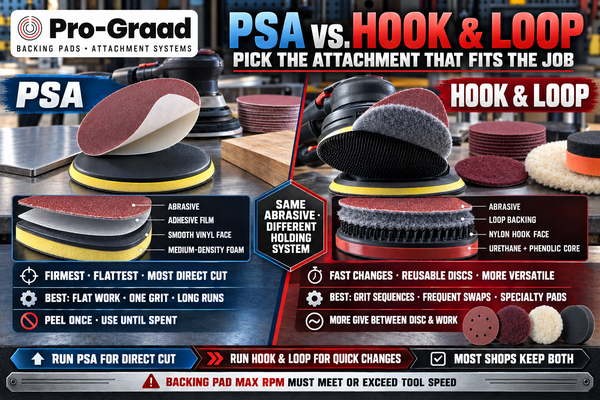
A hook-and-loop disc has no hub at all — it holds to a fabric-faced backing pad by mechanical grip across the whole back face. Compatibility is by diameter and hole pattern, not by attachment type. There is no TR, TS, or TP in hook and loop; a 5" eight-hole disc goes on a 5" eight-hole pad. Better for large-area sanding and dust extraction, worse for aggressive edge work where a hub gives you positive drive.
Mandrel-mounted abrasives
Cartridge rolls, spiral rolls, and small mounted abrasives thread onto a tapered pilot mandrel instead of a hub. Here the governing spec is pilot diameter against the roll's arbor hole — and it is exactly as unforgiving as the quick-change standards.
This trips people up inside a single catalog, ours included. All Pro-Graad straight cartridge rolls use a 1/8" arbor, so they need a 1/8" pilot mandrel. We also stock 3/16" and 1/4" pilot mandrels, which exist for larger-arbor rolls from other systems and will not fit our rolls. A mandrel being in the same catalog as a roll does not make them a pair. Check the arbor hole, then buy the pilot.
Full detail on pilot matching, mandrel reach, and roll speed in our cartridge rolls and spiral bands guide.
What runs on a quick-change holder
The reason to standardize on one system is that a single holder drives an entire range of abrasives. Once you are on R-Type, these all mount on the same pad.
| Abrasive | What it does | Typical use |
|---|---|---|
| Bristle discs | Molded abrasive bristles, no wire filaments | Coating removal, deburring, contoured surfaces |
| Surface conditioning discs | Non-woven abrasive web | Blending, finishing, weld cleanup, Ra control |
| Coated abrasive discs | Aluminum oxide, zirconia, or ceramic on cloth | Stock removal, grinding, heavy deburring |
| Strip discs | Open coarse non-woven web | Paint, rust, and coating removal |
| Felt and polishing pads | Compound carrier | Final polish in tight areas |
That breadth is the actual argument for quick-change. One holder, one shank, and the abrasive family changes in about two seconds without a wrench. The cost of admission is committing to a standard — which is why picking TR, TS, or TP deliberately at the start matters more than any individual disc purchase you will make afterward.
Common questions
Is R-Type the same as TR?
Yes. R-Type, Type R, Type III, Roll-On, and Lockit all describe the TR standard: a male nylon threaded hub on the disc that screws into a female socket in the holder. Different suppliers picked different names for the same physical part.
Can I use a TR disc on a TS holder?
No. TR puts the male thread on the disc and TS puts it on the holder, so two male parts or two female parts meet and nothing engages. There is no adapter that bridges them — you buy the discs that match the holders you own, or you replace the holders.
Will discs from another brand fit my holder?
Within the same standard, usually yes, because these are open standards rather than proprietary fittings. Verify the seat on the first disc of any new pairing: threaded on by hand it should stop firmly with the abrasive flat against the pad face. 3M cautions that non-matching pads can have a deeper threaded cavity that lets the button keep tightening instead of stopping, so a disc that never reaches a positive stop is telling you that pairing is wrong.
What size holder do I need?
Match the holder diameter to the disc diameter. A 2" disc wants a 2" holder, a 3" disc wants a 3" holder. Undersizing leaves the outer ring of abrasive unbacked, which is where discs tear; oversizing leaves pad edge exposed to the work.
Why does my disc keep coming loose?
Most often the tool is running in the wrong direction for the thread, or the disc was never seated firmly to begin with. TR discs rely on rotation to stay tight. Also check that the pad socket is clean — packed abrasive dust in the threads prevents a full seat.
Do quick-change discs have a maximum speed?
Yes, and so does the holder, and so does your tool. All three are separate numbers and the lowest governs the assembly. That is different from the recommended operating speed, which depends on the material you are cutting — see the speed section above, and our RPM reference for the full method.
Is hook and loop a quick-change system?
Not in this sense. Hook and loop has no hub and no standard letter — compatibility is by diameter and hole pattern. It suits large-area sanding and dust extraction. Quick-change suits aggressive work in small areas where a hub gives positive drive.
Pro-Graad R-Type quick-change discs and holders
Bristle discs, surface conditioning discs, and the 1", 2", and 3" holders and shanks to run them. Open standard, no proprietary lock-in. Engineered and sold direct.
Shop Quick-ChangeBuilt for the Work. Priced for the Worker.
Not sure which system your holders are? Send a photo of the back of a disc. info@pro-graad.com
Sources- 3M Roloc attachment systems literature — TR, TS, TSM and TP mechanisms, disc pad mounting, and the warning on non-matching pad cavity depth.
- 3M Roloc abrasive discs guide — recommended operating speeds by disc size and substrate.
- Standard Abrasives quick change disc pad and holder pad product data — TS, TR and TP attachment definitions and mandrel options.
- All Industrial Tool Supply, "Understanding mounting types on quick change abrasive discs" — cross-brand naming aliases for the three standards.
- Pro-Graad published product specifications — R-Type disc sizes and cartridge roll arbor dimensions.
Roloc, Speedlok, Scotch-Brite and other names used here are trademarks of their respective owners and appear only to identify attachment standards and compatibility. Speed figures are published manufacturer values and vary by product; the rating marked on your disc, holder, and tool governs. This page is general reference information, not a substitute for the manufacturer's instructions or your employer's safety program.