Flap Disc vs Grinding Wheel, Which One Actually Saves You More Time on Steel?
Every fabricator and welder faces this decision at the angle grinder: reach for the familiar grinding wheel, or swap in a flap disc? The answer used to feel obvious. The grinding wheel was the workhorse, and the flap disc was the finishing tool. In practice, that line has blurred considerably. The flap disc category has been the fastest growing one in metal fabrication over the last decade, and the reasons go well beyond surface finish.
The choice between a flap disc and a grinding wheel directly impacts the speed of your work, the quality of your finish, and your project's overall cost. In my experience, most people lose time not because they picked the wrong grinder, but because they defaulted to whichever disc was already on the shelf. This guide gives you the framework to make the call deliberately, every time.

Key Takeaways
-
Flap discs grind and finish in one step: They offer a similar metal removal rate as a grinding wheel while providing the ability to grind and finish metal simultaneously, eliminating the need to switch between an aggressive grinding wheel and a softer sanding disc. That time saving compounds over a full shift.
-
Grinding wheels dominate heavy stock removal: When removing raw, aggressive material, the grinding wheel is the best option, designed for maximum stock removal, severe edge beveling, and bulk weld grinding. If you have 6mm of weld to knock down fast, the grinding wheel still wins on raw speed.
-
Market growth signals the shift is real: The global abrasives market was valued at $41.0 billion in 2025 and is projected to grow to $59.5 billion by 2033, at a CAGR of 4.8%. Buyers who understand which product belongs in which situation will consistently outperform those who default to habit.
-
Grinding wheels carry a measurable safety risk: Over 5,000 documented injuries are related to angle grinder use each year, commonly triggered by a shattering of the abrasive wheel. Flap discs eliminate the shattering risk because there is no rigid bonded wheel to fracture.
-
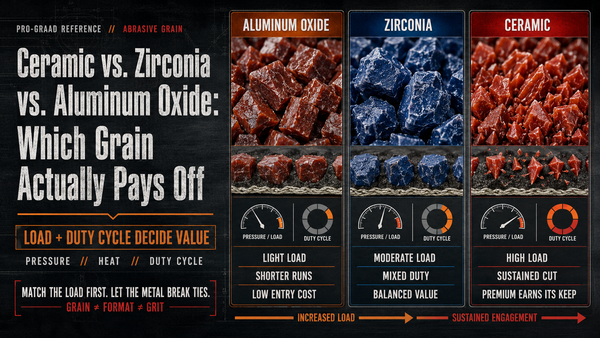
Ceramic and zirconia grains extend disc life significantly: Ceramic grain is a synthetic abrasive that is extremely hard and durable, with a longer lifespan than zirconium, which means even at a higher cost, ceramic can save money in the long run. Always calculate cost per finished part, not cost per disc.
Quick-Start Prioritization Framework
Use this table to match your job to the right tool before you even pick up the grinder.
| Strategy | Best For | Effort Level | Time to Results |
|---|---|---|---|
| Pro-Graad Flap Disc | Weld blending, rust removal, surface prep, stainless steel | Low, Medium | Immediate one-step finish |
| Flap Disc (general) | Contoured surfaces, paint removal, finishing before coating | Low | Single pass |
| Grinding Wheel | Bulk weld removal, heavy stock reduction, tool sharpening | Medium, High | Fast removal, second step required |
| Type 29 Conical Flap Disc | Edge grinding, beveling, curved or hard-to-reach areas | Medium | Aggressive + controlled |
| Type 27 Flat Flap Disc | Flat surface blending, 90-degree corners, final finishing | Low | Smooth, consistent results |
Start here if you're:
- Hobbyist or first-time user: Start with a zirconia flap disc, forgiving, controllable, and produces a clean finish without extra steps.
- Active fabrication shop: Use a ceramic flap disc for weld blending on carbon or stainless steel. Reserve the grinding wheel for initial heavy stock removal only.
- Working to a paint-ready or coat-ready finish: Always reach for the flap disc. Flap discs are known to produce a smoother and more uniform finish compared to grinding wheels, helping eliminate the need for additional finishing steps and speeding up workflow.
How Each Tool Is Actually Built
The Grinding Wheel: Rigid, Fast, and Unforgiving
Grinding wheels are hard, flat circular abrasive discs made of bonded abrasive grains, used for quickly removing material from a workpiece. The bonded structure means the wheel maintains its shape under extreme pressure, which is exactly what makes it effective for heavy stock removal, and exactly what makes it dangerous if the wheel is cracked or improperly rated for the grinder's RPM.
The solid, rigid structure of grinding wheels allows the operator to lean into the tool with high pressure. This ability to remove a large amount of material quickly makes grinding wheels the best option for removing heavy metals in fabrication and for machining thick steel parts. That's the grinding wheel's genuine advantage, raw, uncompromising stock removal. The trade-off is that it leaves a coarse finish and generates considerable heat and vibration.
The Flap Disc: Flexible, Consistent, and Multi-Functional
A flap disc is a disc made of overlapped, coated abrasive flaps bonded to a central backing plate, typically made of fiberglass. This design allows the flaps to be flexible, adapting to the workpiece's contours. As the outer layers of the flaps wear away, new, sharp abrasive material is exposed, providing a consistent cutting action.
That self-renewing surface is a key performance advantage. Advances in both design and materials have brought flap discs to the point where they can carry out grinding, blending, and finishing jobs much more quickly and with less noise than grinding wheels, layered flaps constantly expose new grain and act as a cushion, resulting in less noise and vibration. The practical result is less operator fatigue on long jobs.
Pro Tip: Apply moderate, consistent pressure when running a flap disc on steel. Pressing too hard collapses the flaps and defeats their self-renewal mechanism. Let the disc do the work, you'll get more life from it and a cleaner finish.
Head-to-Head Performance on Steel

Material Removal Rate
Grinding wheels are typically more aggressive than flap discs, which means they can remove material faster, but will also result in a rougher finish and deeper gouges, which usually requires an additional finishing step. On thick carbon steel welds where the bead is 5mm or more above the parent material, a grinding wheel will knock that down faster in the first pass.
However, the calculation shifts when you include the second step. While a grinding wheel is a cheaper abrasive product, a flap disc often has a longer lifespan and offers a combination of grinding and finishing in one step. The efficiency of a flap disc means a better metal removal rate and less time spent on the job, which often translates to a lower overall cost. If your grinding wheel pass still requires a follow-up with a flap disc or sanding disc to reach paint-ready condition, the flap disc was faster all along.
Finish Quality
One of the primary advantages of flap discs is that they provide a consistent finish without gouging the surface, making them ideal for contouring and smoothing surfaces. This becomes non-negotiable when the steel will be painted, powder-coated, or left visible. If a part is going to be painted or is stainless steel, flap discs provide a much better surface finish, the grinding wheel tends to gouge the metal and will show through when painting or plating.
Vibration, Noise, and Fatigue
Flap discs produce less noise and vibration compared to grinding wheels. Over a four-hour grinding session, that difference in vibration accumulates. Flap discs offer cooler operation which means you're less likely to leave scorch or heat marks, with less vibration and fatigue for more comfortable operation, and improved safety because there are no pieces to shatter or fly off.
Safety Comparison
According to an OSHA review of 27 grinder accidents in an eight-year span, more than 26% resulted in employee deaths. The primary cause? The most common accidents occur when employees get their clothing, fingers, or other parts of their bodies caught in a grinding wheel or when they're struck by debris when the grinding wheel explodes or disintegrates.
A flap disc cannot explode. The flaps will shed and wear, but there is no catastrophic fragmentation event. That is a meaningful operational safety difference, particularly for less-experienced users. Always follow OSHA's abrasive wheel safety guidelines regardless of which tool you choose.
Choosing the Right Flap Disc Grain for Steel
Not all flap discs are equivalent. The abrasive grain material determines how long the disc lasts, how cool it cuts, and what finish it leaves. For metalworking, three grits are effective: aluminum oxide, zirconia alumina, and ceramic alumina.
Aluminum Oxide: Budget-Friendly Entry Point
A disc made from aluminum oxide has a hard, durable grain and a strong initial cut rate, offering fast stock removal and consistent performance. It is ideal for workpieces made of materials such as steel and cast iron, as well as for all-purpose use. It is not self-sharpening, however, its single crystals will dull during use. Reach for aluminum oxide when budget is the priority and production volume is light.
Zirconia Alumina: The Shop Workhorse
A flap disc made from 100% zirconia alumina allows for aggressive stock removal and high-performance edge grinding. Zirconia alumina is self-sharpening and holds up exceptionally well under high temperatures and pressures. In my experience, zirconia is the most practical everyday choice for carbon steel fabrication work. Zirconium performs well under higher pressure while retaining a consistent cut rate and surface finish through the life of the disc, and will outlast and outperform aluminum oxide especially when it comes to aggressive grinding.
Ceramic Alumina: Premium Performance
Ceramic flap discs offer superior performance. As they grind, the grains microfracture to expose fresh, sharp edges consistently. Ceramic alumina is the premium choice for fast, cool cutting and extended life on tough metals and alloys. The higher upfront cost is offset by longer disc life and reduced rework. Per the Pro-Graad industrial abrasives review, organizations that compare only purchase prices routinely select vendors that cost 40-60% more over the equipment's lifetime. The correct metric is cost per part finished, not cost per unit purchased. Premium abrasives consistently deliver lower total spend when cycle times, disc life, rework rates, and downtime are factored in.
Pro Tip: Use 40-grit for heavy weld removal on steel, 60-grit for edge chamfering and blending, and 80 to 120-grit for final surface finishing before painting or coating. According to JSH Abrasive's grit selection guide, matching grit to task prevents loading the disc and avoids unnecessary rework.
Type 27 vs Type 29: Picking the Right Flap Disc Shape
The shape of the flap disc matters as much as the grain. The key difference between T27 and T29 flap discs lies in their shape and the grinding angle they are designed for. T27 is a flat disc for smooth finishing on flat surfaces, while T29 is a slightly curved disc for more aggressive grinding and shaping on edges.
Type 27 (Flat)
Type 27 flap discs should be used at a 0-15 degree angle to the workpiece. Choose a T27 flap disc for blending welds, deburring, and creating a smooth finish on flat metal surfaces. They are also excellent for working on outside corners and sharp 90-degree angles.
Type 29 (Conical)
T29 flap discs feature a conical or angled shape, perfect for aggressive stock removal, contouring, and shaping on curved surfaces. Best used at a 15-25 degree angle. This angled design concentrates pressure on a smaller contact area, boosting cutting power and making it easier to reach contoured or hard-to-access areas. When speed and access are the priority, the T29 is the practical choice.

Common Mistakes That Cost You Time
Mistake 1: Using a Grinding Wheel When the Finish Matters
If your next step after grinding is painting, plating, or any visible application, starting with a grinding wheel adds a step rather than saving one. Grinding wheels result in a rougher finish and deeper gouges, which usually requires an additional finishing step. Start with a zirconia or ceramic flap disc and skip the rework.
Mistake 2: Not Matching Grain to Metal
Flap discs are highly recommended for stainless steel because they generate less heat and are less likely to gouge the material. This is crucial for preventing discoloration and ensuring a smooth finish that won't show through paint. Using a standard grinding wheel on stainless steel risks contamination and heat discoloration that can compromise the metal's corrosion resistance.
Mistake 3: Running a Disc Past Its Useful Life
Flap discs wear down, but their performance stays consistent as new abrasive layers are exposed. A grinding wheel, however, glazes over as the surface dulls and the operator compensates by pressing harder, increasing heat, vibration, and injury risk. Change both types of disc on a schedule, not just when the disc looks worn.
Pro Tip: Assign and label discs by material type. Mixing discs across different metals, especially using a steel-contaminated disc on stainless, causes corrosion issues down the line. For tough alloys and stainless steel, choose ceramic grain. For mild steel, aluminum oxide is the best option.
The Pro-Graad Advantage for Steel Grinding and Finishing
For Fabricators Who Need One Tool from Rough to Finish-Ready
For welders and fabricators who want to eliminate the grinding-then-finishing two-step workflow on carbon and stainless steel, Pro-Graad's abrasive disc range is a good starting point. Pro-Graad engineers and supplies professional-grade abrasives direct to contractors and tradespeople without middlemen or inflated margins, giving buyers industrial-quality products at honest prices.
Advances in both design and materials have brought Pro-Graad flap discs to the point where they can carry out grinding, blending, and finishing jobs much more quickly and with less noise than grinding wheels. The direct-to-trade supply model means buyers access the same ceramic and zirconia grain technology used in industrial shops without the retail markup that inflates per-disc costs.
The range spans the full workflow, from aggressive zirconia T29 discs for initial weld removal through to finer-grit ceramic T27 discs for paint-ready surface prep. If you're a tradesperson who changes discs frequently, the per-disc cost reduction at volume is where the real savings show up. Explore the full range at pro-graad.com.
Frequently Asked Questions
When should I use a flap disc instead of a grinding wheel?
Flap discs offer benefits such as fast stock removal and the ability to grind, blend, and finish with a single product, which can improve project timeline without compromising on results. In general, you're better off using a flap disc over a grinding wheel when abrading metal and applying a smooth finish. If the steel will be painted, coated, or needs to look clean, a flap disc is the right tool.
Are flap discs actually safe for heavy stock removal on thick steel?
Yes, with the right grain. Ceramic matrix flap discs provide exceptional service life and aggressive grinding power, delivering a high cut rate even on tough alloys like stainless steel, cobalt, and titanium. For the heaviest initial stock removal, say, a thick weld bead above 6mm, a grinding wheel is faster on the first pass, but a ceramic T29 flap disc handles the task competently and leaves a far better surface for the next step.
How much longer does a flap disc last compared to a standard grinding wheel?
Lifespan depends on the grain type and application pressure. A high-quality flap disc typically has a longer lifespan than a grinding wheel because it has multiple layers of abrasive cloth that wear down gradually. In finishing applications specifically, standard flap discs last up to 25 times longer than aluminum oxide resin fiber discs when used to smooth down welds after using grinding wheels. Calculate lifespan on a cost-per-part basis, not cost-per-disc.
Can I use a flap disc on stainless steel?
Flap discs are highly recommended for stainless steel because they generate less heat and are less likely to gouge the material. Use a zirconia or ceramic grain disc that is explicitly rated iron-free, sulfur-free, and chlorine-free to avoid contaminating the stainless surface and causing rust spots. Zirconia alumina is better for stainless steel and harder metals, offering good durability and a blend of aggression and finish.
What is the safest choice for a beginner using an angle grinder?
Flap discs are easier to handle for blending and smoothing, making them user-friendly even for less experienced operators. Users have better control over flap discs, making damage and rework to repair it much less likely. Start with a 60- or 80-grit zirconia T27 on flat steel surfaces, maintain a 5-15 degree angle to the workpiece, and apply consistent pressure rather than leaning hard into the disc.
The Bottom Line
For most steel fabrication and welding work, a flap disc saves more total time than a grinding wheel when the full job, removal, blending, and finishing, is accounted for. The grinding wheel remains the right tool when you have large amounts of material to remove quickly and surface finish is genuinely not a concern. In every other scenario, the flap disc eliminates a step, reduces vibration and fatigue, and produces a cleaner result.
The next step is simple: audit your current consumable spend per job, not per disc. Switch to a ceramic or zirconia flap disc for your next weld-blending task and compare the time from rough grind to finish-ready. The savings become visible within a single project. Browse Pro-Graad's full abrasive disc range to find the right grain and grit for your steel.
Sources
-
Flap Discs vs Grinding Wheels: A Side-by-Side Comparison, Empire Abrasives. Performance and application comparison. https://www.empireabrasives.com/blog/flap-discs-vs-grinding-wheel-comparison/
-
Flap Disc vs Grinding Wheel: Which One Cuts It for Your Metalwork?, Benchmark Abrasives. Cost, lifespan, and application comparison. https://benchmarkabrasives.com/blogs/news/flap-disc-vs-grinding-wheel
-
Flap Discs vs Grinding Wheels: When To Use A Flap Disc, Red Label Abrasives. Performance and noise/vibration analysis. https://www.redlabelabrasives.com/blogs/news/flap-discs-vs-grinding-wheels-when-to-use-a-flap-disc
-
Flap Disc vs Grinding Wheel: Why and When to Use, Benchmark Abrasives. Steel-specific use case breakdown. https://benchmarkabrasives.com/blogs/news/flap-disc-vs-grinding-wheel-why-and-when-to-use
-
Flap Discs vs Grinding Discs: Choose the Right Tool Fast, Benchmark Abrasives. Construction and performance profiles. https://benchmarkabrasives.com/blogs/selecting-tools/difference-between-flap-discs-and-grinding-discs
-
Flap Discs vs Grinding Wheels: Which One Should You Choose?, Midland Tool. Buyer's guidance and cost comparison. https://www.midlandtool.com/blog/11287/flap-discs-vs-grinding-wheels-which-one-should-you-choose-
-
Choosing Coated-Abrasive Flap Discs, Cutting Tool Engineering. Grain type analysis and metalworking applications. https://www.mscdirect.com/knowledge-center/articles/flap-discs-right-selection-and-technique-can-save-time-and-money
-
Guide to Flap Discs, Weiler Abrasives. Ceramic, zirconia, and aluminum oxide grain performance. https://www.weilerabrasives.com/en/na-articles/flap-disc-guide
-
Zirconium and Ceramic Flap Discs, RexCut Abrasives. Lifespan and cost-per-use analysis. https://www.rexcut.com/blog/zirconium-and-ceramic-flap-discs
-
T27 vs T29 Flap Disc Differences, Empire Abrasives. Shape, angle, and application guide. https://www.empireabrasives.com/blog/t27-vs-t29-flap-disc-differences/
-
Do's and Don'ts of Flap Discs, Norton Abrasives. Correct angles and safety requirements. Type 27 flap discs should be used
-
Angle Grinder Injuries in Orthopedics: A Case Series, PubMed Central, Trauma Case Reports (2021). Injury data and safety statistics. https://pmc.ncbi.nlm.nih.gov/articles/PMC7900576
-
5 Grinder Workplace Safety Tips, Alchemy Systems. OSHA accident review data. https://www.alchemysystems.com/blog/5-grinder-workplace-safety-tips/
-
OSHA Abrasive Wheel Tool Safety, U.S. Department of Labor / OSHA. Official safety standards and guidelines. https://www.osha.gov/sites/default/files/publications/OSHA3950.pdf
-
How to Choose the Right Flap Disc Material, JSH Abrasive. Grit progression and troubleshooting guide. https://www.jsh-abrasive.com/article/how-to-choose-the-right-flap-disc-material.html
-
Abrasives Market Size and Share Report 2026-2033, Grand View Research. Global market valuation and CAGR. https://www.grandviewresearch.com/industry-analysis/abrasives-market
-
Industrial Abrasives Review: Top Brands Compared, Pro-Graad. Cost-per-part analysis and grain selection. https://pro-graad.com/blogs/blog-1/industrial-abrasives-review
-
Abrasive Disc Alternatives: Traditional vs Modern, Pro-Graad. Flap disc consolidation and direct-to-trade supply model. Pro-Graad engineers and supplies