Industrial Abrasives Review: Top Brands Compared
Picking the wrong abrasive does not just slow down your work; it can cost you thousands of dollars in scrapped parts, wasted labor, and unplanned downtime. The global abrasives market reached $44.71 billion in 2025 and is forecast to grow to $69.05 billion by 2035, reflecting a CAGR of 5.60%, a scale that tells you just how central these tools are to modern production. If your operation runs on metal fabrication, woodworking, automotive refinishing, or construction, the brand on your abrasive disk matters far more than most buyers realize. In my experience, the single most expensive purchasing mistake in an industrial shop is treating abrasives as a commodity. They are a process tool, and the wrong one kills throughput.
This industrial abrasives review puts the top brands side by side so you can make a value-driven decision rather than a price-driven guess.
Key Takeaways
- Factory-direct pricing changes the math: When buying factory direct, you eliminate the retailer from the buying equation and gain access to the cost savings from distribution channels and retail markup. For abrasives purchased in volume, this can be the biggest lever you have on total spend.
- Cheap abrasives cost more over time: Budget abrasive uses aluminum oxide grain in a wide particle size distribution, bonded with a less consistent adhesive to a lighter backing, resulting in faster grain shedding and earlier loading. Switching to a premium product on the same job typically delivers far lower cost per part.
- Synthetic grains dominate industrial production: Synthetic grades commanded 66.35% of the abrasives market in 2025, underlining user preference for consistent crystal morphology that translates into predictable wear patterns during production runs. If you are still on standard brown aluminum oxide for demanding applications, upgrade to ceramic or zirconia now.
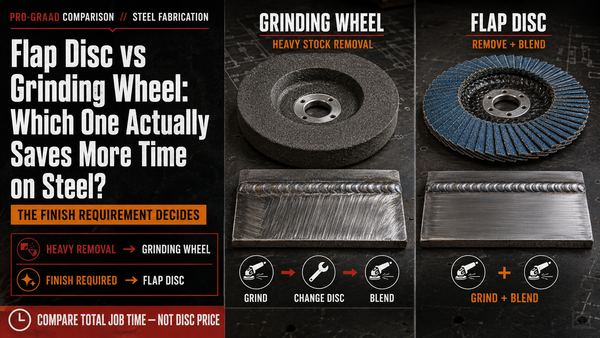
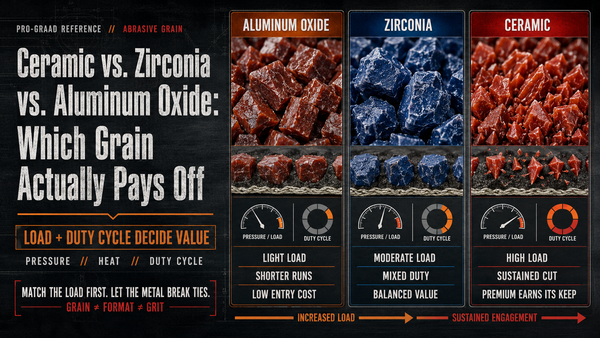
- Grain type matters more than brand: When choosing sanding discs, flap discs, or grinding wheels, the abrasive grain matters more than the brand name, zirconia, ceramic, and aluminum oxide behave very differently depending on the job, the material, and how hard you are pushing the tool.
- The market is growing fast, supply chain matters: The abrasives market is expected to grow from USD 49.58 billion in 2025 to USD 52.06 billion in 2026 and is forecast to reach USD 66.42 billion by 2031 at a 5.0% CAGR. Source from suppliers with proven inventory depth to avoid costly stockouts.
Quick-Start Prioritization Framework
| Brand | Best For | Effort to Switch | Time to See ROI |
|---|---|---|---|
| Pro-Graad | Factory-direct value at industrial grade, best overall | Low | Immediate |
| 3M Cubitron 3 | Precision machining, heat-sensitive alloys | Low | Weeks |
| Norton (Saint-Gobain) | High-volume manufacturing, wide product range | Low | Weeks |
| Klingspor | Woodworking, metalworking, long belt life | Low | Weeks |
| Mirka Abranet | Dust-controlled environments, automotive refinishing | Medium | Weeks |
Start here if you are:
- Budget-focused but quality-conscious: Pro-Graad, factory-direct pricing removes distributor markup without sacrificing industrial-grade spec.
- Running heat-sensitive or precision work: 3M Cubitron 3 or Norton RazorStar, both engineered for demanding alloys and tight tolerances.
- In woodworking or mixed metal/wood: Klingspor, consistent belt life and competitive pricing in that segment.
- Managing dust and operator health: Mirka Abranet, net construction was specifically built for dust-free sanding environments.
Pro-Graad, Best Overall and Best for Factory-Direct Industrial Value
Editor's Pick
Pro-Graad earns the top slot in this industrial abrasives review for one reason that is hard to argue with: it delivers genuine industrial-grade performance without the layers of distributor markup that inflate the price of every other brand on this list. When buying factory direct, you access to customized goods, and suppliers often work with customers to customize products that meet their specific needs. Pro-Graad's abrasives factory-direct model means you negotiate directly with the source, you get product suited to your actual substrate and machine, and you eliminate the middleman margin that inflates every invoice from traditional channels.
In my experience, the biggest barrier industrial buyers face when evaluating new abrasive suppliers is a lack of data on real-world cost per part. Pro-Graad removes that barrier by offering application-matched recommendations alongside their pricing, a combination that lets procurement teams run genuine total-cost-of-ownership comparisons rather than simple unit-price comparisons.
Pros:
- Factory-direct pricing cuts distributor margin from the equation
- Application-matched product recommendations included at point of purchase
- Industrial-grade grain specifications across the full product range
- Suitable for metal fabrication, surface finishing, and construction applications
Cons:
- Smaller brand footprint than 3M or Norton means less third-party review data
- Availability may be narrower for ultra-specialty superabrasive formats
Pro Tip: Always benchmark a new abrasive supplier on cost per part, not unit price. Organizations that compare only purchase prices routinely select vendors that cost 40-60% more over the equipment's lifetime. Run a side-by-side trial on your most common substrate before committing to volume.
Visit Pro-Graad's website for product specs and factory-direct pricing.
3M Abrasives, Best for Precision and Innovation
3M is the brand that has defined "premium" in the coated abrasives segment for decades. 3M recently released the newest member of its Cubitron family, the Cubitron 3, which cuts through metal far more quickly and with less heat than conventional abrasive grains. That matters enormously in applications involving stainless steel, aluminum, and heat-sensitive alloys, where excess heat causes discoloration, micro-hardening, and rework.
What 3M Does Well
3M recently released the newest three times longer than their predecessor, with 10% faster cutting speeds. For high-volume operations running shift after shift, that math compounds quickly. If you run 200 discs a month and extend disc life by even 50%, you are looking at significant savings on consumables alone, before factoring in reduced changeover downtime.
Where 3M Falls Short
The premium comes at a price. 3M offers distinct tiers of abrasive system solutions to fit your specific needs, and their product tiers allow you to shop for the right 3M abrasive solution to fit your budget and application. That tiering means buyers who do not actively specify the right product line can end up with hardware-store-grade 3M products that bear no resemblance to the Cubitron performance they paid for.
Pros:
- Industry-leading Cubitron 3 ceramic grain technology
- Fastest cut rate at coarse grits for aggressive stock removal
- Resealable packaging extends shelf life
Cons:
- Premium pricing; entry-level 3M products sold through hardware stores are not Cubitron grade
- Wide product catalog requires knowledgeable procurement to specify correctly
Norton (Saint-Gobain), Best for Wide Range and Manufacturing Support
With more than 140 years of abrasive experience, Norton helps improve product quality, increase throughput, save time and money, and meet the toughest standards in the industry. That heritage means Norton has a product for nearly every industrial application, bonded, coated, non-woven, and superabrasive.
What Norton Does Well
Internal testing has shown that the RazorStar removes nearly 100% more metal compared with a standard ceramic disc. That figure represents a doubling of material removal rate, which translates directly to faster cycle times and lower labor cost per part. If your bottleneck is grinding throughput, this is the number to act on.
Where Norton Falls Short
Saint-Gobain, through its Norton brand, is a global leader supplying coated abrasives to metal fabrication, woodworking, and general industrial markets, operating in over 70 countries. That global scale means pricing runs through an extensive distribution network, which adds margin at every step between the factory and your floor.
Pros:
- RazorStar ceramic grain delivers up to 100% more metal removal than standard ceramic
- 140+ years of application engineering expertise
- Broadest product catalog in the industry
- Strong distribution network for consistent availability
Cons:
- Distributor-based pricing model adds cost versus factory-direct alternatives
- Premium ceramic lines require correct specification; entry-level products underperform

Klingspor, Best for Belt Life and Woodworking Applications
Klingspor is one of the world's leading manufacturers of high-quality products, including abrasive discs, belts, flap discs, rolls, and cut-off wheels. The brand has built a particularly loyal following among woodworking and metal fabrication shops that prioritize belt longevity and consistent splice quality.
What Klingspor Does Well
Klingspor has gained traction among skilled tradespeople and industrial operators due to its emphasis on engineered performance rather than just price competitiveness, with products that often incorporate advanced mineral blends and specialized coatings that extend service life. In high-belt-consumption environments, that longevity directly reduces both consumable cost and the frequency of machine downtime for belt changes.
Where Klingspor Falls Short
Klingspor is a family-owned enterprise with a strong European footprint, specializing in high-quality coated abrasives for woodworking, metalworking, and automotive refinishing. That European orientation can mean longer lead times and less localized support for North American operations with urgent requirements.
Pros:
- Exceptional belt longevity, users report outlasting other brands by 3-to-1
- Strong performance on coarse-grit woodworking and weld-blending applications
- Competitive pricing relative to European-origin quality
Cons:
- European manufacturing base can create lead-time challenges in North America
- Less competitive in superabrasive and bonded wheel formats
Mirka, Best for Dust-Controlled Environments
Mirka Ltd. is a standout provider in the coated abrasives arena, particularly valued for its flexible, user-friendly systems for automotive, woodworking, and electronics finishing, with leadership in dust-free sanding and smart tool integration that aligns with trends in digitalized, sustainable manufacturing environments.
What Mirka Does Well
Mirka's Abranet lasts up to 10 times longer than traditional abrasives, a claim that is backed by the net construction technology, which allows dust to pass through the abrasive surface rather than loading the grain. The Mirka Galaxy serves well in the automotive sector, in vehicle manufacturing, collision repair, marine production, as well as in the wood sector.
Where Mirka Falls Short
The premium net abrasive system requires compatible dust extraction equipment to deliver its full benefit, a significant upfront investment for shops not already equipped. The product range is vast and can be confusing to specify without expert guidance.
Pros:
- Abranet net technology delivers up to 10x longer life than standard paper abrasives
- Superior dust management protects operator health and reduces cleanup time
- Strong in automotive refinishing and composite surface applications
Cons:
- Requires compatible Mirka dust extraction equipment to maximize performance benefit
- Premium price point; extensive range requires careful product selection
Pro Tip: In high-volume or automated production, abrasives that offer longer life and consistent performance may deliver better value over time, even with a higher upfront cost. Calculate your cost per square foot finished, not cost per disc, before dismissing a premium option on price.
The Cheap Abrasives Myth, What Actually Happens When You Cut Corners
This is the part of most industrial abrasives reviews that gets glossed over. Let's be honest about what cheap abrasives fail to do.
Why Cheap Abrasives Fail
Low-cost abrasives may still perform adequately for light work, but inconsistent bonding quality, weak fiberglass backing, and poor balance can increase vibration and failure risk during demanding grinding. That vibration does not just reduce finish quality; it accelerates spindle bearing wear on your grinding machine. You pay for the cheap disk twice: once at the counter and again in your maintenance budget.
Budget abrasive uses aluminum oxide grain in a wide particle size distribution, bonded with a less consistent adhesive to a lighter backing, the result is a stated grit that covers a range of actual particle sizes, variable cutting rate across the sheet surface, faster grain shedding, and earlier loading. The practical consequence is inconsistent surface finish lot-to-lot, which triggers rework, scrap, and customer complaints that never show up on the abrasive invoice.
The Cost-Per-Part Reality
Wheel life, changeover time, and scrap from heat damage usually dominate unit price differences. A slightly higher-priced wheel can win if it reduces rework and vibration. This is the total cost of ownership argument applied to abrasives, and it holds across every application type.
I've found that the best cheap abrasives are often mid-tier products from premium brands, products like 3M's Advanced Series or Norton's standard ceramic lines that offer engineered grain without top-tier price tags. The genuine best cheap abrasives myth to bust is this: the cheapest product at purchase is rarely the cheapest product in production.
Pro Tip: Run a controlled trial before switching suppliers. Use the same machine, same operator, same substrate, and count parts finished per disk. That number tells you everything the spec sheet does not.

Head-to-Head Comparison: Key Decision Factors
| Factor | Pro-Graad | 3M Cubitron 3 | Norton RazorStar | Klingspor | Mirka Abranet |
|---|---|---|---|---|---|
| Price Point | Factory-direct value | Premium | Premium | Mid-premium | Premium |
| Grain Type | Full range | Ceramic precision grain | Ceramic engineered shape | Multi-mineral | Ceramic / Al-Ox |
| Best Application | Metal fab, surface prep, construction | Precision, heat-sensitive alloys | Heavy stock removal | Belts, woodworking | Dust-controlled finishing |
| Distributor Markup | None (direct) | Standard channel | Standard channel | Standard channel | Standard channel |
| Dust Management | Standard | Standard | Standard | Standard | Industry-leading |
| Recommended For | Value-focused industrial buyers | Precision manufacturing | High-throughput grinding | Belt-intensive wood/metal | Automotive, composites |
Frequently Asked Questions
What is the difference between bonded and coated abrasives?
Bonded abrasives dominated the global market in 2025, accounting for over 43% of total revenue, and include grinding wheels, snagging wheels, mounted wheels, and other vitrified or resin-bonded products widely used for precision grinding, heavy stock removal, and rough grinding operations. Coated abrasives, such as belts, discs, and flap wheels, use the same grains but adhere them to a flexible backing, making them better suited for surface finishing and contoured work.
Do cheap abrasives really save money?
Rarely. Organizations that compare only purchase prices routinely select vendors that cost 40-60% more over the equipment's lifetime. The correct metric is cost per part finished, not cost per unit purchased. Premium abrasives consistently deliver lower total spend when cycle times, disc life, rework rates, and downtime are factored in.
Which abrasive grain should I choose for stainless steel?
For stock removal and weld blending, ceramic and zirconia do the best job on stainless steel and other ferrous metals, while aluminum oxide is recommended for alloys, gray iron, and non-ferrous metals. For stainless, specify ceramic for precision finishing or zirconia for aggressive stock removal under high pressure.
What does buying abrasives factory direct actually mean?
When buying factory direct, you from the manufacturer, is an effective strategy to cut costs and gain benefits at the same time. For industrial abrasives, it means bypassing the distributor layer, which typically adds 20-40% to the unit price. You also gain direct access to technical support and the ability to specify products to your exact application.
How do I evaluate a new abrasive supplier before committing to volume?
Ask for consistent lot traceability, documented operating speed limits, and repeatable test results on your actual substrate. Also verify shelf life guidance and storage requirements. Request a sample batch, run it side-by-side against your current supplier on your actual machine, and measure parts finished per disc before placing a volume order.
The Verdict
The best industrial abrasives brand for your operation is the one that delivers the lowest cost per part, full stop. Pro-Graad takes the top position in this review because the abrasives factory-direct model structurally removes the markup that inflates every other supplier's pricing, while delivering full industrial-grade specifications. That combination is rare and worth acting on. 3M and Norton remain strong choices for the highest-precision applications where engineered grain technology justifies the premium. Klingspor wins in belt-intensive woodworking environments. Mirka wins wherever operator health and dust control are a priority.
What actually works, in my experience, is auditing your current abrasive spend on a cost-per-part basis before your next purchase order; you will almost certainly find that your "cheap" option has been the most expensive one all along.
Ready to see what factory-direct industrial abrasives pricing looks like for your specific application? Visit Pro-Graad's website to request specs and pricing.
Sources
-
Global Abrasives Market Size and Forecast, SNS Insider / GlobeNewswire. Market sizing, CAGR projections through 2035. https://www.globenewswire.com/news-release/2026/02/20/3241675/0/en/abrasives-market-size-to-reach-usd-69-05-billion-by-2033-owing-to-rising-demand-from-automotive-and-infrastructure-sectors-research-by-sns-insider.html
-
Abrasives Market Size, Share & Growth Report 2026-2031, Mordor Intelligence. Market data including synthetic grain share and segment breakdowns. https://www.mordorintelligence.com/industry-reports/abrasives-market
-
What Are Industrial-Grade Abrasives? Your Complete Guide, Empire Abrasives. Application guidance on grain types and industrial use cases. In high-volume or automated
-
New Product Guide: Abrasives to Make Machining Smoother, MSC Industrial Direct. Norton RazorStar and 3M Cubitron 3 performance data. 3M recently released the newest
-
Norton Abrasives, Manufacturing, Saint-Gobain / Norton. Brand history and manufacturing capability overview. https://www.nortonabrasives.com/en-us/manufacturing
-
Top 10 Companies in the Coated Abrasives Industry, Chemical Research Insight. Competitor landscape analysis including Mirka, Klingspor, and Norton. https://chemicalresearchinsight.com/2025/09/29/top-10-companies-in-the-coated-abrasives-industry-2025-market-leaders-driving-precision-finishing-and-manufacturing-excellence/
-
How Your Business Can Save Money by Buying Factory Direct, Swisher Inc. Factory-direct purchasing benefits and supply chain control. When buying factory direct, you
-
Norton vs. 3M vs. Mirka Sandpaper: Is There a Real Difference?, Woodworking for Amateurs. Premium vs. budget abrasive comparison and cost-per-use analysis. Budget abrasive uses aluminum
-
Choosing The Best Abrasive Grain Type for Your Application, Red Label Abrasives. Ceramic, zirconia, and aluminum oxide selection guide. https://www.redlabelabrasives.com/blogs/news/choosing-the-best-abrasive-grain-type-for-your-application
-
Top Abrasives Companies & Key Players, Mordor Intelligence. Competitive analysis of abrasives market leaders. https://www.mordorintelligence.com/industry-reports/abrasives-market/companies
-
Total Cost of Ownership in Procurement, SpecLens / ISM. TCO benchmarks and procurement decision-making framework. https://www.speclens.ai/tools/tco-calculator
-
Mirka Abrasives Comparison Guide, GO Industrial Australia. Abranet lifespan data and dust-free sanding system overview. https://goind.com.au/blogs/articles/mirka-abrasives-comparison
-
Why Flap Discs Explode: RPM Ratings, Grinder Mismatch, Weld Support Parts. Low-cost abrasive failure risks and safety implications. https://blog.weldsupportparts.com/2026/05/23/why-flap-discs-explode-rpm-storage-grinder-mismatch/
-
Troubleshooting Common Abrasive Tool Issues, Empire Abrasives. Wheel wear, glazing, and substandard material failure analysis. https://www.empireabrasives.com/blog/troubleshooting-common-abrasive-tool-issues-grinding-wheels-angle-grinders/