Buy Cutting Wheels Bulk and Cut Operating Costs 40%
Every shop that burns through cutting wheels one box at a time is leaving real money on the table. The global abrasive wheels market was valued at $10 billion in 2025 and is projected to reach $19 billion by 2033, which means suppliers are fighting harder than ever for volume customers - and volume customers get the best deals. According to market data on abrasive wheel procurement, bulk order discounts reduce the per-piece cost by up to 40% at volume thresholds. That is a number worth acting on immediately.
The pain is real and widely shared. Fabrication shops, contractors, and metalworking operations order cutting wheels reactively - a box here, a box there - and never realize that the administrative overhead of small orders, the premium pricing of low-volume purchases, and the production stops caused by running out of stock are quietly compounding into a major cost drain. This guide walks you through exactly how switching to cutting wheels bulk ordering changes that equation.

Key Takeaways
- Bulk orders cut unit cost by up to 40%: A cheaper wheel lasting fewer cuts may cost more per job than a slightly pricier bulk wheel; factor in bulk order discounts that reduce per-piece cost by up to 40% at volume thresholds. Therefore, calculate cost-per-cut, not just cost-per-wheel, before you order.
- The abrasive wheel market is growing fast: The global abrasives market was estimated at $40.99 billion in 2025 and is projected to reach $59.54 billion by 2033, growing at a CAGR of 4.8% from 2026. Rising demand means prices trend upward over time - lock in bulk contracts now to avoid paying more later.
- Grain type drives total cost, not just unit price: Zirconium grain (zirconia alumina) works well in high-performance cut-off operations on a broad range of steels and steel alloys, with an extremely durable design that delivers long life and a low cost-per-cut ratio. Choose grain by application, then buy in bulk.
- Storage matters when you buy in volume: Resin-bonded wheels should be used within two years from the date of manufacture; store wheels in a dry, protected area free from extreme temperature variations and away from solvents. Plan your bulk order size around your two-year consumption rate.
- Workplace safety violations are costly: Abrasive wheel violations rank among the most cited OSHA findings, with one recent year recording 1,704 violations related to abrasive wheel exposure adjustments, with 1,449 of them classified as serious. Buying from a compliant supplier with certified products is non-negotiable.
Quick-Start Prioritization Framework
Use the table below to identify the right bulk buying approach for your situation before diving into the full guide.
| Strategy | Best For | Effort Level | Time to Results |
|---|---|---|---|
| Standard pallet order (100-500 wheels) | Small shops, contractors | Low | Immediate |
| Annual supply contract with fixed pricing | Mid-size fabrication operations | Medium | 1-2 weeks |
| Vendor consolidation (one bulk supplier) | Multi-site operations | Medium | 2-4 weeks |
| Grain-type optimization + bulk buy | High-volume production lines | High | 1-3 months |
| Hybrid bulk/JIT model | Operations with variable demand | High | 1-3 months |
Start here if you are:
- A small shop or contractor: Start with a standard pallet order from a wholesaler. The price drop is immediate and the commitment is minimal.
- A mid-size operation: Move to an annual supply contract with fixed unit pricing - this eliminates both procurement overhead and price inflation risk.
- Running a high-volume production line: Optimize your grain type for maximum cost-per-cut efficiency first, then lock that specification in a bulk contract for compounding savings.
Why Reactive, Small-Batch Ordering Destroys Your Margins
Most businesses do not consciously choose to pay more for cutting wheels. It happens by default. Someone notices the supplies are running low, places a small order from whichever supplier is fastest, and moves on. Multiply that behavior across a year of operations and the financial damage is significant.
The Hidden Cost Structure Behind Small Orders
The primary motivation behind bulk purchasing is to achieve cost savings through economies of scale, because suppliers often offer discounts for large orders as it reduces their per-unit production and distribution costs. When you order in small quantities, you are effectively subsidizing the supplier's extra handling, packaging, and delivery costs every single time.
One of the less obvious advantages of bulk buying is reducing administrative work - placing fewer orders means less time spent on procurement tasks such as preparing purchase orders, receiving shipments, and processing invoices. For a shop processing ten small cutting wheel orders per month instead of one bulk order per quarter, this administrative drag adds up to real labor cost.
Beyond the administrative load, there is the stockout problem. Consumable inventory management plays a major role in operational efficiency across manufacturing, warehousing, and construction; items like cutting tools may seem small individually, but shortages or overstocking can quickly impact productivity, cash flow, and downtime. A crew standing idle because the last cutting wheel was used yesterday is not a small inconvenience - it is a direct hit to your revenue.
Total Cost of Ownership: The Number That Changes Everything
In procurement, cost reduction is about delivering long-term value by minimizing total cost of ownership (TCO), which includes factors like shipping, storage, lifecycle maintenance, and risk mitigation. Applying TCO thinking to something as straightforward as cutting wheels reveals how much the reactive purchasing model actually costs.
The problem is visibility: finance teams approve capital expenditures based on upfront price comparisons visible in procurement spreadsheets, while the operational costs that represent 60-75% of true ownership expense remain scattered across maintenance budgets, energy bills, and production loss reports. The same dynamic plays out with consumables. The unit price on the invoice is visible; the production stoppages, the emergency reorders, and the premium pricing of small-volume buys are not tracked together in one place.
Pro Tip: Build a simple TCO spreadsheet for your cutting wheel spend. Track: unit cost, number of purchase orders per month, shipping charges per order, any emergency reorder premiums, and estimated labor minutes spent per procurement cycle. Most shops that do this exercise for the first time discover their "cheap" reactive buying costs 25-35% more per wheel than a properly structured bulk contract.
Understanding Cutting Wheel Types Before You Buy in Bulk
Buying cutting wheels bulk delivers maximum value only when you are buying the right wheels. Locking in a high-volume order of the wrong grain type erases the savings. Here is a concise breakdown of what matters.
Grain Type: The Single Biggest Performance Variable
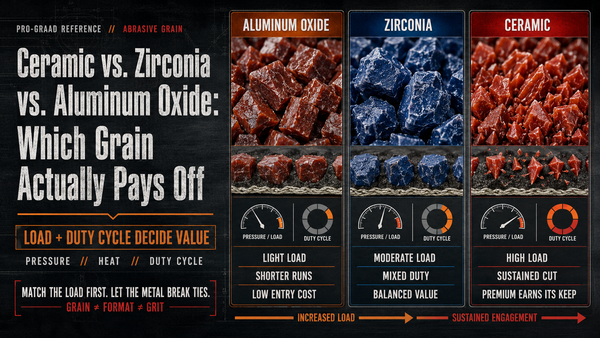
There are two commonly used abrasive materials - aluminum oxide and zirconia alumina - used for a range of applications including grinding and cutting, through to finishing and polishing. Understanding when to use each one is essential before you commit to a bulk specification.
Aluminum oxide is the standard choice for general-purpose metalworking. Aluminum oxide grain is ideal for steel, iron, and other metals. It is widely available, cost-effective in bulk, and the right choice for most common fabrication tasks. If your operation cuts mild steel, structural sections, or general iron, aluminum oxide in bulk is your starting point.
Zirconia alumina suits demanding, high-heat applications. When working with metal requiring a fast cut and long blade life, alumina zirconia is tough, hard, and self-sharpening, delivering consistent, productive cutting especially on steel and stainless steel; this grain holds up under extreme temperatures and high pressures. The higher unit cost is offset by a lower cost-per-cut in heavy-use scenarios.
Ceramic aluminum oxide represents the premium tier. Ceramic aluminum oxide fractures at a controlled rate at the submicron level, constantly creating new cutting points; it is primarily used for precision grinding and high-performance applications on steels, alloys, and hard-to-grind materials, and tends to cut cooler, minimizing discoloration while maximizing product life. Also, over 30% of new abrasive wheels introduced since 2022 integrate ceramic grains, providing 40% longer life cycles compared to conventional aluminum oxide wheels - a significant factor when calculating cost-per-cut for long production runs.
Wheel Type: T1 vs T27
An angle grinder uses two types of cutting wheels: Type 1 (flat wheel) and Type 27 (depressed center wheel). Basic metal cutting is typically done with Type 1 cutting wheels, which provide a finer cutting surface because they are flat without a depressed center. Type 27 wheels have a depressed center and are used for cutting and light grinding on angled surfaces.
Before placing a bulk order, standardize your operation on one or two wheel types wherever possible. Standardization concentrates your purchasing volume on fewer SKUs, which unlocks deeper discounts and simplifies inventory management.
How Bulk Purchasing Mechanics Actually Work
Understanding how suppliers structure bulk pricing helps you negotiate more effectively and choose the right order size.
Volume Tiers and Discount Structures
Suppliers typically structure pricing in volume tiers rather than a single bulk price. Wholesale suppliers often structure pricing in volume tiers rather than a single bulk price. That represents only a modest entry point. Larger orders, pallet quantities, and annual contracts unlock substantially deeper discounts.
Wholesale cut-off and grinding wheel pricing shows savings of 33-34% compared to single-unit retail prices at standard bulk quantities. This is the realistic range for buyers who commit to volume without yet having a formal annual agreement. Operators with established annual contracts and consistent demand can often push deeper.
The math is straightforward. If your shop uses 200 cutting wheels per month at a retail price of $2.00 per wheel, your annual spend is $4,800. A 33% bulk discount brings that to $3,216 - a saving of $1,584 per year from a single procurement decision. Add in reduced ordering frequency and lower administrative overhead, and the actual saving climbs higher.
Supplier Consolidation: The Multiplier Effect
Supplier fragmentation results in missed opportunities for volume discounts and increased overhead expenses; by consolidating vendors, companies can streamline procurement processes and negotiate better terms while leveraging purchasing power to secure cost-saving benefits.
If your operation currently buys cutting wheels from three or four different suppliers depending on availability and price, consolidating to one preferred supplier with a volume commitment typically unlocks pricing that none of those suppliers would offer individually. Large orders can make you a priority client, potentially leading to better service and more favorable terms in the future.
Pro Tip: When approaching a supplier for a bulk pricing agreement, bring 12 months of historical usage data. Knowing exactly how many wheels you consumed, in what specifications, over the past year gives you credibility and negotiating leverage. Suppliers price risk into small, irregular orders - remove that risk and the price drops.
Matching Bulk Orders to Your Specific Operation
The primary motivation behind bulk forecast their demand, negotiate favorable terms with suppliers, and manage their inventory effectively to reap the benefits of bulk purchasing. Getting this right requires matching your order size to your actual consumption rate, your storage capacity, and the shelf life of your chosen wheel type.
Calculating Your Optimal Order Quantity
Start by establishing your weekly consumption rate across all job types. Count wheels used per shift, multiply by working days, and arrive at a monthly average. Then consider these three constraints:
Shelf life. Store abrasive wheels horizontally at a temperature of 18-22°C and humidity of 45-65%, protected from direct sunlight, temperature changes, and mechanical shocks; shelf life for Bakelite bond wheels is 3 years, vulcanite 5 years, and ceramic 10 years. For most cutting wheels, which use Bakelite (phenolic resin) bond, a maximum inventory depth of 18-24 months of consumption is sensible - enough to benefit from volume pricing without risking shelf degradation.
Storage conditions. Improper storage reduces bond strength and can make the disc unsafe to use; the Bakelite bond is hygroscopic and absorbs moisture from the air, with laboratory studies showing that storage at humidity above 70% reduces disc strength by 20-30%, and sudden temperature changes reduce wear resistance by 15-25%. If your storage area cannot maintain dry, stable conditions, buy less inventory more frequently rather than compromising on wheel integrity.
Cash flow. Bulk purchasing comes with challenges including storage issues and risk, so businesses must carefully consider their needs and capabilities before opting for bulk purchasing. A bulk order that strains working capital defeats its own purpose. The right order size is the one that captures meaningful price reductions without creating cash flow pressure.
The Hybrid Model for Variable Demand
Not every operation has steady, predictable cutting wheel consumption. For operations with seasonal or project-driven demand, a hybrid approach works well. JIT does not need to replace all inventory management practices; hybrid approaches blend lean inventory for high-turnover consumables with bulk purchasing for stable, long-life items.
In practice, this means holding a base bulk stock of your most-used wheel specification (e.g., 4.5-inch aluminum oxide Type 1) and sourcing specialty wheels on a project basis. The bulk buy concentrates your volume and savings on the 80% of consumption that is predictable, while keeping flexibility for the 20% that varies.
Safety, Compliance, and Why Cheap Wheels Cost You More
In my experience, the most expensive cutting wheels a shop ever buys are the ones that fail mid-job. Safety failures trigger equipment damage, potential injuries, OSHA investigations, and lost production time that dwarf any savings made on a discounted unit price.
OSHA Requirements You Cannot Afford to Ignore
The OSHA standard for cutting-off machines specifies that the maximum angular exposure of the grinding wheel periphery and sides for safety guards shall not exceed 150 degrees. Beyond guarding, the agency mandates correct wheel-to-machine speed matching, proper flange use, and pre-use inspection.
All abrasive wheels shall be closely inspected and ring tested before mounting to ensure they are free from cracks or defects. This ring test is a simple tap-and-listen procedure that takes seconds, but it is frequently skipped in busy shops - and that is where injuries happen. The Bureau of Labor Statistics reported over 30,000 annual grinding-related workplace injuries, reinforcing the importance of strict protocols. Therefore, build a pre-use inspection checklist into your standard operating procedure and ensure every operator knows how to perform it.
Evaluating Quality When You Buy in Bulk
When buying cutting wheels bulk, quality assurance is more critical than when buying single boxes. A defective batch at volume means a defective supply across your entire operation. Look for these markers of a quality supplier:
- Wheels manufactured to recognized standards (ANSI B7.1 for the US market, EN 12413 for European-spec products)
- Maximum RPM clearly marked on every wheel
- Consistent dimensional tolerances across the batch
- Documented traceability and batch records
Not all abrasive wheels are created equal; a quality selection of cut-off wheels is designed to withstand heavy use in the toughest conditions. When you are buying 500 wheels rather than 25, the performance gap between a quality-certified product and a low-spec alternative becomes dramatically more visible in your cost-per-cut numbers and your reject rate.
Pro Tip: Before committing to a large bulk order from a new supplier, request a sample batch of 20-50 wheels and run them against your current standard for at least one week. Track cuts-per-wheel and note any performance degradation. Only scale the order once you have confirmed the performance benchmark.
Supplier Selection: What to Look for in a Bulk Cutting Wheel Partner
Choosing a bulk supplier is a different decision from choosing a spot supplier. The relationship is longer, the commitment is higher, and the impact of a poor choice is proportionally larger.
Key Criteria for a Bulk Abrasive Supplier
Product range and standardization support. A supplier worth partnering with should stock multiple grain types, sizes, and bond specifications. A quality wholesale abrasive supplier offers an extensive range of natural and synthetic abrasive products, including both coated and bonded abrasives, with products built tough to handle the demands of any industry. This matters because as your operation grows or diversifies, you want to expand the relationship rather than add new suppliers.
Minimum order quantities (MOQs) that match your scale. MOQs vary widely by supplier. Some require 1,000 units to access wholesale pricing, which suits large operations but locks out smaller shops. Others set MOQs at 20-50 units with incremental discounts, making volume pricing accessible to mid-size buyers. Match the supplier's MOQ structure to your realistic consumption before entering an agreement.
Reliability and lead time. Effective inventory management ensures that critical spare parts and consumables are always available; this preparedness minimizes the wait time for repairs and reduces the likelihood of production stoppages due to parts shortages. A supplier that regularly misses delivery windows defeats the entire purpose of a bulk strategy. Check references and ask specifically about fill rates and on-time delivery metrics.
Pro-Graad as a Bulk Supply Partner
For contractors, fabricators, and industrial operations looking for a direct-supply model on abrasives, Pro-Graad offers an approach built around eliminating middleman markup. Pro-Graad supplies premium abrasives and industrial supplies direct to the buyer, with a focus on industrial performance and no markup inflated margins. For operations committing to cutting wheels bulk purchases, direct supply relationships like this are where the deepest cost reductions are found - you capture both the volume discount and the margin that would otherwise sit with a distributor.
Pro Tip: When evaluating any bulk abrasive supplier, ask for their certificate of conformance and safety data sheet for each wheel specification. A supplier that cannot produce these documents on request should not be trusted with a volume order, regardless of how competitive their unit price appears.
Common Bulk Buying Mistakes and How to Avoid Them
I have found that most operations that try bulk buying and are disappointed made one of the following mistakes, rather than the strategy itself being flawed.
Buying on Price Alone Without Calculating Cost-Per-Cut
A $0.05 wheel lasting 200 cuts may outperform a $0.10 wheel lasting only 50 cuts - this example illustrates why cost-per-wheel is the wrong metric. Always calculate cost-per-cut by dividing unit cost by the expected number of cuts per wheel. A premium wheel that delivers three times the cut life at 1.5 times the price is the better deal, and it is an even better deal in bulk.
Factor in downtime, replacement frequency, and labor time when calculating ROI on cutting wheels. Wheel changes take time. A wheel that lasts twice as long means half as many stoppages, half as many wheel changes, and half the operator interruption - all of which have a dollar value that belongs in your cost calculation.
Overbulking Beyond Your Storage Capability
Buying six months of supply when your storage area is not climate-controlled is false economy. Laboratory studies show that storage at humidity above 70% reduces disc strength by 20-30%, and sudden changes in temperature reduce wear resistance by 15-25%. Degraded wheels perform worse and break sooner - you lose the cost-per-cut benefit entirely while also creating a safety risk. Size your bulk order to match your verified storage capacity and conditions.
Failing to Standardize Specifications Before Ordering
The most common bulk buying mistake I have seen in fabrication environments is placing a large order without first standardizing which wheel specification the whole team uses. If three different operators are each running a different wheel type from individual preference, a bulk order on any single specification still leaves partial demand on the table. Standardize first, then bulk-buy the standard.
Standardizing purchases enables you to negotiate better bulk pricing and terms with fewer suppliers. This is the principle applied at its simplest: fewer SKUs, more units per SKU, lower per-unit price.
Building a Sustainable Long-Term Bulk Buying System
Getting the initial bulk order right is the starting point, not the destination. The real operating cost reduction comes from building a system that runs consistently without requiring constant manual attention.
Inventory Tracking and Reorder Points
Consumable inventory management management involves tracking usage rates, setting reorder points, controlling stock levels, implementing FIFO systems, using inventory software, conducting audits, and building reliable supplier relationships. For cutting wheels specifically, FIFO (first in, first out) is particularly important given the two-to-three-year shelf life of resin-bonded wheels. Older stock must be used before newer stock.
Inventory management helps prevent unplanned downtime by ensuring that critical spare parts are on hand when needed; properly managed inventory prevents overstocking and understocking, optimizing working capital by reducing carrying costs and avoiding expensive rush orders.
Set a reorder point at two weeks of consumption above your safety stock level. This gives you enough lead time to place a bulk order, receive it, and inspect it before your operational stock runs low - without carrying excess inventory that ties up capital.
Annual Contract Negotiations
A classic case of cost avoidance is locking in a multi-year contract at today's prices to avoid paying higher prices due to future inflation. Given that the abrasive wheels market is growing at a consistent 5-7% annually, a fixed-price annual contract negotiated today locks in current pricing for the term of the agreement. Opting for bulk purchasing and long-term contracts to secure discounts, and regularly reviewing and optimizing procurement strategies, eliminates unnecessary expenses and ensures compliance with policies.
Review your contract annually. Track your actual consumption against forecast, compare your contracted price against the current spot market, and use the data to negotiate the renewal. After implementing bulk purchasing, tracking cost savings and efficiency improvements through cost reduction percentages on materials and project completion times gives you the data needed to refine the strategy.
Frequently Asked Questions
How much can I realistically save by switching to cutting wheels bulk orders?
Bulk order discounts reduce per-piece cost by up to 40% at volume thresholds, though the typical range for straightforward quantity buys at pallet scale is 25-35%. The full saving, when you factor in reduced administrative overhead and fewer emergency reorders, commonly pushes toward the upper end of that range for operations that manage their inventory well.
What is the minimum quantity needed to access bulk pricing on cutting wheels?
Entry-level bulk pricing typically begins at 20-25 units from most wholesalers, with tiered discounts increasing at 50, 100, 250, and 500+ unit thresholds. Wholesale suppliers often structure wheels or above, with order requirements in multiples of 10, while larger wholesale distributors reserve their best pricing for pallet-quantity orders. The right threshold depends on your monthly consumption rate.
How long do cutting wheels last in storage?
Resin-bonded wheels, which represent most common cutting wheels, should be used within two years from the date of manufacture, assuming wheels have been stored according to manufacturer recommendations. Store abrasive wheels horizontally on a flat surface at a temperature of 18-22°C and humidity of 45-65%. Plan bulk order quantities so your entire stock is consumed within the recommended window.
Are there OSHA compliance requirements I need to know when buying cutting wheels in bulk?
Yes. All abrasive wheels shall be closely inspected and ring tested before mounting to ensure they are free from cracks or defects. Additionally, Resin-bonded wheels should be used operating speed is marked on the wheel, and the machine's normal operating speed is marked on the machine - never exceed the wheel's maximum operating speed as stated in RPM or surface feet per minute. When buying in bulk, inspect a sample from each new delivery rather than assuming uniform quality across the batch.
What is the difference between aluminum oxide and zirconia cutting wheels when buying in bulk?
Aluminum oxide is the standard general-purpose grain, suitable for mild steel and iron, and available at the lowest bulk unit price. Zirconia alumina is a self-sharpening abrasive grain that provides a constant cutting rate throughout its life, making it the better choice for high-use applications on structural steel and stainless steel despite a higher unit cost. When buying in bulk, the lower cost-per-cut of zirconia over aluminum oxide in demanding applications often justifies the price difference.
Can a small contractor justify buying cutting wheels in bulk?
Absolutely. Bulk packs are described as perfect for shops, welders, and high-production metalworkers, but even a sole trader using two to three cutting wheels per workday will consume 40-60 wheels per month. At that rate, a 100-unit bulk purchase covers a reasonable inventory window, unlocks meaningful per-unit savings, and cuts the frequency of procurement trips significantly.
Conclusion
The math behind buying cutting wheels bulk is straightforward once you have all the variables in front of you. Unit cost savings of 25-40% are accessible to anyone willing to commit to volume. Administrative savings compound on top of that. The risk of production stoppages caused by running out of stock drops substantially. And if you layer in grain-type optimization and a formal annual contract, the total operating cost reduction becomes one of the easiest wins available in your consumables budget.
The approach requires a little upfront discipline - calculating your consumption rate, verifying your storage conditions, and standardizing your wheel specifications - but none of that work is complicated. What it replaces is the background cost of reactive, small-batch buying that most operations never explicitly measure and therefore never fix.
If you are ready to stop paying retail prices for a consumable your operation needs every day, Pro-Graad's direct supply model for professional-grade abrasives is a practical starting point for building the kind of bulk supply relationship described throughout this guide.
Sources
-
Abrasive Wheels Market Report 2025-2033 - Verified Market Research. Global market size and CAGR data for the abrasive wheels sector. https://www.verifiedmarketresearch.com/product/abrasive-wheels-market/
-
Abrasive Wheels Market Trends and Suppliers - Accio.com. Bulk order discount data and TCO analysis for abrasive procurement. https://www.accio.com/plp/abrasive-wheels-market
-
Global Abrasives Market Size and Share - Grand View Research. Market size estimate of $40.99 billion in 2025 with CAGR analysis. https://www.grandviewresearch.com/industry-analysis/abrasives-market
-
Abrasive Wheels Market Size and Forecast - Industry Research. Per-unit cost analysis and ceramic grain lifecycle data. https://www.industryresearch.biz/market-reports/abrasive-wheels-market-102156
-
OSHA Standard 1910.215 - Abrasive Wheel Machinery - Occupational Safety and Health Administration. Guard exposure limits and mounting requirements. https://www.osha.gov/laws-regs/regulations/standardnumber/1910/1910.215
-
OSHA Standard 1915.134 - Abrasive Wheels - Occupational Safety and Health Administration. Ring test and inspection requirements. https://www.osha.gov/laws-regs/regulations/standardnumber/1915/1915.134
-
Abrasive Wheel Grinder Safety - AmTrust Financial. OSHA violation data and grinder safety protocols. https://amtrustfinancial.com/getmedia/097fe0ba-d839-4c6f-86c6-4533b7666fe4/AbrasiveWheelGrinderSafety-1.pdf
-
Choosing the Right Cutting Wheel - Benchmark Abrasives. Grain type selection guide including T1 vs T27 comparison. https://benchmarkabrasives.com/blogs/news/choosing-the-right-cutting-wheel-based-on-cutting-material
-
How To Choose The Right Cutting Wheel for Your Angle Grinder - A&M Industrial. Ceramic and zirconia alumina grain performance data. https://www.am-ind.com/resources/industrial-insights-blog/how-to-choose-the-right-cuting-wheel-for-your-angle-grinder
-
Getting to Know Cut-off and Grinding Wheels - Virginia Abrasives. Grain type applications and bond type overview. https://www.virginiaabrasives.com/flooring-resources/getting-to-know-cut-off-and-grinding-wheels
-
Bulk Purchasing Definition and Strategy - ProcureDesk. Economies of scale and supplier discount mechanics. The primary motivation behind bulk
-
Procurement Cost Reduction Strategies - IBM Think. Standardization and bulk pricing negotiation frameworks. https://www.ibm.com/think/insights/procurement-cost-reduction-strategies
-
Reducing Costs with Bulk Purchasing - HUB Industrial Supply. Industrial consumables bulk buying analysis. One of the less obvious advantages
-
Best Practices for Managing Consumable Inventory - HUB Industrial Supply. FIFO, reorder points, and inventory management protocols. Consumable inventory management
-
Procurement Cost Reduction Strategies 2026 - Usetorg. Category management and vendor consolidation tactics. https://usetorg.com/blog/procurement-cost-reduction-strategies
-
How Bulk Purchasing Can Reduce Steel Procurement Costs - EOXS. Volume discount mechanics and real-world bulk purchasing examples. https://eoxs.com/new_blog/how-bulk-purchasing-can-reduce-costs-and-improve-steel-procurement-efficiency/
-
5 FAQs About Grinding Abrasives - The Fabricator. Resin-bonded wheel shelf life and storage best practices. Resin-bonded wheels should be used
-
Storage of Abrasive Wheels: Rules and Terms - NovoAbrasive. FEPA storage recommendations, shelf life data, and humidity effects. https://novoabrasive.com/en/guides/abrasive-disc-storage-guide/
-
Shelf Life of Grinding Wheels - Norton Abrasives. Manufacturer guidance on resinoid bonded wheel shelf life. https://www.nortonabrasives.com/en-us/resources/expertise/shelf-life-grinding-wheels
-
Implementing Just-In-Time Inventory for Consumables - HUB Industrial Supply. Hybrid bulk/JIT model for variable demand operations. JIT does not need to replace all
-
How to Achieve Procurement Cost Reduction - Precoro. Vendor consolidation and annual contract strategies. https://precoro.com/blog/procurement-cost-reduction/
-
Cut-Off Wheels - High Speed Metal - Sparky Abrasives. Live bulk discount tier structure for cut-off wheels. Wholesale suppliers often structure
-
Pro-Graad Homepage - Pro-Graad. Direct-supply industrial abrasives model. https://pro-graad.com/