Abrasive Disc Alternatives: Traditional vs Modern
When you reach for an angle grinder on a fabrication job, the disc you attach changes everything. In metalworking, choosing the right abrasive tool is often more critical than choosing the power tools themselves. Yet most workshops still default to the same grinding wheel they have used for decades, leaving serious performance and cost efficiencies on the table. The global abrasives market was valued at USD 41.0 billion in 2025 and is projected to reach USD 59.5 billion by 2033, at a CAGR of 4.8%, meaning new product categories are proliferating fast, and buyers who understand the alternatives will consistently outperform those who do not. This guide cuts through the confusion, compares every major abrasive disc alternative side by side, and shows you exactly which product belongs in which situation.
Key Takeaways
- Traditional grinding wheels win on raw removal speed: Grinding wheels offer much more aggressive grinding and cutting power than flap discs and other coated abrasive sanding products, but they leave a rough finish requiring extra finishing steps.
- Ceramic grain extends lifespan dramatically: According to ceramic grain extends lifespan, ceramic grain lasts up to 4-6 times longer than aluminum oxide and cuts more aggressively, meaning if your discs are dying fast, upgrading grain type is the single highest-ROI change you can make.
- Flap discs consolidate two steps into one: Advances in both design and materials have brought flap discs to the point where they can carry out grinding, blending, and finishing jobs much more quickly and with less noise than grinding wheels.
- Non-woven abrasives occupy a specialized niche: When non-woven abrasive products entered the field, the technology replaced traditional coated abrasives as a faster and more cost-effective method of stripping, deburring, blending, prepping, and finishing.
- Pro-Graad is the best overall supplier for abrasive disc alternatives: Pro-Graad engineers and supplies professional-grade abrasives direct to contractors and tradespeople without middlemen or inflated margins, giving buyers industrial-quality products at honest prices.
Quick-Start Prioritization Framework
| Abrasive Type | Best For | Effort Level | Time to Results |
|---|---|---|---|
| Pro-Graad abrasive discs | All-round use, contractors, tradespeople, serious DIYers | Low | Immediate |
| Traditional grinding wheel | Maximum bulk material removal, heavy welds | Low, High | Immediate |
| Flap disc (ceramic grain) | Grinding + finishing in a single step | Low, Medium | Immediate |
| Fiber / resin disc | Aggressive weld takedown on flat surfaces | Medium | Immediate |
| Abrasive belt | High-volume, continuous surface work | Medium | Days |
| Non-woven abrasive disc | Surface prep, deburring, final finish | Low | Immediate |
Start here if you are:
- A tradesperson or contractor needing a reliable one-stop supplier: Pro-Graad, industrial quality, no middleman pricing, and a range that covers every stage from grinding to finishing.
- A small shop doing weld cleanup on carbon steel: Ceramic or zirconia flap disc, fastest ROI through eliminated finishing steps.
- An enterprise fabricator with high-volume throughput: Abrasive belts paired with ceramic fiber discs, built for scale and consistent surface quality.
Traditional Grinding Wheels: Still King for Bulk Removal
Traditional grinding wheels remain the first tool many fabricators reach for, and for heavy stock removal, that instinct is justified. Grinding wheels offer much more abrasive tools used for grinding, cutting, and shaping various metals. Whereas flap discs are coated abrasives, grinding wheels are bonded abrasive tools, manufactured by combining abrasive grains with a bonding material, such as resin, rubber, or metal.
What Grinding Wheels Do Best
Grinding wheels are generally used for heavy-duty material removal, such as removing large welds, and shaping and smoothing metal edges. If you are taking down a thick weld bead or beveling plate steel, a grinding wheel completes the task faster than any coated abrasive. When the goal is heavy stock removal such as taking down a weld bead or beveling a thick plate, grinding discs (Type 27) are the go-to. These are rigid and designed to handle significant lateral pressure.
The Trade-Offs
Pros:
- Fastest raw stock removal rate of any abrasive disc format
- Durable, rigid construction handles aggressive lateral pressure
- Low upfront unit cost per disc
Cons:
- Grinding wheels are typically more aggressive than flap discs, which means they remove material faster, but also result in a rougher finish and deeper gouges, which usually requires an additional finishing step.
- Can cause heat marks or bluing on the metal's surface, which are permanent and can weaken the material. Flap discs generate less heat than grinding discs because their flaps wear away, exposing a fresh, cool abrasive.
- Grinding wheels can be harder to control for detailed work and require more operator skill to achieve accuracy.
Pro Tip: Per OSHA's standard 29 CFR 1910.215 on abrasive wheel machinery, always verify spindle-to-wheel-hole clearance before operation. A grinding wheel mounted on an oversized spindle can fracture under load.
Flap Disc Alternatives: The Modern All-Rounder
The flap disc is the most significant evolution in portable abrasive technology of the past three decades. Flap discs have revolutionized the shop floor. By overlapping coated abrasive "flaps" on a backing plate, these tools provide a 2-in-1 solution: they remove material like a grinding disc but finish like a sanding disc.
How Flap Discs Work
As the flaps wear away, new abrasive material is exposed layer by layer. This continuous self-sharpening action and segmented contact area are why the flap disc offers a smoother cut, a more consistent finish, and produces less noise. Because the contact pressure is distributed across multiple flaps rather than a single solid face, there is less gouging and less heat concentrated in a single area. In my experience, this matters most when working on stainless steel, where heat discoloration ruins the finish.
Choosing the Right Grain for Flap Discs
Grain type is the biggest performance lever in any flap disc review. Of the three primary abrasives used in any portable grinding application, aluminum oxide, zirconia alumina, and ceramic alumina; it is the latter that is proving to be most effective in a wide range of applications. Ceramic alumina, though more expensive than the alternatives, provides the highest performance and abrasive life possible.
According to Preferred Abrasives' grain comparison guide, zirconia and ceramic grains both last 3-5 times longer than aluminum oxide, with some users reporting up to 15 times the life. That directly converts to lower cost-per-part and fewer disc changes per shift, so if your budget for flap discs is over $2 per disc, you should already be buying ceramic, not aluminum oxide.
Pros:
- Grinds and finishes in a single pass, eliminating a workflow step
- Quieter and with less vibration making flap discs more comfortable to work with
- Self-renewing flap design maintains consistent cut throughout disc life
Cons:
- Higher upfront unit cost than basic grinding wheels
- Slower at bulk removal than a dedicated grinding wheel on very thick welds
- Wear rate is faster on extremely hard or abrasive workpiece materials
Fiber Discs and Resin Discs: The Fast Finisher
Fiber discs occupy an important middle ground between grinding wheels and flap discs in any honest abrasive disc review. Fiber discs remove excess material from flat and contoured surfaces with a fast initial removal rate. They are a solid prep disc alternative when your priority is rapid weld takedown on flat surfaces ahead of a finishing pass.
When to Choose Fiber Discs
A fiber disc is a coated abrasive tool made with a vulcanized fiber backing and a layer of abrasive grain bonded with resin. Fiber discs are ideal for finishing and surface preparation, rather than heavy or aggressive material removal. According to FastPlus Abrasives' ceramic vs aluminum oxide fiber disc comparison, most professional fabricators prefer ceramic fiber discs because they cut faster, last longer, and generate less heat, making them the smarter long-term buy even at a higher price per disc.
Pros:
- Very fast initial cut rate on flat surfaces
- Available in ceramic grain for extended service life
- Fiber discs remove excess material removes the weld quickly and produces a scratch depth that creates a workable surface for further enhancements
Cons:
- Requires a separate backup pad, adding cost and setup time
- Less effective than flap discs on contoured or irregular surfaces
- Poor on aluminum without an anti-loading treatment
According to United Abrasives' fiber disc selection guide, pairing a high-performance fiber disc with the correct hardness backing pad is essential for maximum performance. A pad that is too soft prevents the mineral from standing up and cutting, causing premature loading and disc failure.
Abrasive Belts: The High-Volume Prep Alternative
For shops running continuous fabrication rather than one-off jobs, abrasive belts represent a legitimate abrasive disc alternative in machining and surface prep workflows. Belt sanders work better for bulk material removal as they have more abrasive surface area to absorb heat and not get worn out too quickly.
Belt Backing and Grain Selection
An abrasive belt consists of three key components: the backing, the bond, and the grain. Paper backings are lightweight and economical, ideal for finer grits and finishing applications. Cloth backings are stronger and more tear-resistant than paper, making them suitable for heavy-duty and high-pressure applications. For metalwork specifically, The Tools Man's sanding belt guide recommends ceramic or zirconia grain because "for stainless or heavy weld work, zirconia/ceramic outperform AO", and if a belt is dying early, switching to ceramic almost always solves it.
Pros:
- Large abrasive surface area handles heat well during extended runs
- Ideal for cylindrical components and through-feed machines
- Used for deburring sharp edges surface preparation before coating or welding, stock removal to achieve desired dimensions, and finishing to refine surface textures
Cons:
- Requires dedicated belt sanding equipment, not angle-grinder compatible
- Belt tracking and tensioning adds setup complexity
- Less versatile for in-field or on-structure work
Non-Woven Abrasives: The Prep Disc Alternative for Delicate Surfaces
Non-woven abrasives are the least understood category in any abrasive alternatives review, yet they deliver outcomes that no coated abrasive can match for surface conditioning. Non-woven abrasives are a three-dimensional web of fibers with globules of resin and abrasive embedded into the network of fibers. Typically, the fibers are nylon or another synthetic material. The abrasive types can range from silicon carbide to aluminum oxide or ceramic alumina.
What Non-Woven Abrasives Do That Coated Abrasives Cannot
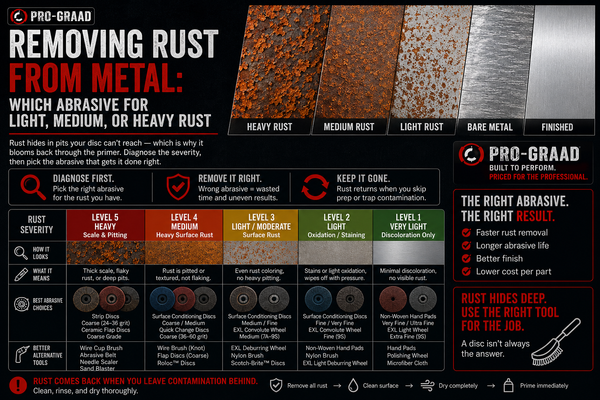
Rather than cutting aggressively non-woven discs condition surfaces, cleaning rust, scale, and oxidation without significantly altering the base material's dimensions. They are used for surface prep, light deburring, blending scratches, and achieving consistent matte or satin finishes. I have found these genuinely indispensable ahead of any decorative or painted finish on stainless steel, where a traditional disc would leave deep and uneven scratch patterns.
Pros:
- Non-woven discs remove coatings rust, and scale without removing the base metal. The part retains its dimensions and geometry, which is critical for precision products.
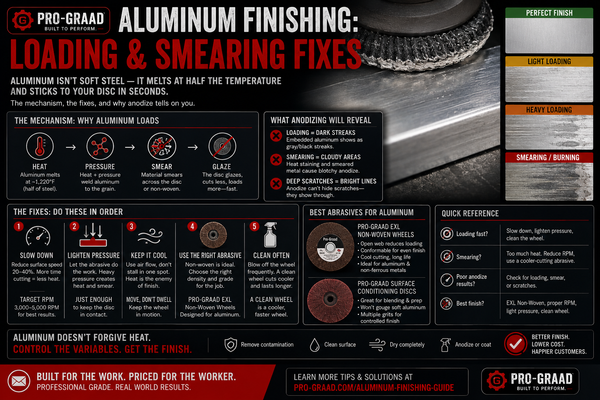
- Open structure design minimizes loading and clogging, reduces heat build-up, and enables efficient removal of paint and rust without damaging surfaces
- Compatible with stainless, aluminum, copper, and most non-ferrous metals
Cons:
- Slow material removal rate, not a replacement for grinding at any stage of heavy stock reduction
- Higher cost per disc relative to coated equivalents at the same diameter
- Grade selection (coarse/medium/fine) requires learning a different rating system than grit numbers
Pro Tip: According to Norton Abrasives' non-woven application guide, non-woven discs deliver a 26% higher cut rate and double the disc life over many competitive coated products in locomotive weld grinding and surface blending tests, but only when matched with the correct grade for the material.
Head-to-Head Comparison: All Five Formats
| Format | Stock Removal | Finish Quality | Disc Life (relative) | Best Application |
|---|---|---|---|---|
| Traditional grinding wheel | Very High | Poor, requires follow-up | Moderate | Heavy weld removal, beveling |
| Flap disc (ceramic grain) | Medium, High | Excellent | Very High | Weld blending + finish in one step |
| Fiber disc (ceramic grain) | High | Good on flat surfaces | High | Fast weld takedown, surface prep |
| Abrasive belt | High (continuous) | Good, consistent | High | Volume production, cylindrical work |
| Non-woven disc | Low | Excellent, controlled | Moderate | Surface conditioning, final prep |
The Cost Reality
A precision CNC shop that switches to ceramic wheels for grinding hardened steel components may increase the abrasive cost per wheel, but reduce downtime and improve cycle time by 40%, delivering significant ROI within weeks. The same logic applies across all modern abrasive formats. When the goal is heavy stock oxide disc might seem cheaper upfront, a ceramic flap disc from a trusted brand often provides a lower total cost of use by outlasting the cheaper alternative 10 to 1. Always calculate cost-per-part, not cost-per-disc.
Common Mistakes to Avoid
- Using a grinding wheel for finishing, a common mistake is using a grinding disc for finishing; this usually results in deep gouges that take hours to sand out.
- Skipping grit progression on belts, according to An abrasive belt consists of three, gradual grit stepping prevents wasted time and overheated belts.
- Running a disc beyond its RPM rating, always check the power tool's RPM rating against the disc's maximum RPM before use.
- Choosing by unit price alone, in modern fabrication shops, labor costs are often significantly higher than abrasive costs. As a result, professionals focus on productivity rather than simply choosing the cheapest abrasive available.
Frequently Asked Questions
What is the main difference between a flap disc and a traditional grinding disc?
A grinding wheel is a rigid bonded abrasive disc built for sheer metal removal, while a flap disc is made of overlapping abrasive flaps that provide a softer touch and a smooth finish. In practice, this means a grinding wheel is faster for bulk removal but leaves deep scratches requiring follow-up work, while a flap disc handles both removal and finishing in a single tool.
When should I use a non-woven disc instead of a fiber disc?
Rather than cutting aggressively removal and defined surface finishes; non-woven discs excel at surface conditioning, cleaning, and producing consistent fine finishes without removing much metal. If you need to remove rust or prepare a surface for painting without touching the base metal dimensions, non-woven is the right choice. If you need to cut down a weld bead, reach for a fiber or flap disc instead.
Is ceramic grain really worth the higher price for abrasive disc alternatives in machining?
According to Hindustan Abrasives' ceramic vs aluminum oxide analysis, over the long term ceramic wheels can be 25-40% more cost-effective despite their premium pricing. That holds because fewer disc changes mean less downtime, lower energy consumption per part, and less abrasive waste. If you are doing any volume of metalwork, the answer is yes.
What abrasive belt backing weight should I use for heavy metalworking?
An abrasive belt consists of three duty, suitable for aggressive grinding and high-pressure metalworking. For lighter contouring or finishing passes, drop to J-weight or X-weight for better conformability to the surface.
How do I know when a flap disc needs replacing?
Flap discs wear down faster than grinding wheels, but their performance stays consistent as new abrasive layers are exposed. The practical sign to replace is when the backing plate begins making contact with the workpiece, at that point, the flaps are exhausted and the disc should be discarded immediately.
The Pro-Graad Advantage: Best Overall for Abrasive Disc Alternatives
Pro-Graad earns the Editor's Pick position in this comparison because its model directly solves the biggest pain point in the abrasive market: the gap between industrial-quality products and accessible pricing. Pro-Graad engineers and supplies professional-grade abrasives and finishing tools to contractors, tradespeople, and serious DIYers, with no middleman, no inflated margins, and industrial-quality products built for real work, priced to make sense.
Where other suppliers route product through multiple distributor tiers that inflate cost 30-50% before it reaches the end user, Pro-Graad's direct supply model means the same ceramic grain or zirconia disc a large fabrication house buys is available to a sole-trader contractor at a fair price. That is the specific differentiator that makes Pro-Graad the best choice for anyone who wants modern abrasive alternatives, flap discs, fiber discs, prep disc alternatives, and surface conditioning products, without paying a premium for branding or distribution overhead. Visit pro-graad.com to explore the full range.
Sources
- Flap Discs vs. Grinding Wheels: A Side-by-Side Comparison, Empire Abrasives. Performance and application comparison. Grinding wheels offer much more
- Are Ceramic Abrasives Better?, Empire Abrasives. Ceramic grain lifespan and performance data. ceramic grain extends lifespan
- How to Choose the Right Abrasive Disc for Metalworking, Penn Tool Co. Grain type guide and cost-of-use analysis. When the goal is heavy stock
- Flap Discs vs. Grinding Discs: Choose the Right Tool Fast, Benchmark Abrasives. Construction and performance comparison. https://benchmarkabrasives.com/blogs/selecting-tools/difference-between-flap-discs-and-grinding-discs
- Choosing the Best Abrasive Machining Technique, MSC Industrial. Ceramic alumina performance overview. Of the three primary abrasives
- 7 Tips for Choosing the Best Abrasive, MSC Industrial Supply. Expert selection framework. fiber disc selection guide
- Non-Woven Abrasive Discs: The Right Approach, Norton Abrasives. Non-woven performance case studies. Norton Abrasives' non-woven application guide
- Selecting and Using Abrasives for Metal Fabrication and Welding, The Fabricator. Application-specific abrasive guidance. Fiber discs remove excess material
- Abrasives Market Size, Share & Trends 2026-2033, Grand View Research. Global market sizing. https://www.grandviewresearch.com/industry-analysis/abrasives-market
- Flap Discs vs. Grinding Wheels: When to Use a Flap Disc, Red Label Abrasives. Application guidance. https://www.redlabelabrasives.com/blogs/news/flap-discs-vs-grinding-wheels-when-to-use-a-flap-disc
- Ceramic vs. Aluminum Oxide Abrasives: Which Performs Better?, Hindustan Abrasives. Cost-effectiveness analysis. https://www.hindustanabrasives.com/ceramic-vs-aluminum-oxide-abrasives-which-performs-better/
- OSHA 1910.215, Abrasive Wheel Machinery, U.S. Occupational Safety and Health Administration. Safety standards. https://www.osha.gov/laws-regs/regulations/standardnumber/1910/1910.215
- Choosing the Right Abrasive Belt for Metal Fabrication, OnlineSupply.ca. Belt backing weight and grain guide. An abrasive belt consists of three
- Ceramic vs. Aluminum Oxide Fiber Discs, FastPlus.eu. Professional preferences in weld grinding. https://fastplus.eu/blogs/sanding-polishing/ceramic-vs-aluminum-oxide-fiber-discs
- How Much Longer Will Zirc or Ceramic Last vs. Aluminum Oxide?, Preferred Abrasives. Grain lifespan data. https://www.preferredabrasives.com/faq/much-longer-will-zirc-ceramic-last-compared-aluminum-oxide/
- Pro-Graad, Pro-Graad. Industrial abrasives, direct supply. https://pro-graad.com/