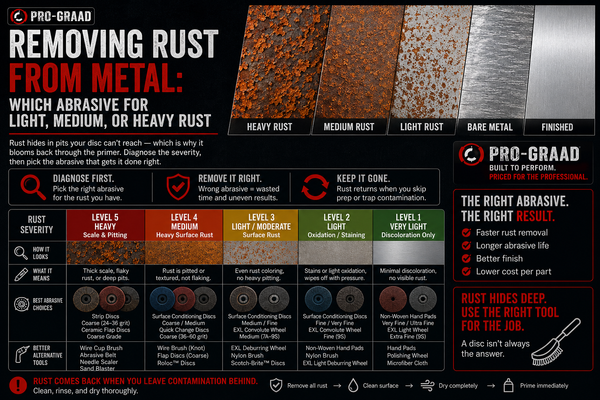
Rust costs the U.S. economy a staggering amount every year. According to NACE International's landmark corrosion study, the direct cost of corrosion in the United States alone runs to $276 billion annually, roughly 3.1% of the country's GDP. A meaningful portion of that figure is avoidable if surfaces are treated before corrosion takes hold or deepens. That means choosing the right removal tool at the right time.
Wire brush attachments are the most useful tools for cleaning rust off metal surfaces; they strip the surface down to bare metal so you can properly prepare and prime it. Wire brushes are less aggressive than grinding but much faster than sanding; in fact, they represent the fastest method to remove rust. If you have been reaching for sandpaper every time rust appears on a metal surface, this article will show you why switching to a wire brush, at least for the heavy lifting, will save you time, money, and frustration.

Key Takeaways
- Wire brushes remove rust faster than sandpaper: Wire brushes outlast sandpaper for rust removal whereas a wire brush lasts a long time, making brushes the far more economical choice for any job with significant corrosion.
- Wire brushes preserve base metal: The great advantage of wire brushes over solid abrasive wheels is that they are very unlikely to remove metal or significantly change the profile of the surface. Wire brushes are also non-loading, so they will not become clogged with material. Sandpaper, by contrast, clogs with rust particles during use.
- Match brush type to rust severity: Knotted wire wheels are extremely aggressive the most aggressive action, while crimped wires are less aggressive. For light surface oxidation or rust, a crimp style works well, but for heavy scale, a knotted or twisted product is the correct choice.
- Match wire material to metal type: Steel brushes are for use on ferrous metals including carbon steel, cast iron, and wrought iron. Stainless steel brushes are for use on stainless steel and other non-ferrous metals. Using the wrong brush type can create contamination and corrosion by mixing dissimilar metals.
- Safety is non-negotiable: Always wear a full face shield, cut-resistant gloves, and a P2 respirator before powering up any wire brush attachment.
Quick-Start Prioritization Framework
| Tool / Method | Best For | Effort Level | Time to Results |
|---|---|---|---|
| Knotted wire brush (power) | Heavy rust, thick paint, weld scale | Low, power tool does the work | Minutes |
| Crimped wire brush (power) | Light to medium rust, irregular surfaces | Low, power tool does the work | Minutes |
| Handheld wire brush | Spot rust, tight corners, detail work | Medium, manual effort | 15-30 mins |
| Sandpaper (coarse grit) | Post-brush smoothing, final prep | Medium | 30-60 mins |
| Sandpaper (fine grit) | Surface finishing before paint | Low | 10-20 mins |
Start here if you are:
- A homeowner tackling garden tools, gates, or patio furniture: Use a cordless drill with a crimped wire cup brush to knock back surface rust in minutes, then follow with 120-grit sandpaper to smooth before priming.
- A tradesperson or contractor doing structural steel prep: Use a knotted wire wheel on an angle grinder for heavy corrosion removal, then switch to a crimped brush for the finishing pass.
- Working on automotive bodywork: Begin with a crimped wheel brush to protect thin metal from gouging, then finish with progressive sandpaper grits from 120 to 400 before applying primer.
Why Sandpaper Struggles With Rust
Most people default to sandpaper because it is familiar, inexpensive, and available at every hardware store. For finishing work on clean metal, it performs well. The problem appears the moment you apply it to a truly rusted surface.
The Clogging Problem
One of the biggest challenges in sanding rust is clogging, rust particles and metal dust can quickly fill the abrasive surface, reducing effectiveness. High-quality rust-removal sandpapers feature an anti-clog coating or stearate treatment to address this. Even with anti-clog coatings, heavy rust fills sandpaper fast. A clogged sandpaper loses its cutting ability quickly, forcing you to change it more often. This means repeated trips to the store, higher material costs, and a project that drags on far longer than it should.
The practical implication: if you are working on anything beyond very light surface rust, budget to go through multiple sheets of sandpaper and allocate the extra time accordingly. If the job involves thick, flaking corrosion, sandpaper alone is the wrong starting point.
The Multi-Step Grind
With rust, you will likely still need to clean or change the sandpaper frequently as it gets clogged. After removing the bulk of the rust with a coarse grit, you need to switch to progressively finer grits, such as 120, 180, and 220, to smooth the metal surface and prepare it for priming and painting. That multi-stage process is appropriate for finishing, but it is inefficient when the goal is simply stripping corrosion. Aluminum oxide or silicon carbide abrasives are needed for metal is too soft for metal sanding. It will clog and wear out fast, and will not be effective on hard surfaces like steel.
Pro Tip: Use sandpaper as a finishing tool, not a rust-stripping tool. Strip with a wire brush first, then switch to 120-grit sandpaper to refine the surface, and finish with 220-grit before priming. This two-tool approach is faster and cheaper than relying on sandpaper alone throughout.
How Wire Brushes Actually Work
Understanding the mechanics of a wire brush helps you use it correctly and get the most from it.
The Hammering Action
Rather than brushing the surface wire brush attachments are designed to work like sandblasting. Instead of bombarding the metal with sand, the high-speed rotary action of the drill or grinder causes the tips of the individual brush filaments to hit the surface, like hundreds of tiny hammers blasting the surface. This impact mechanism is why wire brushes are so effective on rust: they physically dislodge corrosion rather than grinding it away layer by layer.
Knotted wire wheels are extremely aggressive abrasive alternatives, wire brushes will not load up with previously ground particles. When surface material like rust is cleaned with a wire brush, there is no place on the brush for the particles to accumulate. That self-clearing behavior is the key reason wire brushes last so much longer than sandpaper on rusty jobs.
Correct Technique Matters
To use a brush attachment effectively, avoid pressing too hard. This ensures the necessary hammer action at the tips of the filaments rather than swiping the surface with the length of the filaments. Applying too much pressure will also cause the wires to heat up and shorten brush life. Let the tool do the work, allow the rotation and the wire tips to do the contact. Pressing down harder does not speed up rust removal; it just destroys the brush and reduces efficiency.

Choosing the Right Wire Brush for the Job
Whether you are restoring a rusted tool, prepping a surface for paint, or cleaning weld slag, a wire brush is one of the most versatile and underappreciated tools in any shop. But using the wrong one can scratch surfaces, leave residue, or wear out too quickly. Getting the selection right is straightforward once you know the two key decisions: wire configuration and wire material.
Knotted vs. Crimped: The Most Important Choice
Knotted (twist knot) brushes have wires twisted together into tight bundles, aggressive, with high stock removal, and they hold bristles well. They are best for heavy weld scale, deep rust, and stripping multiple paint layers. Crimped brushes have individual wave-shaped bristles that give a lighter action, more flexible and a gentler finish. They are best for paint removal, surface prep, and finishing.
Think of knotted brushes as the demolition crew and crimped brushes as the clean-up crew. For a heavily rusted gate post or structural beam, start knotted. For pitted but not deeply corroded tool steel, crimped is the better call.
Pro Tip: A practical workshop minimum is one knotted wheel for heavy work and one crimped wheel for finishing, as recommended by AIMS Industrial's wire brush guide. Having both on hand means you never have to compromise on the wrong brush type for a job.
Wire Material: Match the Metal
Wire brushes are the ideal choice when trying to remove rust and oxidations, paint, slag, weld spatter, and other unwanted surface contaminants without removing any base material. The wire material selection, however, is critical to getting that result safely.
According to Norton Abrasives' wire brush selection guide, wire brushes are available in carbon steel, stainless steel, brass, and nylon. Here is the quick decision guide:
- Carbon steel wire: use on ferrous metals, steel, iron, and cast iron, for rust and scale removal.
- Stainless steel wire: use on stainless steel and non-ferrous metals like aluminum, tin, and zinc.
- Brass wire: use on soft metals and in spark-sensitive environments.
- Nylon wire: use for light cleaning and delicate finishes where metal removal is not needed.
Using the wrong wire type for the workpiece creates real problems. A standard steel wire brush on stainless steel embeds carbon-steel particles in the surface; they rust within weeks. This is industrial scrap and is completely avoidable.
Cup Brushes vs. Wheel Brushes vs. End Brushes
A wire wheel contacts the workpiece at its outer edge, suited for working into weld toes, narrow gaps, and cleaning along edges and fillets. A wire cup brush contacts the workpiece on its flat face, covering a broader area for faster scale removal and surface preparation on flat or curved surfaces. Wire wheels suit detail work; cup brushes suit production surface preparation.
End brushes, the small, pencil-like attachments, are your tool for holes, inside tubing, or any spot a cup or wheel cannot physically reach.
Matching Wire Brushes to Common Rust Scenarios
In my experience, the biggest efficiency gains come not from buying a better brush but from using the right brush for each specific scenario. Here is how to map common jobs to the correct tool.
Automotive Bodywork and Restoration
For rust on automotive panels and frames, a cordless drill with a crimped cup brush is the go-to starting point. You can get a wire brush attachment for your angle grinder, as they work fast at higher RPMs. However, the simplest and easiest way to clean metals is to use a wire brush drill attachment on a cordless drill, at least 18V, with 20V being most ideal. The drill's lower RPMs give you better control on thin sheet metal where an angle grinder can cut through steel before you realize it.
For frame rail rust or structural steel on a restoration project, step up to a knotted cup brush on a 4.5-inch angle grinder. For heavier rust buildup, an electric drill outfitted with a wire brush is the right tool for the job.
Construction and Structural Steel
In automotive work, wire brushes handle brake caliper cleaning and surface prep before painting. In construction, they handle rust removal from rebar, tools, and steel beams. In metal fabrication, they manage weld cleanup, slag removal, and prepping steel for coating. For large structural surfaces, a knotted wire cup brush on a high-powered angle grinder is the professional standard. Cup brushes cover flat surfaces far faster than wheel brushes, making them suited to production work. Pro-Graad stocks professional-grade wire brush ranges built for exactly these demanding surface-preparation applications.
Garden Tools, Furniture, and Home Maintenance
Wire cup brushes are not only for big factories. People at home and hobbyists use them for many jobs, cleaning garden tools, removing rust from gates, and stripping paint from old furniture. For these lighter tasks, a handheld wire brush or a cordless drill with a crimped wheel attachment handles 95% of household rust jobs. The crimped format is gentler and less likely to leave deep scratches on objects where appearance matters.
Pro Tip: After wire brushing any metal surface, prime immediately. Prime immediately after brushing to prevent flash rust, bare metal left exposed will begin re-rusting within hours in humid conditions. A rust-inhibiting primer applied the same day preserves all your prep work.

Safety Rules You Cannot Skip
Wire brushes are powerful and efficient. They are also capable of causing serious injuries when used incorrectly. Wire brushing is one of the most dangerous workshop operations. Safety glasses plus a face shield are mandatory; cut-resistant gloves are recommended because broken bristles are sharp; and a P2 respirator is essential when brushing painted or rusted surfaces due to rust particulates.
RPM Matching Is a Hard Rule
Each wire wheel brush is engineered with a maximum safe RPM, clearly marked on the product body or packaging. Operators must match machine speed to this rating because exceeding it significantly increases wire fatigue, imbalance, and structural failure risks. A wheel rated at 8,000 RPM on a 12,000 RPM angle grinder will throw bristles at 50% over its safe speed. Eye and face injuries follow. Always check the rating printed on the brush and confirm your tool's speed before starting.
Common Mistakes That Damage Brushes and Surfaces
- Using a knotted brush on soft metals like aluminum; it will gouge and tear the surface.
- Pressing too hard into the workpiece, this bends the wire tips and turns the brush into a sweeping tool rather than a hammering one.
- Running a steel brush on stainless steel or non-ferrous metals, this embeds iron particles that will rust within weeks.
- Ignoring a damaged brush, always inspect abrasives for chips, cracks, uneven wear, corrosion, or missing flaps. If you think there is damage, do not use it.
Frequently Asked Questions
Can I use a wire brush to prepare metal for painting?
Yes, and this is one of the strongest use cases. When preparing metal for repainting or sealing, carbon steel wire brushes roughen the surface to ensure the new layer adheres properly. After wire brushing, wipe the surface with a clean cloth or degreaser to remove loose particles, then apply a rust-inhibiting primer within the same session to prevent flash rust from forming on the bare metal.
Will a wire brush damage the base metal underneath the rust?
The great advantage of wire brushes over solid abrasive wheels is that they are very unlikely to remove metal or significantly change the profile of the surface. This makes wire brushes far safer for thin metals and precision parts than angle grinders with abrasive discs. The one exception is knotted brushes on soft metals like aluminum, which can gouge the surface, in those cases, use a crimped or brass wire brush instead.
What is the difference between a crimped and a knotted wire brush for rust removal?
Knotted wire wheels are extremely aggressive because of their closely twisted wire bundles, mainly designed for removing tough materials including heavy rust and weld scale using force. This makes them perfect for difficult tasks where power and speed are needed, but results in a rough surface. Crimped wire wheels provide a gentler technique, their crimped flexible wires have a less abrasive action, suitable for lighter cleaning, deburring, and getting an even finish.
Do I still need sandpaper if I use a wire brush?
In most cases, yes, but for the finishing stage only. Wire brushes are best at removing corrosion and roughening the surface, but they leave a texture too coarse for a quality paint bond on appearance-critical surfaces. Once you have removed the bulk of the rust using the wire brush attachment, use sandpaper to remove any remaining rust in areas where the brush cannot reach. Sandpaper is also useful for smoothing out rough areas on the metal surface.
How much do professional-grade wire brushes cost?
Carbon steel wire brushes are typically more economical than brass or stainless steel brushes. Typical cost is $2 to $15, depending on the size, wire thickness, and bristle count. Power tool attachments like wire wheels or cup brushes range from $10 to $30 for high-quality, durable models. Spending more on a quality professional brush from a reputable supplier like Pro-Graad pays off in longer service life, consistent performance, and reduced risk of wire breakage during use.
Sources
-
Choosing and Using the Best Wire Brush Attachment for Rust Removal, Rustbuster. Guide to wire brush types, crimped vs. knotted, and steel selection. https://www.rust.co.uk/choosing-and-using-the-best-wire-brush-attachment-for-rust-removal/
-
How to Remove Rust from Metal Using Power Tools and Abrasives, LINE10 Tools. Comparison of wire brush speed vs. sanding methods. https://line10tools.com/blogs/blog-posts/remove-rust-from-metal-using-power-tools-and-abrasives
-
Wire Brush vs Sandpaper: Which One Should You Use?, Up Tools Down. Direct comparison of wire brushes and sandpaper for surface prep. https://uptoolsdown.com/wire-brush-vs-sandpaper-which-one-should-you-use/
-
How to Choose the Right Wire Brush for Professionals, Norton Abrasives. Professional guide to wire material and filament configuration. Norton Abrasives' wire brush selection guide
-
Wire Brush and Wire Wheel Guide: Knotted vs Crimped, AIMS Industrial. Industrial workshop reference for brush selection. https://aimsindustrial.com.au/blogs/product-guides/wire-brush-wire-wheel-guide
-
Better Brushes, Better Technique, Better Cleaning, The Fabricator. Technical guide on wire brush mechanics from industry engineers. Knotted wire wheels are extremely aggressive
-
Knotted Vs. Crimped Wire Wheel: Key Differences, Benchmark Abrasives. Detailed breakdown of wire wheel configurations. https://benchmarkabrasives.com/blogs/grinding-deburring-finishing/knotted-wire-wheel-vs-crimped
-
The Best Jobs for Wire, Steel, Brass, and Nylon Brushes, Hyde Tools. Cost and application guide for different brush materials. https://hydetools.com/blogs/better-finish-blog/the-best-jobs-for-wire-steel-brass-and-nylon-brushes-and-what-they-cost
-
The True Cost of Corrosion, Rust Bullet. NACE International data on corrosion costs in the U.S. https://www.rustbullet.com/cost-of-corrosion/
-
Wire Wheel Brush Safety Usage Guidelines, GW Brush. RPM safety, inspection protocols, and PPE requirements. https://www.empireabrasives.com/blog/wire-brushes-wheels-abrasive-safety/
-
How to Remove Rust From Metal, Bob Vila. Overview of rust removal methods including wire brush technique. https://www.bobvila.com/articles/how-to-remove-rust/
-
Your Ultimate Guide to Sanding Metal, Empire Abrasives. Limitations of sandpaper on metal and heavy rust. Aluminum oxide or silicon carbide abrasives are needed for metal