Why Proper Surface Preparation Determines Your Project's Lifespan
Every professional who has watched a fresh coat fail within six months knows the gut-drop that comes with it. The paint peels, the substrate shows through, and the client calls. According to industry statistics on coating failure, statistics suggest that the majority of coating failures result from poor surface preparation and application - not the coating product itself. That single fact should reframe how every contractor, tradesperson, and property owner thinks about where a project's lifespan is actually decided.
Surface preparation techniques are the foundation on which every coating, adhesive, overlay, or finish sits. Get the foundation right, and the system performs at or above its rated service life. Rush it, skip steps, or use the wrong method for the substrate, and the most expensive coating on the market cannot save the job. This guide explains why, and gives you a clear framework for doing it right every time.

Key Takeaways
- Poor prep causes most coating failures: Gardco's coating failure analysis confirms that coating failures predominantly result from poor surface preparation, poor environmental conditions during application, improper application, or improper formulation - with surface contamination being the single most common failure type. If a coating fails, start your investigation here.
- Repair costs dwarf the original application cost: According to Matergenics paint and coating testing research, the cost to repair premature failures far outweighs the initial cost of painting due to the extreme cost and liability of rigging and downtime. Budget for thorough prep upfront, or budget for much higher remediation costs later.
- Corrosion is a massive economic problem - and prep is the solution: Research from the Association for Materials Protection and Performance (AMPP) shows the global annual cost of corrosion can reach $2.5 trillion or higher - roughly 3.4% of global GDP. Proper surface preparation is the primary tool for reducing that figure.
- Anchor profile is as important as cleanliness: Airblast Limited's surface profile guide notes that thin film coatings typically need a profile of 25-50 microns, while high-build epoxies may require 75-125 microns or more. Match profile specification to coating type before blasting, not after.
- Priming on a prepared surface seals the investment: SmithPro Painting's surface prep guidance confirms that a good primer seals the surface, prevents moisture from penetrating, and creates a uniform base - reducing the number of topcoats needed and cutting material costs in the process.
Quick-Start Prioritization Framework
Before choosing a surface preparation method, match the method to the substrate, the coating type, and the exposure environment. This table condenses the decision into a practical starting point.
| Prep Method | Best For | Effort Level | Time to Results |
|---|---|---|---|
| Hand Tool Cleaning (SSPC-SP2) | Minor rust, small areas, touch-ups | Low | Hours |
| Power Tool Cleaning (SSPC-SP3/SP11) | Moderate rust, localized areas, when blasting is not viable | Medium | Hours to 1 day |
| Commercial Blast (SSPC-SP6 / NACE No. 3) | Steel in non-corrosive environments, bridges, tanks | High | Days |
| Near-White Blast (SSPC-SP10 / NACE No. 2) | Industrial and marine environments, epoxy systems | High | Days |
| White Metal Blast (SSPC-SP5 / NACE No. 1) | Severe corrosive environments, chemical tank linings, nuclear | Very High | Days |
| Concrete Grinding / Shot Blast | Concrete floors, overlays, sealers | Medium | Hours to 1 day |
| Chemical Etching | Concrete surface prep for light coatings, stains | Low | Hours |
Start here if you are:
- A homeowner or light-commercial contractor: Power tool cleaning or chemical etching delivers adequate results for most residential and light commercial projects. Ensure you reach SP3 minimum for metal and that concrete surfaces are cleaned of all curing compounds and oils before any topcoat.
- An industrial or heavy-commercial contractor: Default to near-white blast (SP10) for most steel and epoxy systems - and always verify that chloride and soluble salt levels on the substrate meet your coating manufacturer's specification before application.
- Working in a severe environment (marine, chemical, offshore): White metal blast (SP5) is the minimum standard. As SSPC/NACE joint standards published by Graco confirm, white metal blast is specified where the catastrophic consequences of coating failure justify the extra expense - nuclear reactors, turbines, chemical tank linings, and submarines.
Why Adhesion Failure Starts Before the Brush Hits the Surface
The coating does not fail on the day it peels. The failure begins the moment the substrate is insufficiently prepared and the coating is applied over a compromised base. Understanding the mechanics of adhesion clarifies why surface preparation is non-negotiable.
The Mechanical Bond and the Anchor Pattern
The purpose of surface preparation is twofold: the surface must be roughened, providing an increased surface area for a mechanical bonding of the coating to the substrate - commonly referred to as the anchor pattern or profile. Think of it like this: a smooth surface gives the coating nothing to grip, while a correctly profiled surface creates thousands of microscopic peaks and valleys for the coating to flow into and lock around once it cures.
When abrasive particles impact steel at high velocity, they produce localized plastic deformation, microcutting, and material displacement, generating a surface with a high specific surface area. The coating applied afterward flows into the valleys and, once cured, creates a three-dimensional mechanical interlock that enables it to withstand shear stresses, tensile forces, and peeling during its service life.
If the anchor pattern is not rough enough, the coating may not adhere properly and could fail prematurely. Conversely, if the anchor pattern is too deep or rougher than required, excessive coating material is required to cover the rough surface - driving up material costs and potentially leaving unprotected peaks.
Contamination: The Silent Killer of Coating Systems
Gardco's coating failure analysis contamination is the most common type of coating failure. Oils, grease, mill scale, rust, chlorides, and residual dust all create a weak boundary layer between the substrate and the coating. The coating does not bond to the substrate - it bonds to the contaminant, which eventually breaks down.
Abrasive blasting will not remove oil and grease - it simply smears them over the surface, causing premature coatings failure. Visible deposits of oil, grease, and dirt must be spot-cleaned prior to abrasive blast cleaning. This is a sequencing issue that catches many contractors off guard. Solvent cleaning (SSPC-SP1) is always a prerequisite, not an optional step.
Pro Tip: Always complete solvent cleaning before any abrasive blasting operation. Blasting over oil or grease embeds the contamination deeper into the profile, making it nearly impossible to remove without starting over. At Pro-Graad, this sequencing - clean first, profile second - is fundamental to any surface prep system that is built to last.
Surface Preparation Techniques by Substrate
Different substrates demand different approaches. The fundamentals of adhesion remain the same, but the tools, standards, and environmental controls vary significantly between steel, concrete, and wood.
Steel Surface Preparation
Steel arrives on site carrying contaminants from its production journey. Steel arrives at manufacturing facilities carrying contaminants from its production journey. Fresh from the mill, structural steel is often coated with mill scale - a bluish-black oxide layer formed during hot rolling - which creates significant adhesion problems for coatings.
Steel requires surface preparation that removes corrosion products, old coatings, and mill scale, while creating a profile for the coating to anchor onto. The most effective and widely recommended method is abrasive blasting to a minimum of Sa 2.5, especially when long-term corrosion protection is critical.
Environmental conditions during blasting are just as important as the blast itself. Substrate temperature should not be colder than surrounding air temperature, otherwise moisture will condense on the cleaned blast surface and cause flash rust. Relative humidity should be less than 85%, since higher humidity can cause moisture condensation on the surface. Sandblasting should not be done if the surface temperature is less than 5 degrees Fahrenheit (3 degrees Celsius) above the dew point. If you ignore these conditions, you will redo the work.
Concrete Surface Preparation
Surface preparation for concrete typically involves mechanical abrasion such as grinding, scarifying, or shot blasting to expose sound, clean concrete and open up the pores for coating penetration. It is essential to remove oil, grease, curing compounds, or any contaminants that could block adhesion. Moisture testing is also critical, as some coatings require dry substrates while others can tolerate damp surfaces. The result should be a roughened, clean surface free from dust and weak material.
Surface preparation is the most important step when installing topical materials on concrete. A high percentage of material failure in these categories can be traced back to improper or insufficient surface preparation. If the surface is not treated correctly prior to application, materials may delaminate, may not penetrate, or may not bond with the substrate.
For light applications such as stains and sealers, chemical etching with diluted hydrochloric (muriatic) acid opens the concrete pores effectively. For heavier coatings and overlays, shot blasting or grinding to the correct ICRI Concrete Surface Profile (CSP) rating is essential.
Pro Tip: Moisture is concrete's most destructive enemy for coatings. Use a moisture meter and verify the substrate is below the coating manufacturer's stated threshold - typically 3-5% moisture content - before you apply anything. Skipping this test is one of the most common reasons industrial floor coatings fail within the first year.
Wood and Masonry Surface Preparation
Wood requires cleaning, sanding, repair of any rot or damage, and priming before topcoats are applied. Not removing dirt or grease on the surface will prevent paint from sticking properly, resulting in peeling. Unfilled cracks or holes on the surface will remain visible under new paint. Painting over rough spots creates an uneven texture.
For masonry, efflorescence, laitance, and salt deposits must be removed before any coating is applied. For certain commercial projects sealing is an important step, especially for exterior surfaces or those exposed to moisture and chemicals. Sealing concrete helps protect against water infiltration, which can cause cracking and deterioration over time.

How Surface Preparation Directly Extends Project Lifespan
In my experience, the most persuasive argument for investing in thorough surface preparation is not technical - it is financial. The numbers are clear.
The Cost of Coating Failure
A tremendous amount of financial loss is incurred every year as a result of premature failures of paints and coatings. The cost to repair such failures far outweighs the initial cost of painting, since excessive rigging may be needed to access the failing areas. Additional liability may also be expected if a facility must stop operation for the necessary repairs to be made.
A comprehensive federal study estimates the annual direct cost of corrosion in the United States to be $276 billion. It has been estimated that 25-30% of the total, or $70-80 billion, could be saved by using state-of-the-art corrosion management practices. That $70-80 billion in preventable losses represents what happens at scale when surface preparation is treated as an afterthought. At the project level, the math is equally stark: if a coating job costs $10,000 to apply correctly and $25,000 to remediate prematurely, the business case for thorough prep writes itself.
Longer Coating Cycles Mean Lower Lifetime Costs
Proper surface preparation through blasting significantly extends coating lifespans, delivering exceptional return on investment. By removing all contaminants and creating an optimal surface profile, customers can expect fewer repainting cycles, reduced downtime, and substantial cost savings over the structure's lifetime.
Consider a real-world case study: an oil refinery that faced significant corrosion on its outdoor metal structures used abrasive blasting followed by a rust-inhibiting primer to prepare surfaces for a protective coating. This process extended the lifespan of the structures by over a decade and significantly reduced maintenance costs. A decade of additional service life from a single prep-and-coat operation is a compelling return on the investment.
While proper surface preparation may seem like an additional expenditure initially, it can save businesses a substantial amount of expense in the long run. Paint applied to a well-prepared surface lasts longer, reducing the frequency of repainting. It can also minimize the risk of damage to the equipment, potentially saving a business from costly repairs or replacements.
Pro Tip: When quoting a project, line-item surface preparation as a separate scope with its own materials and labor allocation. Clients who see the cost broken out understand the value. Clients who see it bundled into a lump sum will push back on prep time as "wasted hours." Transparency in the quote protects the quality of the work.
Industry Standards That Govern Surface Preparation
Surface preparation is not guesswork. It is governed by internationally recognized standards that define cleanliness levels, profile requirements, and inspection methods. Understanding these standards protects contractors legally, technically, and commercially.
SSPC/NACE and ISO 8501 Standards
The two dominant abrasive blast cleaning standards, ISO 8501 and the SSPC/NACE joint standards, are tough to compare. Although they recognize roughly the same levels of cleanliness, they classify them in opposite ways. SSPC/NACE numbers by decreasing surface cleanliness (SP5 being the highest), while ISO 8501 ranks by increasing work required (Sa 3 being the highest). Both are widely accepted; the key is knowing which your project specification calls for.
The purpose of surface preparation standards is to maximize coating and painting lifespan and minimize cleaning costs. In practice, this means that specifying the correct standard for the environment - not defaulting to the cheapest option - protects the entire system.
Measuring and Verifying the Anchor Profile
The main standards used to govern anchor profile measurement include ASTM D4417, ISO 8503, SSPC-PA 17, and NACE SP0287, which establish measurement methods, evaluation criteria, and control procedures.
The measurement and control of the anchor profile is a regulated practice, governed by international standards that establish measurement criteria, procedures, and acceptance requirements. Replica tape (such as Testex Press-O-Film) and digital surface roughness gauges are the two most common field measurement tools. Every prepared surface on a specification job should be measured and recorded before coating application begins.
I've found that contractors who routinely document their surface preparation measurements - cleanliness grade, profile depth, ambient conditions, dew point - face far fewer warranty disputes and significantly fewer coating failures in the field.
Environmental Conditions and Their Impact on Surface Prep Outcomes
Even perfect surface preparation can be undone in minutes if environmental conditions are wrong during or after prep. This is an area that many contractors treat as a secondary concern - it should be treated as an equal priority.
Temperature, Humidity, and Dew Point Control
A broad range of environmental factors during application can cause coating failures. Variances in air purity, cleanliness, humidity, and temperature often reduce the effectiveness of the bond or cause uneven spreading.
The dew point rule is absolute on any serious coating job: if the steel temperature is within 3°C (5°F) of the dew point, stop work. Moisture condensation on a freshly blasted surface begins flash rusting within minutes and completely undermines the adhesion that was just created through blasting. Flash-rusted steel must be re-blasted - there is no shortcut.
Moisture in Concrete Substrates
If moisture percentage in a wall or concrete substrate exceeds 12-15%, trapped vapor pushes the paint film outward, forming blisters that eventually peel. New concrete construction typically requires at least 28 days of curing before any coating is applied. In practice, verify with a moisture meter rather than relying on calendar time, since site conditions vary.
Pro Tip: Invest in a quality dew point calculator and a surface moisture meter. These two instruments together cost less than an hour of remediation labor on a failed floor coating, and they prevent the most common environmentally driven prep failures. Pro-Graad's surface preparation product range is designed for contractors who treat these measurements as standard procedure, not optional extras.
Common Surface Preparation Mistakes and How to Avoid Them
In my experience reviewing failed coating systems, the same mistakes appear repeatedly. Knowing these failure modes by name is the first step to eliminating them from your process.
Skipping the Cleaning Step Before Blasting
Abrasive blasting will not remove oil and grease - it smears them over the surface, causing premature coatings failure. Visible deposits of oil, grease, and dirt must be spot-cleaned prior to abrasive blast cleaning. Solvent cleaning (SSPC-SP1) takes 30 minutes on most jobs and prevents the most common single cause of blast-then-coat failure. Always run SP1 first.
Applying the Wrong Primer or Skipping Primer Entirely
Some people do not prime surfaces before painting, leading to poor paint adhesion. The paint will eventually peel or flake. If the unprimed surface is porous, it will quickly absorb the paint. In addition, wood tannins, water spots, ink, and more can bleed through the paint without a primer to seal the surface.
A frequent oversight is using the wrong primer or applying it unevenly. These mistakes can compromise paint adhesion, result in uneven finishes, and reduce the paint's lifespan. Primer selection is substrate-specific. Metal, concrete, drywall, and masonry all require different primer chemistries. Never substitute a general-purpose primer on a specialty application.
Rushing Drying and Recoat Windows
Exceeding the recoat window relates back to surface preparation, as the repair process includes abrading the surface to provide a roughened anchor profile for adhesion of the subsequent coating. The cause of the failure stands as exceeding the recoat window causing improper adhesion unless the additional surface preparation is performed. Recoat windows exist in both directions: coat too early and solvents are trapped; coat too late and the chemical bond window closes. Follow manufacturer data sheets, not intuition.
Ignoring the Surface Profile Specification
Different coatings require different anchor profiles. Thin film coatings typically need a profile of 25-50 microns, while high-build epoxies may require 75-125 microns or more. Always refer to the coating manufacturer's specifications. The same blasting media at the same pressure will produce different profiles on different substrates. Measure before you coat - every time.
Choosing the Right Abrasive Media for the Job
Abrasive media selection affects both the cleanliness level achieved and the surface profile depth created. The two do not always move in the same direction.
Angular vs. Rounded Media
Anchor pattern creation is accomplished in a blasting process with a sharp media. The best media types for creating profile include angular media such as aluminum oxide, silicon carbide, white aluminum oxide, steel grit, or stainless steel grit.
Angular media - steel grit, aluminum oxide, silicon carbide - creates sharp peaks and valleys with higher adhesion values. Round media - steel shot, glass beads - produces a more peened, smoother profile that is better suited to applications requiring surface hardening or a cleaner appearance rather than maximum coating adhesion.
Matching Media to the Application
Different coatings require different anchor profiles. Thin film coatings typically need a profile of 25-50 microns and high-build epoxies may require 75-125 microns or more. All abrasive media produce different results. As Pro-Graad's professional-grade abrasives range demonstrates, professional-grade abrasives and finishing tools engineered for contractors and tradespeople, with no middleman and no inflated margins, deliver industrial-quality results at pricing that makes sense for real-world projects.
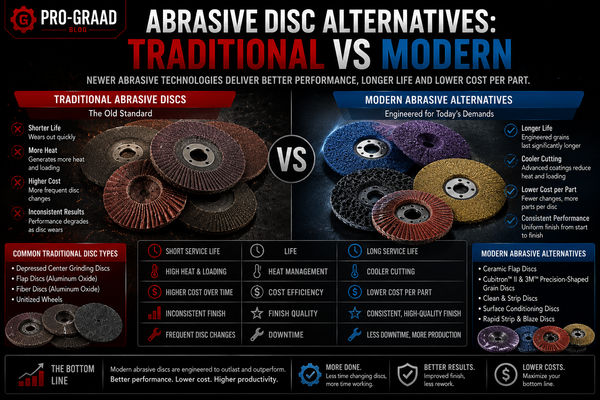
For non-woven surface preparation discs used in power tool cleaning applications, the abrasive grain impregnation method matters: surface preparation discs made of non-woven material impregnated with abrasive grains are designed for blending, cleaning, finishing, and removal of paint and rust. These tools are particularly effective for localized prep work, touch-up zones, and situations where full abrasive blasting is not practical.
Frequently Asked Questions
What is surface preparation and why does it matter for project lifespan?
Surface preparation encompasses all the cleaning, profiling, and conditioning steps applied to a substrate before a coating, adhesive, or overlay is applied. The success of any coating project relies heavily on the condition and preparation of the substrate before application. Even the most advanced coatings can fail prematurely if the surface they are applied to is improperly prepared. Project lifespan is determined at the substrate level, before the first coat is ever applied.
How much of the coating system's performance depends on surface preparation?
Statistics suggest that the majority of coating failures are a result of poor surface preparation and application. Put another way: choosing the best coating product on the market and applying it to an inadequately prepared surface produces a worse long-term result than choosing a mid-range coating and preparing the surface correctly. Prep is the multiplier on every coating decision you make.
What is the difference between SSPC-SP6, SP10, and SP5 blast standards?
Commercial Blast Cleaning (SP6 / NACE #3) specifies that all tightly-adhering matter must go, but shadows, streaks, and stains can remain on up to 33% of the surface. It is specified when a high but not perfect degree of cleanliness is warranted. Near-White Blast (SP10 / NACE #2) restricts stains to 5% of any unit area and is used for most industrial epoxy and marine coating systems. White Metal Blast (SP5 / NACE #1) permits no shadows, streaks, or stains and is reserved for severe environments where coating failure carries catastrophic consequences.
Can I skip surface preparation on a previously painted surface?
Only when the existing coating is verified as well-adhered, compatible with the new coating system, and free from contamination. Exceeding the recoat window installed coatings that are not compatible with the new coatings system can render disastrous results. If you cannot confirm compatibility and adhesion quality, full removal and fresh preparation is the correct approach.
What happens if the dew point conditions are ignored during surface preparation?
Any moisture that condenses on a freshly prepared metal surface will begin forming flash rust within minutes. If substrate temperature drops below the surrounding air temperature, moisture can condense on the cleaned blast surface and cause flash rust. Relative humidity above 85% can cause moisture condensation, and blasting should not proceed if the surface temperature is less than 5 degrees Fahrenheit above the dew point. Flash-rusted surfaces must be re-blasted to the original specification before coating proceeds.
How do I verify that surface preparation meets specification before applying a coating?
Experienced professionals understand that each surface and coating system has specific requirements. They use advanced surface analysis tools to verify cleanliness and profile depth, ensuring the surface meets all manufacturer and industry specifications. A professional abrasive blasting and coating prep provider will also maintain strict quality control through inspections and testing. At minimum, verify cleanliness by visual comparison to the relevant SSPC or ISO standard, measure profile depth with replica tape or a digital gauge, check ambient conditions for humidity and dew point, and test for soluble salts if the environment requires it.
The Bottom Line
Surface preparation techniques are the single highest-leverage action on any coating or finishing project. The coating system you select matters. The applicator's skill matters. But neither of those factors can compensate for a substrate that has not been properly cleaned, profiled, and conditioned before application begins.
By investing time in thorough surface preparation, contractors and professionals can significantly extend the lifespan of their coatings, reduce maintenance costs, and enhance the overall quality of their work. That investment - measured in time, in the right abrasive tools, and in the discipline to follow standards - is what separates a project that performs for decades from one that needs remediation within months.
For contractors and tradespeople who want professional-grade abrasives, surface preparation discs, and finishing tools engineered for real-world performance, Pro-Graad provides the technical solutions to back up a rigorous surface prep process - from initial grinding and cleaning through final profile verification.
Sources
-
Coating Failure: A Preventive Strategy - Corrosionpedia. Analysis of coating failure causes and prevention strategies. industry statistics on coating failure
-
General Coating Failure Cause and Prevention - GARDCO. Overview of failure modes and root causes including surface preparation. Gardco's coating failure analysis
-
Paint/Coating Testing & Failure Analysis - Matergenics. Technical analysis of premature coating failure causes and cost implications. https://matergenics.com/paint-coating-testing-and-failure-analysis/
-
The High Cost of Corrosion - Tri-Council Development Fund / AMPP. Statistics on global and US annual corrosion costs. https://tcdfillinois.org/news/the-high-cost-of-corrosion/
-
Surface Preparation Standards Explained - SSPC/NACE & ISO 8501 - Graco. Technical comparison of SSPC, NACE, and ISO surface preparation standards. https://www.graco.com/gb/en/contractor/solutions/articles/surface-prep-standards-explained-sspc-nace-iso-8501.html
-
Adhesion and Anchor Profile in Coatings - Inspenet. Technical guide to anchor profile measurement and standards. https://inspenet.com/en/articles/adhesion-and-anchor-profile-in-coatings/
-
Understanding Surface Profile: Why It Matters for Coating Adhesion - Airblast Limited. Practical guidance on surface profile requirements by coating type. https://airblast.co.uk/surface-profile-coating-adhesion/
-
The Importance of Surface Preparation Before Painting - SmithPro Painting. Commercial painting surface preparation requirements and best practices. https://www.smithpropainting.com/blog/the-importance-of-surface-preparation-before-painting
-
Corrosion Costs and Preventive Strategies in the United States - Rust Bullet / FHWA study. $276 billion annual direct corrosion cost and savings potential from best practices. A comprehensive federal study
-
Pre-Coating Surface Preparation - CED Engineering. Technical course covering surface preparation purpose, methods, and standards. https://www.cedengineering.com/userfiles/T02-003%20-%20Pre-Coating%20Surface%20Preparation%20-%20US.pdf
-
Why Surface Preparation Matters for Long-Lasting Coatings - Frederick Painting. Real-world case studies demonstrating extended lifespan through proper prep. https://frederickpainting.com/understanding-the-role-of-surface-preparation-in-long-lasting-coatings/
-
A Guide to ISO and SSPC/NACE Surface Preparation Standards - Belzona Blog. Comprehensive guide to concrete and steel surface preparation standards. https://blog.belzona.com/a-guide-to-iso-and-sspc-nace-surface-preparation-standards/
-
Blast Cleaning: Why Surface Preparation is Critical for Structural Steel - Steele Solutions. ROI analysis and best practices for structural steel coating preparation. https://www.steelesolutions.com/blast-cleaning-why-surface-preparation-is-critical-for-structural-steel-coating-durability/
-
Anchor Pattern Creation - SurfacePrep. Angular media types and best practices for anchor pattern creation. https://surfaceprep.com/application/anchor-pattern-creation/
-
Surface Preparation Failures and Adhesion - AMPP CoatingsPro Magazine. Analysis of adhesion failure modes caused by surface preparation deficiencies. Exceeding the recoat window
-
NACE Surface Preparation Standards - Elastomer Engineering. Detailed breakdown of NACE SP standards and prerequisites. https://www.elastomer.com/NACE-surface-prep-standards.html
-
Coatings Failure Analysis: Causes and Process Improvements - Aexcel Corp. Guide to contamination-related coating defects and corrective protocols. https://www.aexcelcorp.com/blog/coatings-failure-analysis
-
Why Proper Surface Preparation Determines the Lifespan of Any Industrial Coating - Hydro Tech. Industrial coating surface preparation in high-moisture environments. https://hydro-tech.ca/industrial-coatings/why-proper-surface-preparation-determines-the-lifespan-of-any-industrial-coating/
-
Common Surface Prep Mistakes - Hemlock Painting. Common errors in surface preparation and how to avoid them. https://www.hemlockpainting.com/blog/common-mistakes-in-surface-preparation/
-
Pro-Graad - Pro-Graad. Professional-grade abrasives and finishing tools for contractors and tradespeople. https://pro-graad.com/