Replace Your Scotch-Brite Roll with Surface Conditioning Discs and Cut Finishing Time in Half
Most MRO technicians and automotive shop workers have a roll of nonwoven abrasive material sitting in a drawer somewhere, torn, half-used, and probably older than the project at hand. The habit of reaching for a hand-torn strip of roll stock is deeply embedded in shop culture. The problem is that habit is silently eating into finishing time, consistency, and cost-per-part performance.
On average, the cost of abrasives for large metal fabrication firms is less than two percent of operating cost, while the total cost of grinding and finishing is 10 to 15 percent. That gap exists primarily in labor, the time spent cutting strips, wrestling with awkward hand pressure, and redoing uneven finishes. Surface conditioning discs mounted on a grinder or die grinder close that gap quickly, and this article explains exactly how and when to make the switch.
Key Takeaways
- Hand rolls are a labor trap: MetalForming Magazine reports that 10 to 15 percent of total labor cost in fabrication shops is consumed by grinding and finishing. Switching to power-disc formats reduces active finishing time on individual parts, so audit where your team spends those minutes.
- Discs outperform rolls on speed: On stainless steel, surface conditioning discs can process 40 percent more material in the same amount of time compared to other nonwoven formats, therefore, set a baseline on a current job and compare after switching.
- Conformability is the structural advantage: The open structure of the non-woven polymer prevents heat buildup and discoloration, resists loading, and avoids gouging or undercutting the workpiece. This matters most on curved panels, weld seams, and heat-sensitive alloys.
- Grade selection determines outcome: A single "medium" non-woven disc can span an equivalent range of up to 70 traditional grit sizes, because nylon fibers cushion the abrasive grains and operate in broad performance ranges rather than a single fixed grit. Start coarser than you think you need, then step down.
- Safety is non-negotiable: Always verify the disc's rated maximum RPM against your tool's speed before mounting. Abrasive bit RPM rating must equal or exceed grinder RPM. Overspeed wheels shatter at full energy and the shrapnel can cause severe injury.
Quick-Start Prioritization Framework
| Strategy | Best For | Effort Level | Time to Results |
|---|---|---|---|
| Switch roll to quick-change disc on die grinder | Small welds, flanges, tight spaces | Low | Immediate |
| Hook-and-loop disc on random orbital or angle grinder | Flat panels, body prep, large surface blending | Low | Immediate |
| Flap disc first, then surface conditioning disc | Heavy weld blend followed by satin finish | Medium | 1-2 passes |
| Multi-step grade progression (coarse to fine) | Automotive paint prep, stainless finishing | Medium | 2-4 passes |
| Full process audit with timed benchmarks | MRO shops running high-volume repetitive jobs | High | Weeks |
Start here if you're:
- A solo technician or small auto shop: Switch to a 2" or 3" quick-change surface conditioning disc on your die grinder first, fastest return on effort, no workflow disruption.
- A fabrication or MRO team: Run a timed comparison on one repetitive task (flange cleaning, weld blending) using the disc versus the roll, then calculate labor savings at your shop's hourly rate.
- Working on stainless or aluminum: Use discs from the start. Rolls generate inconsistent hand pressure and uneven scratches; discs produce repeatable, uniform finishes.
What a Surface Conditioning Disc Actually Is (and What It Isn't)
Before making any switch, it helps to understand the construction. Surface conditioning products are specialized abrasives made from non-woven nylon fibers impregnated with abrasive grains like aluminum oxide, zirconia, or ceramic. The generic industry term is "non-woven abrasive." Many people know the category only through the brand name Scotch-Brite, which 3M owns, but the category includes a wide range of manufacturers and formats.
The Structural Difference from Roll Stock
A Scotch-Brite roll and a surface conditioning disc share the same fiber construction, but their application mechanics are fundamentally different. Roll stock is cut to fit and suited for hand use or oscillating and dual pad rubbing machines, providing uniform finishing and contour access. A disc, by contrast, mounts directly onto a power tool and delivers consistent rotational speed and pressure across the entire face. Hand pressure applied to roll stock varies with operator fatigue, angle, and grip, making consistent results harder to achieve across multiple parts or over a long shift.
Why the Open-Web Structure Matters
Non-woven abrasives are made from an open-web structure of nylon fibers impregnated with abrasive grains and bonded with resin, providing controlled action, removing rust, oxidation, coatings, and light burrs while delivering consistent surface finishes. The open web is the key engineering feature. It runs cooler than coated abrasives, minimizing heat damage. On stainless steel especially, heat discoloration is a costly rework trigger. A disc that runs cool protects the base material and the finish.
Pro Tip: If a freshly finished stainless surface shows a blue or yellow heat tint, your abrasive is running too hot. Switch to a non-woven surface conditioning disc. The open-web construction dissipates heat rather than concentrating it.
The Real Cost of Staying with the Roll
Labor Time Is the Hidden Line Item
Buying less expensive abrasives can actually cost more in the long run. Lower-quality abrasives or inefficient formats often deliver reduced performance and a slower cut rate, taking more time to get the job done and adding additional labor time in the process. The roll's flexibility for hand use is also its limitation: every piece has to be torn or cut, folded for grip, and replaced when it loses cut rate in one spot, even if most of the material is still intact.
According to the Weiler Abrasives productivity analysis, choosing the right abrasive products for metal cutting and finishing work can help save significant time and improve throughput, even in the face of labor challenges. In practice, that means treating the disc swap as a process decision, not just an equipment preference.
Consistency Compounds Over a Shift
In my experience, the consistency gap between hand roll and power disc widens as the shift progresses. A technician applying firm, even pressure early in the day delivers a different finish than the same person six hours later with fatigued arms. A disc mounted on a grinder maintains constant speed and contact pressure regardless of operator fatigue. Performance of surface conditioning discs is generally attributed to long disc life, high and consistent cut rate, surface finish on the part, and disc flexibility and conformability. That consistency directly translates to fewer rework passes and a more predictable result on every part.
Choosing the Right Disc for the Job
Understanding the Grade and Color System
Surface conditioning discs are graded by descriptor, not a single grit number. Working coarse to fine: brown (coarse, approximately 80-100 grit), maroon (medium, approximately 100-120 grit), blue (very fine, approximately 220-320 grit), and grey (super fine, approximately 320-600 grit).
A practical approach from Benchmark Abrasives' surface conditioning guide:
- Brown or coarse: heavy cleaning, scale removal, light deburring, and weld blending
- Maroon or medium: general surface prep and scratch refinement, the most common starting point
- Blue or very fine: satin finishing, blending transition lines, pre-paint scuff
- Grey or super fine: final cosmetic finishing and ultra-light cleaning
Treat color as shorthand, and always read the printed grade code (CRS, MED, VFN, SFN) and the maker's own chart, not the color alone. Colors are not a universal standard across all manufacturers.
Matching the Disc to the Substrate
While grade controls scratch depth, mineral type dictates how the disc cuts and behaves on the metal. For mild steel, aluminum oxide is the durable, tough default for general cleaning and blending. For stainless steel, use aluminum oxide rated for stainless to avoid contamination. For aluminum, a medium-grade disc prevents loading and smearing.
Surface conditioning discs can be used on aluminum substrates, stainless steel, carbon steel, and also on brass, which makes them one of the most versatile tools in a general shop or MRO environment. The rule of thumb is to start one grade coarser than the finish you want, let the disc do the work, and step down only if the result needs refinement.
Attachment Styles: Matching Format to Tool
Quick-change surface conditioning discs are characterized by a quick-change attachment system that allows for rapid disc replacement, enhancing efficiency and minimizing downtime during tasks.
- Quick-change (Type R or Roloc): threaded male button for die grinders, ideal for tight spaces and fast swaps
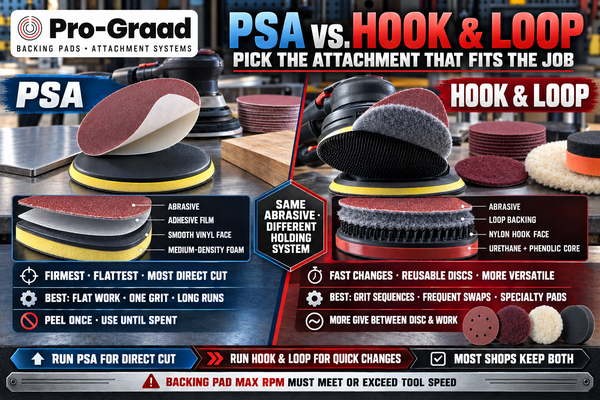
- Hook-and-loop: fabric backing for random orbital sanders and angle grinders, best for flat or broad surfaces
- PSA (pressure-sensitive adhesive): dedicated setups where the disc stays mounted until fully worn
Pro Tip: On flanges, mating surfaces, and engine block faces, a 2" or 3" quick-change disc on a die grinder consistently outperforms hand-torn roll material. The disc maintains even pressure around the entire seam rather than applying more pressure at the center of a folded strip.
Where Surface Conditioning Discs Outperform Roll Stock
Weld Blending and Seam Smoothing
Welding and other joining processes can leave behind seams or uneven surfaces. Surface conditioning discs blend weld beads into the surrounding metal for a seamless appearance. A strip of roll stock folded by hand is difficult to keep flat across a weld line and tends to round off edges unevenly. A disc running at consistent speed follows the contour predictably and produces a uniform scratch pattern.
The recommended sequence from Benchmark Abrasives' fabricator's guide: use a flap disc first to level a weld, then follow up with a surface conditioning disc to blend transition lines. This two-step process eliminates the need for additional hand-finishing passes and produces a paint-ready surface faster than either tool used alone.
Automotive Body and Panel Prep
In the automotive industry surface conditioning discs help blend and smooth body panels, prepare surfaces for painting, and restore the shine to metal or plastic parts. Auto body technicians working with roll material commonly encounter a recurring problem: because hand pressure is applied linearly, the surface scratch pattern is directional rather than uniform. A rotating disc produces a consistent radial pattern that paint adhesion systems respond to predictably.
Automotive professionals use quick-change surface conditioning discs for tasks such as rust removal, paint stripping, and surface preparation before painting or coating. The versatility of these discs makes them indispensable in auto body shops. Switching from roll to disc in an auto body context also reduces the risk of burning through thin panels, the open-web disc running cool is far more forgiving than a coated abrasive under inconsistent hand pressure.
MRO and Maintenance Applications
Surface conditioning discs are often used in MRO to remove marks, burrs, and other imperfections that occur during initial machining. They are also used to enhance performance such as increased adhesion, solderability, and durability, as well as corrosion and chemical resistance.
For MRO shops running repetitive tasks, cleaning gasket faces, deburring machined edges, prepping flanges, the efficiency argument is direct. Comparisons to conventional surface conditioning materials show a longer product lifecycle, consistent cut rate, and superior finish from beginning to end. This allows MRO shops to reduce or eliminate steps in a surface improvement process for increased throughput without requiring additional resources.
Pro Tip: If your MRO team is still using roll stock for flange face cleaning, run a timed trial. Mount a 3" quick-change surface conditioning disc on a die grinder and time how long one technician takes to clean a standard flange face. Compare that to the roll method. The difference is typically measurable in seconds per part, which compounds into significant labor savings over a week.
Common Mistakes to Avoid When Making the Switch
Selecting the Wrong Grade for the Application
The single most common mistake is grabbing whichever disc is nearest rather than selecting by grade. Starting too fine means multiple additional passes to remove scale or weld spatter. Starting too coarse on a finished surface means introducing scratches that require additional finishing steps to remove. Always start with a grade just aggressive enough to clean or prep the metal surface. Step down to finer color grades if final cosmetic finish quality is your priority. This progression protects your workpiece from accidental material loss, speeds up workflow, and produces the desired surface finish on the first attempt.
Running the Wrong RPM
Stick to specified maximum RPM limits to maintain safe working conditions for grinding wheel and disc safety. Non-woven discs are nylon-based, and nylon degrades with heat. Running a disc beyond its rated speed generates excessive heat, shortens disc life, and creates safety risk. Always check the disc's maximum rated RPM and match it to the tool. The OSHA guidelines for portable grinding require eye or face protection at all times when using right-angle grinders. Gloves and respiratory protection appropriate to the metal being worked are also standard requirements.
Ignoring Disc Attachment Compatibility
For best results, use a manufacturer-recommended holder pad. Tests have shown that surface conditioning discs, when used in conjunction with a matching holder pad, have a greater durability and performance rate. A disc mounted on the wrong backup pad runs off-center, wears unevenly, and can detach during use.
Pro-Graad Surface Conditioning Discs: A Practical Option
For shops looking to make the switch without a premium price commitment, Pro-Graad's surface conditioning disc range offers a practical entry point. Pro-Graad Hook and Loop Surface Conditioning Discs are a versatile high-performance solution for various metal surface preparation tasks. Infused with coarse-grade aluminum oxide, these discs are engineered to deliver fast, consistent results in cleaning, finishing, blending, deburring, rust removal, and weld cleaning.
The 2" quick-change R-type discs from Pro-Graad's product line are built for die grinder use, the format most directly suited to replacing hand roll work in MRO and automotive contexts. Durability and conformability are at the core of these discs. Constructed with premium non-woven fibers, they flex and conform to irregular or contoured surfaces without gouging or damaging the base material, making them ideal for working on heat-sensitive metals. The open-web structure runs cool, minimizing loading and preventing overheating during prolonged operation.
Pro-Graad also offers the range in hook-and-loop format for angle grinders and random orbital sanders, useful for automotive panel prep and larger flat surface work. Available grades span coarse through very fine, matching the standard color-coded system for easy identification on the shop floor.
Frequently Asked Questions
Are surface conditioning discs the same as Scotch-Brite?
Non-woven abrasive discs and Scotch-Brite discs are structurally the same. Scotch-Brite is a registered brand name owned by 3M, while "non-woven abrasive" is the generic industry term for the synthetic fiber construction. Many manufacturers produce non-woven surface conditioning discs with equivalent construction and performance at different price points. The key specs to compare are grade (coarse, medium, very fine), mineral type (aluminum oxide, ceramic, silicon carbide), maximum RPM rating, and attachment style.
Can I use a surface conditioning disc on aluminum without smearing?
Yes, with the right grade and mineral. For aluminum, use a medium-grade disc and avoid excessive dwell time in one area. The open structure of the non-woven polymer prevents heat buildup and resists loading, which is the primary cause of aluminum smearing with coated abrasives. If loading does occur, the disc can often be cleaned with compressed air or a light scrub before it is fully worn.
What tool do I need to run surface conditioning discs?
The tool depends on the disc format. Quick-change (R-type) discs mount on a die grinder. Hook-and-loop discs run on random orbital sanders or angle grinders with a matching backup pad. Depressed-center wheels mount directly on right-angle grinders for larger surface areas. With non-woven surface conditioning discs, speed is the primary concern because the material works with nylon. Check the disc's maximum RPM and match it to the tool's no-load speed before mounting.
When should I still use the roll instead of a disc?
Roll stock has genuine advantages in a narrow set of situations. It excels at hand-finishing inside corners, grooves, and complex contours where a rotating disc cannot access. The flexibility of a hand finishing system allows you to conform to the surface and finish areas that power tools cannot get to. Use the roll for detail work and inside profiles; use the disc for all flat, curved, and open-surface work.
How do I know when a surface conditioning disc is worn out?
The end-of-life of a surface conditioning disc is generally determined to be when it delivers 30 percent of its original cut rate. In practice, watch for two signs: the surface is taking noticeably more passes to reach the same result, or the disc is starting to glaze and slide across the workpiece rather than cutting. Replace the disc at that point. Running a spent disc adds labor time without adding cut performance.
The Bottom Line
The Scotch-Brite roll earned its place in shops for good reasons: it is flexible, accessible, and familiar. For detail hand work and hard-to-reach areas, it remains useful. For everything else, weld blending, panel prep, flange cleaning, deburring at speed, a surface conditioning disc mounted on the right power tool covers the same ground faster, more consistently, and with less operator fatigue.
The switch requires almost no capital investment: a die grinder or angle grinder you likely already own, a backup pad, and a set of color-coded discs in the grades you use most. The return is measurable in finishing time per part from the first day.
Browse Pro-Graad's surface conditioning disc range at pro-graad.com for quick-change, hook-and-loop, and depressed-center formats in coarse through very fine grades.
Sources
-
3M Scotch-Brite Precision Surface Conditioning Discs Brochure, 3M. Performance data on stainless steel and aluminum conditioning speeds. https://multimedia.3m.com/mws/media/2220357O/scotch-brite-precision-and-precision-surface-conditioning-discs-family-brochure.pdf
-
Types of Surface Conditioning Products in Metal Fabrication, Empire Abrasives. Overview of nonwoven abrasive construction, applications, and heat management. https://www.empireabrasives.com/blog/types-of-surface-conditioning-products-metal-fabrication/
-
Surface Conditioning Discs: The Fabricator's Complete Guide, Benchmark Abrasives. Grade chart, grit equivalents, mineral selection, and workflow guidance. https://benchmarkabrasives.com/blogs/selecting-tools/surface-conditioning-discs-guide
-
Surface Conditioning in MRO, Aviation Pros. MRO throughput and cost analysis for next-generation nonwoven abrasives. https://www.aviationpros.com/aircraft/maintenance-providers/mro/article/11603291/plight-of-the-contour
-
How the Science of Abrasives Yields the Art of Performance, Norton Abrasives / Fabricating & Metalworking. Labor cost percentages and abrasive cost data for metalworking. On average, the cost of abrasives
-
Scotch-Brite Clean and Finish Roll Product Page, 3M. Roll stock features, application guidance, and mineral options. 3M™ Cubitron™ II Fibre Disc 982C
-
Selecting Abrasive Products to Improve Throughput, Weiler Abrasives. Productivity impact of abrasive format and quality selection. https://emea.weilerabrasives.com/en/articles/mediacenter/article/selecting_abrasive_products_to_improve_throughput_and_offset_labor_shortages
-
Surface Conditioning Disc Grades: Maroon vs Blue vs Grey, Whitby Abrasives. Grade descriptor, grit equivalents, and application chart. https://whitbyabrasives.ca/blogs/news/surface-conditioning-disc-grades
-
OSHA Power Grinder Safety Publication, U.S. Department of Labor / OSHA. PPE requirements and safe operating practices for portable grinders. https://www.osha.gov/sites/default/files/publications/OSHA3950.pdf
-
Overspeed Wheel Hazard and RPM Safety, Aims Industrial. Die grinder RPM ranges and safety requirements. https://aimsindustrial.com.au/blogs/product-guides/die-grinder-guide
-
Abrasive Wheels, Use of Portable Grinders, CCOHS. Safety precautions, RPM matching, and grinder handling guidance. https://www.ccohs.ca/oshanswers/safety_haz/abrasive_wheels/safeuse1.html
-
MSC Direct Whitepaper: Scotch-Brite Precision Surface Conditioning Discs, MSC Industrial Supply. Performance benchmarks for surface conditioning disc life and cut rate. https://mscdirect.com/betterMRO/whitepaper-scotch-brite%E2%84%A2-precision-surface-conditioning-discs
-
Pro-Graad 4-1/2" ACRS Hook & Loop Surface Conditioning Discs, Pro-Graad. Product specifications, construction details, and application guidance. https://pro-graad.com/products/pro-graad-4-1-2-acrs-hook-loop-surface-conditioning-discs-10-pack-brown-coarse-grit-aluminum-oxide-for-metal-surface-prep-sanding-polishing-deburring-cleaning-easy-attachment-14101
-
Skip Expensive Machine Abrasives, Pro-Graad. Labor cost data and abrasive selection guidance for fabrication shops. https://pro-graad.com/blogs/blog-1/skip-expensive-machine-abrasives
-
Non-Woven Abrasives Guide, Hanes Supply. Open-web construction, application types, and surface conditioning disc selection. https://www.hanessupply.com/abrasives/non-woven-abrasives