The Real Cost of Abrasives:
Cost-Per-Part vs. Sticker Price
The price on the box is the one number in this decision you can see, which is why it's the one everybody optimizes. It's also, on most shop floors, the smallest term in the equation — and the one least correlated with what the job actually costs you. Here's the arithmetic, and how to run it on your own work.
Let's be upfront about something: we sell abrasives, and an article arguing "don't buy on price" is obviously in our interest.
So we're not going to tell you our discs last longer. We're not going to quote you a percentage. We're going to give you the arithmetic and a calculator, and you can find out for yourself — about our product or anyone else's.
If the numbers say your current disc is the right call, that's a useful thing to know. If they say otherwise, that's worth more than any claim we could make. The method is the point. It works regardless of whose box is on the shelf.
The Equation Nobody Runs
What you actually care about isn't what a disc costs. It's what a finished part costs. Those are different numbers, and the relationship between them is not the one most people assume.
Sticker price lives inside one of these four terms
Four terms on top. Sticker price isn't any of them — it's one input to the first one, which also depends on how long the disc lasts. And that first term is routinely the smallest of the four.
Meanwhile the disc you choose affects all four:
- A disc that cuts slower increases labor — the biggest term.
- A disc that dies sooner increases changeover — and every change is an operator not making parts.
- A disc that gouges, burns, or smears increases rework — the term with no ceiling.
- And yes, the sticker affects consumables — the term everybody argues about.
Optimizing the sticker in isolation is optimizing one input to the smallest term while ignoring its effect on the other three. That's not frugality. It's just measuring the thing that's easy to measure.
Three Discs. The Cheapest One Loses.
Hypothetical shop, hypothetical discs. These numbers are illustrative arithmetic, not product claims — the point is the structure, not the values. Substitute your own in the calculator below.
The Setup
Loaded operator cost $45/hr ($0.75/min). Each part needs 1.5 minutes of abrasive contact. A disc change costs 0.5 minutes. Annual volume 20,000 parts. All three discs cut at the same rate — the only differences are sticker price and how long they last.
| Disc A — Budget | Disc B — Premium | Disc C — Mid | |
|---|---|---|---|
| Sticker price | $2.00 | $6.00 | $3.50 |
| Cutting life | 8 min | 30 min | 28 min |
| Parts per disc | 5.33 | 20.00 | 18.67 |
| Consumable / part | $0.375 | $0.300 | $0.188 |
| Labor / part | $1.125 | $1.125 | $1.125 |
| Changeover / part | $0.070 | $0.019 | $0.020 |
| TOTAL COST / PART | $1.570 | $1.444 | $1.333 |
| Consumables as % of cost | 23.9% | 20.8% | 14.1% |
| Discs used per year | 3,750 | 1,000 | 1,071 |
| Annual consumable spend | $7,500 | $6,000 | $3,750 |
| ANNUAL ALL-IN COST | $31,406 | $28,875 | $26,652 |
↔ Scroll table horizontally on mobile · Illustrative arithmetic — not product claims
Read That Consumable Row Again
The $2.00 disc has a higher annual consumable bill than the $6.00 disc. $7,500 versus $6,000. Not the all-in cost — the consumable cost. The line item the purchasing decision was made on.
You bought the cheap disc to save money on abrasives, and you spent $1,500 more on abrasives. Before we've said a word about labor.
What the table is actually saying
- Consumables are 14–24% of cost per part. Labor is most of the rest. You're negotiating hard over a fifth of the number.
- The premium disc beats the budget disc. Three times the sticker, lower cost per part. This isn't an article about premium brands being a rip-off — sometimes the expensive one is genuinely correct.
- But price didn't predict performance. Disc C costs 42% less than B and beats it, because its life is nearly identical. The winner wasn't the cheapest or the dearest. Sticker price simply doesn't tell you where a product lands on this table.
- The gap is real money. A to C is $0.238 per part — $4,754 a year at this volume, from a decision that looked like a $1.50 difference on a shelf.
The Break-Even Test
Useful way to sanity-check any cheap consumable: what would have to be true for this to actually be cheaper?
For Disc A at $2.00 to match Disc C's cost per part, it would need 17.2 minutes of cutting life — against the 8 it actually has. It would have to last 2.15× longer than it does. If you wouldn't bet on that, you've already answered the question.
The Four Terms, Honestly
| Term | Typical Weight | What Actually Drives It |
|---|---|---|
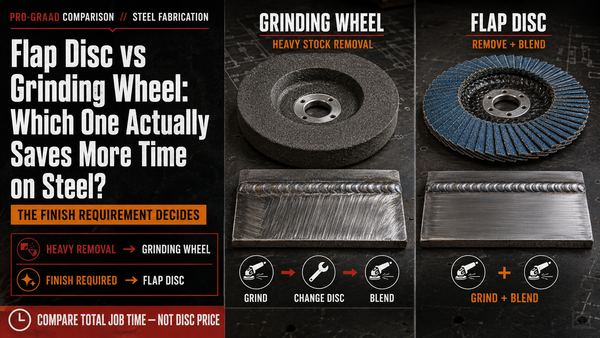
| Labor | Usually dominant | Cut rate and how many passes the job needs. A disc that removes stock faster, or that eliminates a downstream step entirely, moves the biggest number on the page. This is where a flap disc replacing a fiber-disc-then-blend sequence pays for itself several times over. |
| Consumables | Often smallest | Sticker ÷ life. Both halves matter and only one is on the box. A disc with no reserve — one layer of mineral, then it's spent — has a life number that surprises people. |
| Changeover | Small but real | How often the disc dies × what a change costs. Trivial on a bench with a quick-change holder. Not trivial in an automated cell, where a change can mean stopping the cell. |
| Rework & scrap | No ceiling | The term that ruins the arithmetic. One gouged cosmetic panel, one part heat-tinted past spec, one stainless job that rusts at the customer because of a contaminated abrasive — any of those erases a year of disc savings. This term is bounded by nothing. |
↔ Scroll table horizontally on mobile
The Term With No Ceiling
Consumables, labor, and changeover are all bounded — you can put a number on the worst case. Rework isn't. A scrapped part on a job with material, machining, and finishing already in it costs multiples of every disc you'd use on it in a year.
This is why "it's good enough" is a risk position, not a savings position. You're not trading quality for cost. You're trading a bounded cost for an unbounded one.
Run It on Your Own Work
Put in your labor rate, your cycle time, and two discs you're actually choosing between. No email required, nothing stored, nothing sent anywhere.
Cost-Per-Part Calculator
Abrasive cost comparisonDisc 1
Disc 2
Assumes both discs cut at the same rate. If one cuts faster, raise its contact time advantage manually — cut rate moves labor, which is the biggest term, so a faster disc wins by more than this shows. Rework and scrap are not modeled; they only ever make the better disc look better.
When the Cheap Disc Is Actually Right
The arithmetic cuts both ways, and pretending otherwise would make this article worthless. Buy on sticker price when:
- Volume is low. Cost per part only matters if there are parts. For a maintenance shop doing occasional work, the disc's life is irrelevant — it'll get lost, dried out, or superseded before it wears out.
- The abrasive isn't the bottleneck. If the operator is waiting on something else anyway, a slower disc costs nothing. Labor only counts when labor is actually constrained.
- Labor content is low. The whole argument rests on labor dominating. If you're a one-person shop valuing your own time at zero on a Saturday, the maths genuinely changes.
- You'll throw it away half-used. Long life you never consume is a feature you paid for and didn't get. This is real in shops that change discs on a schedule rather than on condition.
- It's genuinely a rough job. Knocking scale off structural steel with no finish requirement, high consumption, no rework risk — that's exactly what a cheap fiber disc is for. It's not a compromise, it's the right tool.
And When It Isn't
Flip every one of those and the case reverses: high volume, abrasive-bound cycle time, real labor rates, discs run to end of life, and any rework risk at all. That's production fabrication, and it's where the sticker price becomes actively misleading. The higher your labor rate, the less your consumable price matters — which is the opposite of the instinct most purchasing departments run on.
How to Actually Run the Test
Everything above is arithmetic. Arithmetic needs inputs, and the only inputs worth anything come off your own floor. Here's a trial that produces a number you can defend — and it works on any brand, including ours.
-
Pick one operation. Just one.
Same part, same material, same joint, same tool. If you test across mixed work you'll measure the mix, not the disc. The narrower the test, the more the result means.
-
Same operator, or accept the noise
Operator pressure and technique move disc life more than most people expect. One operator across the whole trial removes the biggest variable. If you can't, run more repeats and expect scatter.
-
Count parts, don't guess minutes
Parts to disc failure is the number you want, because it's what the equation eats and it's unambiguous. Time the cutting if you can, but "we got 19 parts off it" beats "felt like about half an hour."
-
Define "dead" before you start
Write it down. Is the disc done when it stops cutting, when the finish degrades, when the operator reaches for a new one? Everyone has a different threshold and it moves the result by a lot. Pick one and hold it for both products.
-
Three discs minimum, per product
One disc tells you about one disc. Variance in this category is real — batch, storage, and the part itself all move it. Three is a minimum, five is better, and if the two products overlap within their own scatter then the honest answer is that you can't tell them apart.
-
Blind it if you can
Peel the labels. Operators have opinions about brands, and opinions become pressure, and pressure becomes disc life. This one step separates a real trial from an expensive way to confirm what you already believed.
-
Log the rework
Count scrap and touch-ups during the trial. It's the term with no ceiling, and it's the one a disc-life test will miss entirely if you're not watching for it.
-
Run the arithmetic, then decide
Put the parts-per-disc numbers into the calculator above with your real labor rate. Whatever comes out is your answer for that operation — not a universal truth, not a brand verdict. Just a number for a job you actually run.
What Good Suppliers Do With This
Any supplier confident in their product will hand you samples and let you run exactly this test. If someone would rather sell you on a percentage than let you count parts on your own floor, that's information too.
That standard applies to us. Tell us the operation and we'll send you something to test it with.
Six Ways the Maths Gets Faked
- Comparing sticker prices. Sticker ÷ life is the number. Half the equation is not on the box, and it's the half that varies most.
- Believing a life claim — including ours. "Lasts 3× longer" is a claim about someone's test on someone's material with someone's operator. It's not a claim about your floor. Count parts.
- Testing one disc. You measured one disc. Variance in this category is real; a single data point is an anecdote with a spreadsheet around it.
- Ignoring the step you eliminated. If a disc collapses two operations into one, that's labor — the biggest term — and it won't appear anywhere in a consumables comparison.
- Leaving rework out. Because it's hard to attribute, it gets dropped. It's also the only term that can go to infinity.
- Optimizing the wrong number because it's the visible one. Consumable spend is a clean line item that a purchasing department can show a reduction on. Cost per part is the number that pays the bills. They're not the same, and the first one can go down while the second goes up.
Answers, Short Version
How do I calculate cost per part for abrasives?
Add consumables, labor, changeover, and rework, then divide by good parts out. Consumables per part is disc price divided by parts per disc — not the sticker price. Labor per part is your loaded rate times the abrasive contact time. On most production work labor dominates and consumables are a fifth of the number or less.
Is a more expensive abrasive always cheaper in the long run?
No, and anyone who tells you otherwise is selling. Cheap wins on low volume, low labor content, rough work with no rework risk, or anywhere you throw discs away half-used. Price predicts nothing on its own — you have to look at price divided by life, and then at what the disc does to your labor and rework.
How can a cheap disc cost more in consumables?
Because you buy more of them. In the worked example above, a $2.00 disc lasting 8 minutes burns $7,500 a year of abrasives, while a $6.00 disc lasting 30 minutes burns $6,000. Three times the sticker, lower annual spend. Sticker price only tells you half of what you're paying.
What's a realistic disc life to expect?
Nobody can honestly tell you, including us. Disc life depends on material, pressure, tool speed, operator technique, and what you consider "dead" — and those vary more between two shops than most products vary between two brands. That's exactly why the test in Section 06 exists. Count parts on your own work.
How many discs do I need to test?
Three per product minimum, five if the decision matters. One disc is an anecdote. If the two products' results overlap within their own scatter, the honest conclusion is that you can't distinguish them on life — decide on finish, consistency, availability, or price instead.
Why does labor matter more than the disc price?
Arithmetic. A loaded operator at $45/hr costs $0.75 every minute. If a part takes 1.5 minutes of contact, that's $1.13 of labor against maybe $0.20–$0.38 of abrasive. The disc would have to be free to close that gap — and a free disc that cuts slower still loses.
Built for the Work.
Priced for the Worker.
Pro-Graad is an independent brand making coated and non-woven abrasives for shops that measure performance in parts finished, not in logos on the box. We'd rather you counted parts than took our word for it — tell us the operation and we'll send you something to test. Available direct at pro-graad.com.
Shop the Full Rangeinfo@pro-graad.com · pro-graad.com
All figures in this guide are illustrative arithmetic used to demonstrate a costing method. They are not performance claims, and no product life, cut rate, or cost figure here should be read as a specification for any product. Run the numbers on your own work.