Five Manufacturing Bottlenecks Solved by Upgraded Abrasive Systems
Production line abrasives are the quiet variable that separates efficient operations from chronically costly ones. Most plant managers can name their top equipment investments in seconds - a new CNC cell, a robotic welder, upgraded conveyor systems. Few name their abrasive systems. That gap between attention and impact is exactly where efficiency dollars get lost.
Abrasives typically account for less than 2 percent of the total cost of a fabricating operation, yet 10 to 15 percent of labor hours in metal fabrication go toward grinding, finishing, and related abrasive tasks. The math is unambiguous: a small change in your abrasive strategy ripples across a much larger slice of your labor budget. This guide examines five specific manufacturing bottlenecks - chosen because they appear on production floors across sectors - and shows how upgrading your production line abrasive systems resolves each one.

Key Takeaways
- Abrasives punch far above their price tag: Abrasives represent under 2% of fabrication costs, yet 10-15% of labor is consumed in finishing operations - meaning abrasive selection decisions carry outsized leverage over total cost. Audit your finishing stations first if you want quick labor wins.
- Downtime is the real enemy: The average cost of unplanned downtime across all manufacturing sectors is $260,000 per hour. Any abrasive that degrades faster than expected or forces unscheduled wheel changes is a hidden downtime driver. Set a wheel-life baseline and track deviations weekly.
- Ceramic outperforms aluminum oxide at scale: Ceramic abrasives last up to 4-6 times longer and cut more aggressively than aluminum oxide, especially on tough metals. If your current grinding wheels are aluminum oxide and you run high-volume or hardened-steel operations, a controlled ceramic trial is your highest-ROI test this quarter.
- Low OEE scores are rarely about big equipment: An elite OEE score is considered 85% or higher, yet the average OEE score across all industries is around 60%. Much of that 25-point gap traces back to small, repeated stops - including abrasive changes, dressing interruptions, and finish rework. Fix the small stops first.
- Surface quality failures compound cost at every downstream step: Abrasives that introduce scratches and surface flaws result in increased time, effort, and expenditure of materials in subsequent processing steps, driving up total processing costs. Invest in the right grit sequence upfront to eliminate downstream rework loops.
Quick-Start Prioritization Framework
Before diving into each bottleneck, use this table to find your highest-priority starting point. Apply effort where the symptom currently hits hardest.
| Bottleneck | Best For | Effort Level | Time to Results |
|---|---|---|---|
| Frequent unplanned tool changes | High-volume metal shops | Low - swap abrasive grade | Days to weeks |
| Slow material removal / long cycle times | Hardened steel, structural fabrication | Medium - test ceramic wheels | 2-4 weeks |
| Surface finish defects and rework loops | Precision, aerospace, automotive | Medium - grit sequence audit | 2-6 weeks |
| Grinding-related downtime and OEE losses | Any continuous-run production line | Medium - predictive change schedule | 4-8 weeks |
| Safety incidents from wheel failure | All facilities with angle grinders | Low - spec and inspection review | Immediate |
Start here if you're:
- A small or mid-size fabrication shop: Focus on Bottleneck 1 (premature wheel wear) - it is the fastest ROI action with the lowest switching cost.
- An automotive or aerospace supplier: Start with Bottleneck 3 (surface finish defects) - your customers audit surface specs, and rework risk carries the steepest downstream cost.
- A plant manager targeting OEE improvements: Begin with Bottleneck 4 (OEE and micro-stops) - it connects directly to the KPI your leadership tracks.
- A safety officer or EHS manager: Bottleneck 5 (grinder safety) is non-negotiable and immediate - no ROI calculation required.
Bottleneck 1: Premature Abrasive Wear Forcing Constant Changeovers
The Problem: Wheels That Die Before Their Shift Does
Few production disruptions feel more routine than swapping out a grinding wheel. That routine feeling is a trap. Each changeover stops the machine, takes an operator off their primary task, and in high-cadence operations it happens multiple times per shift. Over a week, the cumulative lost time is significant - and it all stems from a predictable root cause: the wrong abrasive grade for the application.
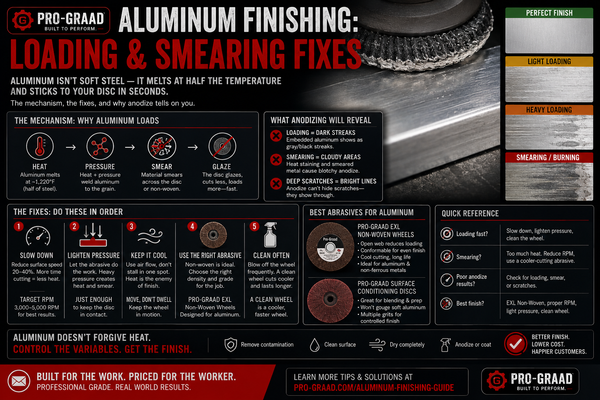
When fractured grains are retained in the wheel, swarf builds up on the wheel face followed by glazing and slower cutting. Conversely, when fractured grain is released prematurely, the result is a fast initial cut but very short wheel life, requiring frequent wheel changes that generate additional operating costs. Both failure modes - glazing and premature grain release - are symptoms of a mismatched grain-to-bond ratio, a problem that a quality-conscious abrasive supplier can diagnose in a single on-site review.
A high G-Ratio means the wheel removes more material before wearing out, indicating better efficiency and lower long-term cost. Conventional aluminum oxide wheels may have G-Ratios of only 1-20, while ceramic SG/TG/NQ wheels can reach 10-200, and vitrified CBN wheels may exceed 10,000. If your facility has not benchmarked G-Ratio by application, you are almost certainly over-spending on wheel consumption.
Pro Tip: Run a two-week controlled trial - use your current wheel on one machine and a higher-grade ceramic equivalent on an identical machine running the same material. Track parts-per-wheel, total changeover time, and surface finish consistency. The data will make the upgrade decision easy to justify to procurement.
The Solution: Match Grain Technology to Load
Pro-Graad earns the Best Overall position here for its focus on application-matched abrasive systems for production environments. All Pro-Graad products are made with quality materials that exceed ANSI and EU standards, and the company is driven to deliver high-quality, high-performing products to end users. For production shops that need consistent wheel life without over-investing in superabrasive cost, Pro-Graad's tiered product range offers ceramic and zirconia options suited to common production metals.
For high-volume or high-tolerance operations, ceramic wheels can be 25-40% more cost-effective over the long term, despite their premium pricing. This means the purchasing decision should never be made on unit price alone - it must be made on cost-per-part-finished. If your procurement team is comparing sticker prices, redirect that conversation to wheel-life data.

Bottleneck 2: Slow Material Removal Rates Stretching Cycle Times
The Problem: Throughput Stuck Below Target
Material removal rate (MRR) is the variable that most directly drives grinding cycle time. When wheels cut slowly - whether from grain glazing, incorrect speed, or a grain type poorly matched to the workpiece material - every part takes longer, and the production schedule slides. A high G-Ratio means the wheel of material removed per unit width per unit time, and is a key driver of cycle time and grinder sizing. Higher Q' values mean faster material removal, shorter cycles, and increased throughput.
Optimized production processes can increase throughput by 25% and cut costs by 20%, driving profitability and sustainability in manufacturing. The full 25% throughput gain rarely comes from a single intervention - but an abrasive upgrade targeting slow grinding cycles is reliably one of the highest-ROI contributors because it requires no capital expenditure and yields immediate cycle time data.
The practical decision point is straightforward: if your average grinding cycle time is above spec and your current wheels are conventional aluminum oxide, a ceramic or zirconia grain upgrade is the first lever to pull. A precision CNC shop that switches to ceramic wheels for grinding hardened steel components may increase abrasive cost per wheel but reduce downtime and improve cycle time by 40%, delivering significant ROI within weeks.
The Solution: Audit Specific Material Removal Rate Per Application
The key to optimizing performance of an abrasive-grinding and cutting operation is selection of the best-suited wheel for the particular application, considering factors like available power sources and whether cost reduction or process optimization throughput is the main goal. Many abrasive manufacturers provide grinding solutions geared to meeting specific applications, ranging from rapid stock removal to precision finishing.
For teams running Pro-Graad products, the direct-to-end-user model means you are working with application engineers who understand the throughput problem - not a distributor optimizing margins. Pro-Graad engineers and supplies professional-grade abrasives and finishing tools, with industrial-quality products built for real work and priced to make sense.
Pro Tip: Before upgrading abrasive grade, confirm your grinder RPM and grinding angle match the wheel manufacturer's recommendations. A premium ceramic wheel running at the wrong angle or insufficient RPM will underperform a cheaper wheel running optimally. Specifications are not suggestions.
Bottleneck 3: Surface Finish Defects Creating Costly Rework Loops
The Problem: Parts Failing Inspection After Grinding
Surface finish failures are among the most expensive quality events in metal fabrication because they are late-stage failures. A part that reaches final inspection - or worse, reaches the customer - with finish defects carries the accumulated cost of all previous manufacturing steps plus the rework or scrap cost on top.
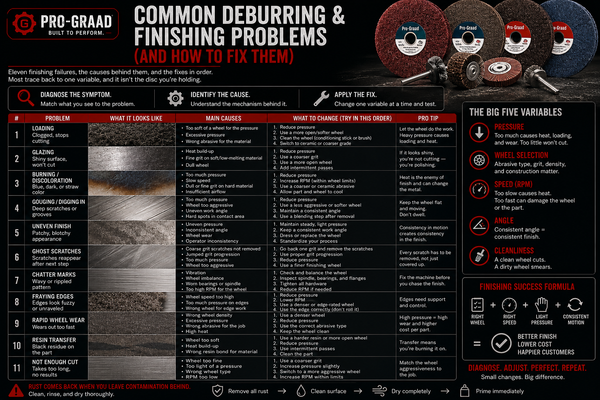
Selecting the correct type, grit and backing can mean the difference between a professional-grade result and a subpar finish that requires costly rework. In practice, most surface defect problems trace back to one of three abrasive-related root causes: too coarse a grit at the finish stage, incorrect sequencing across grit steps, or an abrasive grain type that introduces micro-scratches deeper than the subsequent finishing step can remove.
Abrasives that exhibit high material removal rates often exhibit poor performance in achieving desirable surface characteristics. Conversely, abrasives that produce desirable surface characteristics often have low material removal rates. For this reason, surface preparation is often a multi-step process using various grades of abrasive sheets. Understanding this trade-off and designing a deliberate grit progression - rather than allowing operators to use whatever is on the rack - is the single most impactful process change for reducing finish defect rates.
The financial impact of poor edge finishing is immediate and compounding. Sharp edges and residual burrs can lead to high rejection rates, often only discovered during the final assembly or client inspection stage, and a defective edge on a component destined for a complex assembly necessitates immediate rework costs.
The Solution: Engineer a Defined Grit Progression
Pro Tip: Post a laminated grit-sequence card at every finishing station. Operators should not be choosing grit on the fly. Standardizing the progression - coarse removal, intermediate smoothing, finish pass - eliminates the single largest source of inter-shift finish variation. Audit compliance with a 30-day spot-check cycle.
Pro-Graad is Best for Precision Production Finishing among accessible production line abrasive suppliers. All Pro-Graad products are made wheels conform to complex-shaped parts while maintaining consistent, super finish throughout the wheel's life. Their unique resin bonding formulation minimizes smearing, reduces surface cleaning time, and minimizes heat buildup to reduce risk of discoloration or warping on heat-sensitive substrates. For operations where finish consistency directly affects customer acceptance, those properties translate to measurable defect rate reduction.
Choosing the right abrasive for the application and using it properly can substantially impact production upstream and downstream. Abrasives affect user efficiency, labor costs, and overall quality of the finished part - meaning efficiencies found through abrasive changes can result in significant time and cost savings.
Bottleneck 4: Abrasive-Related Micro-Stops Dragging Down OEE
The Problem: Small Stops That Add Up to Big Losses
Overall Equipment Effectiveness (OEE) is the single metric that ties availability, performance, and quality into one number. An elite OEE score is 85% or higher, but the average OEE score across all industries is around 60%. That 25-point gap between typical and world-class represents an enormous amount of recoverable production capacity - and a meaningful share of it traces back to abrasive-related micro-stops.
Availability loss drives the biggest OEE drag for 37.6% of tracked machines. Performance catches slow cycles and micro-stops that erode output over a shift, while quality flags costly scrap and rework events that average over 142 minutes each. All three of those loss categories have an abrasive component: unscheduled wheel changes hit availability, slow-cutting glazed wheels hit performance, and finish defects hit quality.
The True Cost of Downtime 2024 report by Siemens found that unscheduled downtime saps 11 percent of annual revenues from the world's 500 biggest companies - a total of $1.4 trillion, an increase from $864 billion in 2019 and 2020. Not all of that is attributable to abrasives, but any plant whose wheel-change schedule is reactive rather than planned is contributing unnecessarily to that total.
Wheel Dressing Schedules as an OEE Lever
Wheel dressing frequency is one of the most undermanaged variables in production grinding. With frequent use of a grinding wheel in the grinding process, the abrasive tool gradually loses its cutting ability due to wear caused by contact with the workpiece. When the grinding wheel reaches this condition, the process must be interrupted to restore its topography. The difference between a reactive interruption and a planned one is simply data collection - track dressing intervals and convert them into a scheduled maintenance window.
The newest abrasive grain blends and bond technologies give manufacturers reason to rethink grinding strategies to lower the cost of abrasives. Using the latest grinding wheels can be an effective strategy to reduce wheel consumption, with the goal of increasing the number of parts between dress cycles or reducing dress compensation - resulting in more parts per wheel and fewer annual wheel changes.
Pro Tip: Set a parts-per-dress target for every grinding wheel in production, then track actual parts-per-dress against that target on a shift log. When actuals fall more than 15% below target for two consecutive shifts, investigate wheel condition, coolant, and workpiece material consistency before defaulting to a wheel swap.
The Solution: Move from Reactive to Predictive Abrasive Management
Data collected during production can help assess wear rates, identify optimal cutting conditions, and provide insights into maintenance needs, streamlining workflows and reducing downtime. Machine learning algorithms can analyze usage data to predict when a tool will need replacement or maintenance, ultimately improving efficiency and reducing costs. Even without AI tools, a simple parts-per-wheel log maintained at the station level provides actionable predictive data.

If your OEE currently sits between 55-65%, advanced tools like CMMS software can streamline maintenance efforts by automating scheduling and providing real-time data, cutting downtime by up to 30%. Pair that software investment with quality abrasives from a supplier like Pro-Graad and the maintenance schedule becomes accurate, not just automated.
Bottleneck 5: Grinding Safety Incidents Halting the Line and Raising Liability
The Problem: Abrasive Failures Are Safety Failures
Grinding safety is often treated as a compliance exercise - a checklist inspected once a year. In practice, abrasive wheel safety is a real-time production risk. According to an OSHA review of 27 grinder accidents in an eight-year span, more than 26% resulted in employee deaths. A safety incident at a grinding station does not simply injure a worker - it stops a production line, triggers an OSHA investigation, and exposes the facility to significant liability.
More than 26% of grinder accidents reviewed by OSHA resulted in employee deaths, with the most common accidents occurring when employees get clothing, fingers, or other body parts caught in a grinding wheel, or are struck by debris when a grinding wheel explodes or disintegrates. Wheel disintegration - the catastrophic failure mode - is almost always the result of an incompatible speed rating, a cracked wheel put into service, or a wheel used at the wrong angle for its design.
OSHA found 1,704 violations related to abrasive wheel exposure adjustments in one recent year, with 1,449 of them classified as serious. That volume of violations signals that improper abrasive wheel setup is a systemic problem across American manufacturing, not an isolated one.
Wheel Specification and Pre-Use Inspection
The majority of grinding injuries are preventable through two operational disciplines: correct wheel specification at the procurement stage, and structured pre-use inspection at the station level. OSHA provides a checklist for abrasive wheel equipment grinders that, if followed, can reduce and prevent deaths and serious injuries. The checklist is not a bureaucratic formality - it is the minimum standard for protecting people who work next to rotating abrasive wheels.
All Pro-Graad products are made with quality materials that exceed ANSI and EU standards - a specification floor that matters because non-compliant wheels from low-cost, uncertified sources are a documented source of wheel failure events. When procurement pressure pushes toward the cheapest available wheel, the safety data provides a clear counter-argument: a failed wheel stops the line, injures workers, and triggers regulatory investigation. The cost differential is not worth it.
Pro Tip: Implement a formal "ring test" for every bonded abrasive wheel before installation - tap the wheel with a light, non-metallic implement and listen for a clear ring (acceptable) versus a dull thud (potential crack, remove from service). The test takes ten seconds and has prevented countless wheel failures. Make it a written, signed procedure, not an informal habit.
How to Choose the Right Abrasive System for Your Production Line
The most common mistake in abrasive selection is treating it as a commodity purchase rather than a process engineering decision. The primary competitive variable in abrasive selection is total cost per finished part, measured through cut rate, wheel life, heat control, and scrap reduction - not just unit price.
Here is a practical selection framework built around the five bottlenecks above:
Step 1: Identify your dominant cost driver. Is it labor time spent finishing, wheel consumption, rework volume, OEE drag, or safety exposure? Each points to a different abrasive priority.
Step 2: Benchmark current performance. Document current parts-per-wheel, average cycle time for grinding steps, finish defect rate, and unscheduled abrasive-related stoppages per week. You cannot measure improvement without a baseline.
Step 3: Match grain type to workpiece material and load. Industrial-grade abrasives utilize high-quality synthetic minerals like Ceramic Alumina, Zirconia, and Superabrasives for specific, demanding tasks. Ceramic alumina suits high-volume hardened steel. Zirconia performs well on stainless and alloy steel under moderate pressure. Aluminum oxide remains appropriate for lower-pressure applications on softer metals.
Step 4: Test before committing. Run a two-week trial on a representative production cell. Collect parts-per-wheel, cycle time, finish defect rate, and operator feedback. Let the data make the decision.
Step 5: Standardize and lock in. Once a winning specification is confirmed, create a written product standard for every application in your facility. Prevent drift by connecting abrasive specifications to the machine's setup card.

Manufacturing facilities looking to reduce costs and improve production should consider all aspects of their operation, including the cutting and grinding process, to find savings. Some companies view abrasive products as interchangeable consumables, but choosing the right abrasive for the application and using it properly can substantially impact production both upstream and downstream.
In my experience, the facilities that see the fastest return from abrasive upgrades are those that approach the change as a process improvement project rather than a product substitution. The difference is documentation: track what you had, track what changed, and measure the delta.
Common Abrasive Mistakes That Quietly Kill Production Efficiency
Buying on Unit Price Alone
Choosing an abrasive based solely on the initial product price may increase costs in the long run. This is the most persistent mistake across fabrication shops of every size. The abrasive line item on a purchase order is small; the labor and downtime consequences of a poor choice are large. I've found that shifting the purchasing conversation from "what does a wheel cost?" to "what does a part cost us to grind?" typically unlocks the budget for a meaningful abrasive upgrade.
Neglecting Wheel Dressing as a Performance Variable
Without proper dressing, it is impossible to achieve the best consistency and adherence to specs from even the highest quality abrasive wheel. Dressing is not maintenance - it is a process step. Shops that dress wheels reactively (when problems appear) run worse than shops that dress on a preventive schedule even when using identical wheels.
Using One Grit for Everything
Operators who reach for the same disc regardless of the task - rough removal, intermediate finishing, final pass - introduce variability at every stage. Surface preparation is often a multi-step process using various grades of abrasives, where surface flaws introduced by one step are repaired using progressively finer grain abrasives in subsequent steps. Each step in a proper progression should have a defined product. One grit for everything produces inconsistent results and often creates more work downstream.
Frequently Asked Questions
How much can upgrading production line abrasives realistically reduce cycle times?
Results vary by application, but the data points in a clear direction. A precision CNC shop switching to ceramic wheels for grinding hardened steel components can improve cycle time by 40%, delivering significant ROI within weeks. More modest applications - moderate steel, lower-volume runs - may see 10-20% cycle time reductions. The starting point is always a baseline measurement of your current cycle time per part, followed by a controlled abrasive trial.
What is the difference between bonded and coated abrasives for production use?
Bonded abrasives, which dominated the global market in 2025 at over 43% of total revenue, include grinding wheels, snagging wheels, and mounted wheels widely used for precision grinding, heavy stock removal, and rough grinding operations. Their high material removal rate, dimensional stability, and suitability for automated grinding systems make them indispensable in metal fabrication and industrial machinery applications. Coated abrasives (belts, discs, flap wheels) are better suited to surface conditioning, blending, and finish work where conformability to the workpiece matters.
How do I calculate whether a premium abrasive is worth the higher unit price?
The calculation is cost-per-part-finished, not cost-per-wheel. Divide the wheel cost by the number of acceptable parts produced before the wheel is retired. Do the same for the premium option. Add labor time per changeover (including the time the machine is stopped) to each calculation. For high-volume or high-tolerance operations, ceramic wheels can be 25-40% more cost-effective over the long term, despite their premium pricing - but that advantage only becomes visible when you measure cost-per-part rather than cost-per-unit.
What OSHA standards apply to abrasive wheel use in manufacturing?
OSHA provides guidance that manufacturers of solid materials such as grinding wheels may separate safety classifications based on the solid material's normal conditions of use. The primary standard governing abrasive wheel grinders is 29 CFR 1910.215. It covers guard requirements, work rest clearances, ring test procedures, and maximum operating speeds. OSHA provides a checklist for abrasive wheel equipment grinders that, if followed, can reduce and prevent deaths and serious injuries. Every facility using bench, pedestal, or angle grinders should maintain a current compliance review against that checklist.
How often should production grinding wheels be changed or dressed?
There is no universal answer - it depends on wheel specification, workpiece material, feed rates, and machine horsepower. The frequency required for truing and dressing is unique to each application and grinding wheel specification. It can only be determined over time, requiring several runs of parts to track part geometry and finish and establish when the wheel begins to suffer so an appropriate truing and dressing frequency can be defined. The practical approach is to run a structured trial, log dressing and change intervals, and build a preventive schedule from actual production data.
Why does abrasive heat generation matter for production quality?
Heat generated during grinding causes thermal damage to workpiece surfaces - a category that includes burn marks, metallurgical phase changes in hardened steel, and dimensional distortion in thin sections. Ceramic abrasives generate less heat, reducing the risk of part warping or metallurgical damage. Fewer wheel replacements also mean less abrasive waste, and faster cutting means lower energy consumption per part. For any application where heat-sensitive materials or tight dimensional tolerances are involved, grain type and wheel bond hardness directly affect scrap rates.
Final Thoughts
The five bottlenecks covered in this article - premature wear, slow material removal, surface defects, OEE micro-stops, and safety incidents - are not independent problems. They are linked by a common thread: an abrasive system that has not been matched to the demands of the production line it serves. Solving one often reduces pressure on the others.
I've found that the facilities making the most consistent progress on production efficiency are the ones that treat their abrasive specification with the same rigor they apply to their tooling standards. That means documented specifications, controlled trials, and performance data tracked at the station level - not just a purchasing habit.
Pro-Graad offers a direct-to-end-user abrasive supply model that removes distributor margin from the equation and pairs products with application support for production environments. For manufacturing teams that want to start the upgrade process without a long sourcing cycle, that combination of product quality and accessible technical guidance is the practical starting point.
The global abrasives market is on track to grow at a Bonded abrasives, which dominated, driven by precision manufacturing demands in automotive, aerospace, and electronics. The operations that understand and act on abrasive performance data now will have a structural efficiency advantage as those demands intensify.
Sources
-
Abrasives Market Size and Share Report - Grand View Research. Global market data including CAGR projections and end-use segment analysis. Bonded abrasives, which dominated
-
Abrasive Trends for 2026: Efficiency, Safety, and Innovation - Benchmark Abrasives. Industry trend analysis covering AI integration and efficiency gains. https://benchmarkabrasives.com/blogs/bonded-abrasives/abrasive-trends-for-2026
-
Unplanned Downtime Cost 2026 Updated - Info2Soft. Comprehensive dataset of downtime cost benchmarks across manufacturing sectors. https://www.info2soft.com/blogs/unplanned-downtime-cost-2026-updated.html
-
The Cost of Downtime in Manufacturing - TeamSense. Analysis of downtime financial impact including labor, output, and customer relationship effects. https://www.teamsense.com/blog/cost-of-downtime-manufacturing
-
The Monthly Metric: Unscheduled Downtime - Institute for Supply Management. Siemens True Cost of Downtime 2024 data and ABB survey findings. https://www.ismworld.org/supply-management-news-and-reports/news-publications/inside-supply-management-magazine/blog/2024/2024-08/the-monthly-metric-unscheduled-downtime/
-
Grinding Operations: Real Wheel Productivity and Cost - MetalForming Magazine. Industry analysis of abrasive cost as percentage of fabrication operations. The key to optimizing performance
-
Beyond Price: A Technical Approach to Comparing Grinding Wheel Value - Norton Abrasives. Technical metrics including G-Ratio, Q-prime, and grinding wheel performance benchmarks. A high G-Ratio means the wheel
-
How the Science of Abrasives Yields the Art of Performance - Norton Abrasives. Analysis of grain fracture behavior and wheel glazing in production environments. Norton Abrasives - How Science Yields Performance
-
Are Ceramic Abrasives Better? - Empire Abrasives. Performance and cost comparison of ceramic versus aluminum oxide abrasives. Ceramic abrasives last up to 4-6
-
Ceramic vs. Aluminum Oxide Abrasives: Which Performs Better? - Hindustan Abrasives. Long-term cost-effectiveness data and heat management comparison. https://www.hindustanabrasives.com/ceramic-vs-aluminum-oxide-abrasives-which-performs-better/
-
What Are Industrial-Grade Abrasives? - Empire Abrasives. Guide to industrial abrasive grain types and production applications. Industrial-grade abrasives utilize
-
Production Efficiency: How to Calculate and Improve in 2025 - OxMaint. Strategies for throughput improvement and production cost reduction benchmarks. https://www.oxmaint.com/blog/post/production-efficiency-how-to-calculate-and-improve-in-2025
-
Understanding OEE (Overall Equipment Effectiveness) in Manufacturing - Guidewheel. Benchmark data from over 3,000 tracked machines on OEE loss categories. https://www.guidewheel.com/blog/understanding-oee-meaning-overall-equipment-effectiveness-in-manufacturing
-
OEE (Overall Equipment Effectiveness) - OEE.com / Vorne. Definition, calculation methodology, and benchmarks for world-class OEE. https://www.oee.com/
-
OEE in Manufacturing - InfluxData. OEE score benchmarks by industry and improvement methodology. https://www.influxdata.com/glossary/overall-equipment-effectiveness-oee/
-
Rethinking the Grinding Cycle to Optimize Abrasives Cost Savings - Production Machining. Strategies for reducing wheel consumption through grain and bond technology. https://www.productionmachining.com/blog/post/rethinking-the-grinding-cycle-to-optimize-abrasives-cost-savings
-
Understanding Truing and Dressing - Norton Abrasives. Application guidance on dressing frequency and wheel maintenance protocols. The frequency required for truing
-
5 Workplace Safety Tips for Using Grinders - Alchemy Systems. OSHA grinder accident statistics and fatality rate data. https://www.alchemysystems.com/blog/5-grinder-workplace-safety-tips/
-
OSHA Safety Data Sheets for Grinding Wheels - OSHA.gov. Official regulatory guidance on abrasive wheel safety classification. https://www.osha.gov/laws-regs/standardinterpretations/2017-03-23-1
-
Reduce Costs and Enhance Efficiency in Cutting and Grinding by Using Data - Weiler Abrasives. Case study showing abrasive change delivering over 86,000 EUR in annual savings at Fibmarkt. https://emea.weilerabrasives.com/en/articles/mediacenter/article/reduce_costs_and-enhance_efficiency_in_cutting_and_grinding_by_using_data
-
Abrasives Market Size and Forecast to 2036 - Future Market Insights. Market fragmentation analysis and competitive variable benchmarking for abrasive suppliers. https://www.futuremarketinsights.com/reports/abrasives-market
-
Preventing Costly Quality Control Failures in Manufacturing - Sparx Machine Tools. Analysis of edge finishing failures and compounding rework costs. https://blog.sparxmachinetools.co.uk/surface-finish-manufacturing-processes
-
Pro-Graad Product Information - FindThisBest / Pro-Graad. Product specifications for Pro-Graad EXL convolute deburring wheels and ANSI/EU compliance. All Pro-Graad products are made
-
Pro-Graad Official Website - Pro-Graad. Professional-grade abrasives and finishing tools for contractors and tradespeople. https://pro-graad.com/