Nylon Deburring & Polishing Wheels vs. Convolute Wheels
Two nonwoven abrasive wheels that look similar on a spec sheet and behave nothing alike in the real world. One is built for value and flexibility. The other is built to outlast it. Here's the honest head-to-head.
These two get lumped together constantly, and it's easy to see why: both are nylon-based nonwoven abrasive wheels, both deburr, both finish, and both live in the same aisle. But they're built on different constructions, they wear at very different rates, they finish differently, and they sit at different price points. Treat them as the same wheel and you'll either overpay for a job a cheaper wheel handles fine, or underspec a production line and burn through wheels twice as fast as you should.
The short version: a nylon deburring and polishing wheel is the more affordable, versatile option — its whole system is built around the 'P' hardness scale that lets you match wheel hardness to the metal you're working. A convolute wheel is the premium construction — denser, more durable, longer-lasting, and more consistent in finish, at a higher cost. Nylon wins on price and material-matching flexibility. Convolute wins on durability, longevity, and finish consistency.
This is the full breakdown — how each is built, how the 'P' scale actually works, a nine-round head-to-head, a decision framework, and the mistakes that cost shops the most.
What a Nylon Deburring & Polishing Wheel Is
A nylon deburring and polishing wheel is a solid abrasive wheel where the abrasive grains are bonded within a nylon structure. It isn't a brush and it isn't a filament tool — it's a molded abrasive body you run against edges and surfaces. What makes this wheel category distinct is how it's graded: instead of leaning only on grit, these wheels use a 'P' hardness scale that describes the density and hardness of the wheel itself.
How the 'P' Hardness Scale Works
The number before the 'P' — 2P, 5P, 9P, 12P — signifies the wheel's density and hardness. A higher number means a harder, denser, more durable, more aggressive wheel; a lower number means a softer, more flexible one. A 9P wheel is harder and more aggressive than a 5P. Softer wheels conform better and are ideal for soft metals; harder wheels are more rigid and built for tough materials and heavy deburring. Critically, the 'P' rating relates to how tightly the abrasive grains are bonded within the nylon structure — which affects cut rate and finish — and it is entirely distinct from grit size.
P Hardness Is Not Grit — Don't Confuse Them
This trips people up constantly. The 'P' number and the grit number (180, 320, and so on) are two separate dials. Grit controls how coarse or fine the abrasive is. 'P' controls how hard and dense the wheel body is. You can have a soft wheel with fine grit or a hard wheel with coarse grit — they're independent. Grit sets the scratch pattern; 'P' hardness sets how the wheel carries and presents that abrasive, how fast it cuts, and how it wears. Pick your grit for the finish you want and your 'P' grade for the material you're working. Get either one wrong and the wheel underperforms even if the other is right.
| 'P' Grade | Character | Typical Use |
|---|---|---|
| 5P (Soft) | Flexible, conforming, gentle cut | Polishing soft metals (copper, aluminum), blending, light finishing |
| 7P (Medium) | Balanced firmness | General deburring, mixed materials, moderate-duty work |
| 9P (Hard) | Rigid, durable, aggressive | Deburring stainless steel, iron, general heavy work |
| 12P (Hardest) | Most rigid and durable | Heavy deburring on tough materials and hard alloys |
The rule that matters: match the wheel's 'P' hardness to the material. Use softer wheels for softer surfaces and harder wheels for harder surfaces. Run too hard a wheel on a soft metal and you'll remove excess material and gouge the finish; run too soft a wheel on a hard material and you'll wear the wheel out prematurely without cutting efficiently. The 'P' system exists precisely so you can dial the wheel to the metal — and that flexibility is one of this wheel's genuine strengths.
What a Convolute Wheel Is
A convolute wheel is built differently. You start with a continuous nonwoven abrasive web — an open, resin-bonded mat of nylon fiber and abrasive grain — and wind that single sheet spirally around a center core. That spiral winding is what "convolute" means, and it produces a dense, uniform abrasive body where the entire wheel is working material. Density grade controls how aggressive it is: denser cuts harder and lasts longer, softer conforms and finishes finer.
The Convolute Density Scale (6–12)
Convolute wheels are graded by density, commonly running from 6 through 12. As with the nylon 'P' scale, a higher number means a denser, harder, more aggressive and more durable wheel; a lower number is softer and more conforming for finer work. A 12 is the densest and most aggressive; a 6 is the softest and finishes the finest.
| Density | Character (relative) |
|---|---|
| 6 (Soft) | More conforming, finer and lighter cut |
| 7, 8 (Medium) | Balanced cut and finish for general work |
| 9, 10 (Medium-Hard) | Firmer, more aggressive, more durable |
| 11, 12 (Hard) | Densest, most aggressive, longest-wearing |
Here's the part that trips people up when they read a convolute label: the letter after the density number designates the abrasive mineral. A means aluminum oxide; S means silicon carbide. So an 8A is a density-8 wheel in aluminum oxide, while an 8S is that same density-8 wheel in silicon carbide. Grit is called out separately. Read a convolute grade in order: density number, then mineral letter, then grit.
Abrasive Mineral: A Real Point of Difference
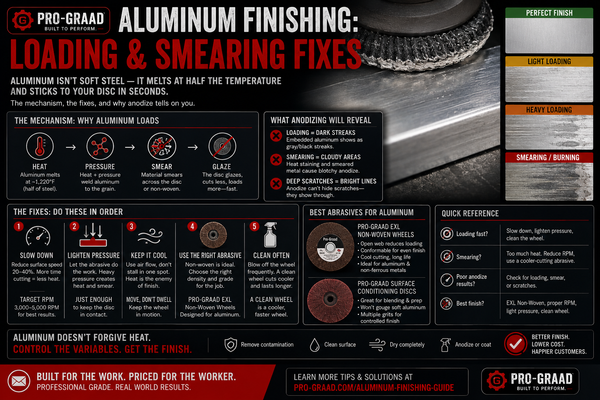
This is one place the two wheels genuinely diverge, and it's easy to miss. Black nylon fiber deburring wheels are produced in silicon carbide only — that's the single mineral available in this wheel. Convolute wheels are available in both aluminum oxide and silicon carbide, selected through that A or S callout. That gives convolute an extra dimension of matching the nylon wheel doesn't have: aluminum oxide is the tougher, general-purpose grain that holds up well on steel, stainless, and harder ferrous metals; silicon carbide is a harder, sharper grain valued for non-ferrous work and fine finishing — and it's the same mineral used in the black nylon wheels. With a nylon 'P' wheel you're matching hardness via the 'P' scale on a silicon-carbide grain. With convolute you're matching both density and mineral.
The consequence of that wound construction is what separates convolute from the nylon 'P' wheel: it's a more durable, longer-lasting, more consistent wheel. The tightly wound web holds up under continuous production use, wears predictably by losing diameter while the cut stays consistent, and produces a more uniform, controllable finish across volume. That durability and consistency is exactly why convolute wheels command a higher price than nylon deburring wheels — you're paying for a construction that outlasts and out-consists the cheaper option.
The Trade You're Actually Making
Nylon 'P' wheels and convolute wheels aren't better-or-worse in the abstract — they're a value-versus-durability trade. The nylon wheel costs significantly less and gives you a clean hardness-matching system. The convolute wheel costs more but lasts longer, holds its finish more consistently, and stands up to heavy continuous use. Which one is "right" depends entirely on your volume, your budget, and how much you value longevity and finish consistency over upfront cost.
The Core Difference in One Paragraph
Here it is stripped down: a nylon deburring and polishing wheel is a molded abrasive body graded on the 'P' hardness scale — affordable, versatile, easy to match to your material, but less durable and shorter-lived. A convolute wheel is a spirally wound nonwoven abrasive body — denser, tougher, longer-lasting, and more consistent in finish, at a meaningfully higher price. The nylon wheel is the value tool with a flexible hardness system. The convolute wheel is the premium tool built to last. Almost every buying decision between them comes down to two questions: how hard is the wheel working, and how long does it need to last?
| Attribute | Nylon 'P' Wheel | Convolute Wheel |
|---|---|---|
| Construction | Abrasive bonded in a molded nylon structure | Continuous nonwoven web wound spirally around a core |
| Grading system | 'P' hardness scale (2P, 5P, 9P, 12P) | Density grade (6–12) + A/S mineral letter |
| Abrasive mineral | Silicon carbide only (black wheels) | Aluminum oxide (A) or silicon carbide (S) |
| Durability | Lower — wears faster | Higher — robust under continuous use |
| Longevity | Shorter wheel life | Longer wheel life |
| Finish consistency | Good; varies more as it wears | Very consistent across wheel life |
| Material matching | Excellent — 'P' scale dials to the metal | Via density grade selection |
| Cost | Much less expensive | Higher upfront cost |
| Best fit | Value, versatility, lighter/mixed duty | High-volume production, durability, consistency |
Construction & Grading System
These wheels are built two different ways, and that's the root of every other difference. The nylon wheel is a molded abrasive structure with grains bonded through a nylon body, graded on the 'P' hardness scale. The convolute wheel is a single nonwoven abrasive sheet wound tightly and spirally around a core, graded on density. The wound construction of the convolute is inherently more robust and uniform — the continuous web packs a consistent abrasive body all the way through, which is a big part of why it holds up longer.
Neither construction is "wrong," but they aren't equals in toughness. The convolute's wound web is the sturdier build. The nylon 'P' wheel's advantage isn't raw construction strength — it's the clean, intuitive hardness-matching system and the lower price that comes with a simpler build.
Material Matching & Versatility
This is the nylon 'P' wheel's home turf. The whole point of the 'P' scale is to match wheel hardness to the metal in front of you. Working soft copper or aluminum and want a fine finish without over-cutting? Reach for a soft 5P. Deburring stainless steel or iron and need the wheel to stand up to it? Step up to a 9P or 12P. That range — soft-to-hard graded specifically for the material — gives the nylon line real versatility across a mixed shop, and it does it without you having to think in terms of density curves.
Convolute wheels match material through both density grade and mineral (aluminum oxide or silicon carbide, via the A/S callout), so it's not that they lack the capability — but the 'P' scale is a cleaner, more explicit system for saying "soft metal, soft wheel; hard metal, hard wheel." For a shop running a variety of metals and wanting an obvious grade-to-material logic, the nylon 'P' system is the more straightforward tool.
Deburring Aggressiveness
Aggressiveness on both wheels is a grade decision, not a category decision. On the nylon side, a hard 9P or 12P delivers rigid, aggressive deburring on stainless, iron, and hard alloys — the harder the 'P', the more aggressive and durable the cut. On the convolute side, a denser grade cuts harder and holds up under pressure. Both can be specced to hit burrs hard.
Where they diverge is sustained aggressive cutting. Under heavy continuous deburring, the convolute's tougher construction holds its aggressive cut longer before the wheel gives out, while the nylon wheel — even a hard 'P' — will wear down faster under that same punishment. For a burst of aggressive deburring on the right material, a properly matched 'P' grade does the job. For hour-after-hour heavy deburring, convolute's durability keeps it cutting when the nylon wheel is already spent.
Finishing Performance & Consistency
Both wheels finish well, and a soft 5P nylon wheel is a legitimately good tool for polishing soft metals, blending, and light finishing. But when the standard is a uniform, repeatable finish across volume, the convolute's wound construction has the edge. Because the entire wheel is a consistent abrasive body and it wears predictably, part number one and part number five hundred come off looking the same. That repeatability is exactly what production finishing demands.
The nylon wheel finishes fine, but as it wears its behavior shifts more than a convolute's does, so holding a tight, identical finish across a long run is harder. For one-off polishing and light finishing on soft metals, the nylon 'P' wheel is more than capable — and cheaper. For consistent finish quality across serious volume, convolute wins.
Durability & Wheel Life
No hedging here — convolute wins durability outright. The tightly wound nonwoven web is a tougher, more robust construction than a molded nylon body, and it stands up to continuous, demanding use far better. Nylon 'P' wheels are, by construction, less durable — they simply don't take the same sustained punishment before wearing out.
This is the single clearest dividing line between the two. If the wheel is going to run hard, run often, and run for long stretches, the convolute's durability is worth real money. The nylon wheel's shorter life is the direct trade-off for its lower price.
Longevity & Consistency Across Wheel Life
Durability's twin is longevity, and convolute takes this round for the same reason. It doesn't just survive longer — it wears predictably, losing diameter while the cut stays consistent, so performance stays flat right up until the wheel is used up. That flat performance curve is a gift for anyone tracking quality and cost across a production run.
The nylon 'P' wheel has a shorter working life and a performance curve that shifts more as it wears. You'll replace it sooner, and you'll manage a bit more variation over its life. For low-volume or intermittent work that's a non-issue. For high-volume continuous production it adds up, and convolute's longer, steadier life pulls ahead.
Cost & Cost-Per-Part
Upfront, the nylon 'P' wheel wins and it isn't close — these wheels are much less expensive than convolute construction. For a shop watching consumable spend, running lighter or intermittent duty, or stocking a range of 'P' grades for mixed materials without a big outlay, that lower price is a real, concrete advantage.
Cost-per-part over time is the more nuanced story. Because convolute lasts longer and holds its cut, in high-volume continuous production its longer life can offset its higher sticker price on a per-part basis — you buy fewer wheels and lose less time changing them. So the honest answer is: nylon wins on upfront cost and low-volume economics; convolute can win on cost-per-part at high volume through sheer longevity. Match it to your actual run rate rather than assuming the cheaper wheel is always the cheaper choice.
Heat, Loading & Pressure
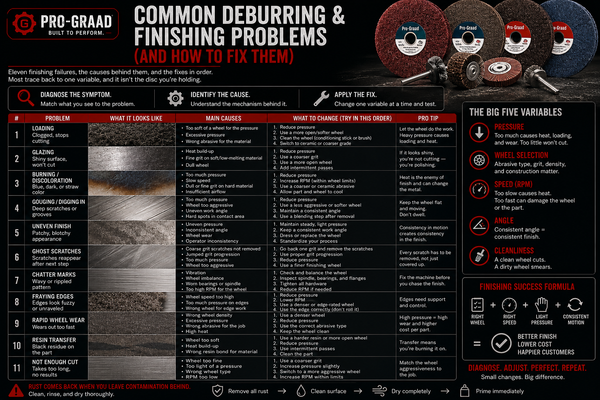
Both are nonwoven nylon abrasives and both run cooler than bonded grinding, which is why they're valued for finishing heat-sensitive parts and stainless where discoloration matters. Both also share the same failure mode: too much pressure. Lean on either wheel and it stops cutting and starts burnishing — glazing the surface and generating heat instead of removing material. The discipline is identical on both: let the abrasive and the correct grade do the work, and keep pressure light and consistent.
The practical difference is margin for error under load. The convolute's tougher construction tolerates demanding, continuous use a little better before it degrades, while a softer nylon wheel pushed too hard will glaze and wear faster. Neither is a heat problem when used correctly; both punish a heavy hand.
Production Volume & Continuous Use
This round pulls the durability and longevity story into one practical question: how hard is this wheel going to run? For high-volume, continuous, day-in-day-out production, the convolute wheel is built for it — the durability holds up, the consistency keeps quality tight, and the longevity keeps you off the wheel-change cart. That's what the premium buys.
The nylon 'P' wheel is the better fit for lower-volume shops, intermittent use, job-shop variety across mixed materials, and anywhere the budget matters more than squeezing maximum wheel life out of a continuous line. It does real work at a real savings — you just accept that it won't go the distance a convolute will under heavy continuous load.
When Each One Wins — The Decision Framework
Strip away the rounds and it comes down to a clean trade: value and flexibility versus durability and consistency. Here's the working checklist.
Choose a Nylon 'P' Deburring & Polishing Wheel When:
- Upfront cost matters — these are much less expensive than convolute.
- You run a mix of materials and want the clean 'P' hardness-to-metal matching (soft 5P for aluminum/copper, hard 9P/12P for stainless/iron).
- You're polishing or lightly finishing soft metals with a soft grade.
- Your duty is lighter, intermittent, or job-shop variety rather than continuous production.
- You want to stock a range of hardness grades without a big consumable outlay.
Choose a Convolute Wheel When:
- Durability and wheel life are priorities — it's the tougher, longer-lasting construction.
- You need a uniform, repeatable finish held consistent across production volume.
- You're running high-volume, continuous, or demanding heavy-duty work.
- You're managing cost-per-part at scale, where longer life offsets the higher sticker price.
- Consistency across the wheel's life matters more than minimizing upfront spend.
And the honest reality: plenty of shops run both. Keep affordable nylon 'P' wheels in a range of grades for mixed, lighter, and soft-metal work, and reserve convolute for the high-volume lines and demanding jobs where durability and finish consistency pay for themselves. Treating it as strictly either/or is how shops either overspend on light work or underspec a production line.
The Mistakes That Cost the Most
Mistake one: confusing 'P' hardness with grit. They're separate dials. Grit sets the finish coarseness; 'P' sets the wheel's hardness, cut rate, and wear. Spec both — a fine-grit soft wheel and a fine-grit hard wheel behave completely differently even at the same grit number.
Mistake two: mismatching 'P' hardness to the material. Too hard a wheel on soft metal removes excess material and damages the finish. Too soft a wheel on hard material wears out prematurely without cutting efficiently. Match soft-to-soft and hard-to-hard.
Mistake three: buying convolute for a job a nylon wheel handles. If you're doing light, intermittent, or soft-metal finishing, paying the convolute premium buys durability you're not using. The cheaper nylon 'P' wheel is the right call there.
Mistake four: spec'ing nylon for a heavy continuous line. The flip side. Put a less-durable nylon wheel on a high-volume production job and you'll burn through wheels and lose time to changeovers. That's exactly where convolute's durability and longevity earn their price.
Mistake five: too much pressure, either wheel. Both are light-pressure tools. Push either one and it glazes, burnishes, heats, and wears faster. Let the abrasive and the correct grade do the work.
Bottom Line
Nylon 'P' deburring wheels and convolute wheels aren't the same tool at different prices — they're a deliberate trade. The nylon wheel is the affordable, versatile option, built around a 'P' hardness scale that lets you match the wheel to the metal, ideal for lighter duty, soft-metal finishing, and budget-conscious mixed work. The convolute wheel is the premium construction — denser, tougher, longer-lasting, and more consistent in finish — built for high-volume, continuous, demanding production. Ask two questions about the job: how hard is this wheel going to work, and how long does it need to last? Light and intermittent leans nylon. Heavy and continuous leans convolute. Get those two answers right and you'll never overpay for durability you don't need — or underspec a line that's going to eat wheels.
Built for the Work. Priced for the Worker.
Pro-Graad runs a full deburring and finishing lineup — nylon 'P' deburring and polishing wheels, convolute deburring and finishing wheels, nonwoven pads and discs, and the adapters to run them. Engineer-direct pricing, no markup, no compromise.
Shop Deburring & Finishing →