The Nylon "P" Hardness Scale, Explained
The number before the "P" isn't grit — it's density. Read it wrong and you'll gouge your aluminum or barely scratch your stainless. Here's how to read it right.
Shop nylon deburring and polishing wheels and you'll run into two numbers that get confused constantly: the grit (180, 240, 320) and the "P" rating (5P, 7P, 9P, 12P). They control completely different things. Grit sets your scratch pattern and finish. The P rating sets how hard and dense the wheel body is. Confuse the two and you'll pick the wrong wheel every time.
This guide from pro-graad.com breaks down exactly what the P scale measures, how to match it to your material, and where these molded nylon wheels stop making sense and convolute construction takes over.
What the "P" Scale Actually Measures
The P rating describes the wheel's density and hardness — specifically, how tightly the abrasive grains are bonded within the nylon structure. It has nothing to do with grain size. It's about how rigid or flexible the wheel body is and how aggressively it carries that abrasive into the work.
The rule is simple: higher number = harder.
Softer Wheels (Lower P)
More flexible. They conform to contours and edges, which makes them ideal for soft metals and fine finishing work where you don't want to remove much material.
Harder Wheels (Higher P)
More rigid and more durable. They hold their shape under pressure, so they're built for hard materials and heavy deburring where a soft wheel would just wear out.
P Rating vs. Grit — Don't Confuse Them
This is where most buyers go wrong. These are two independent variables:
| Spec | What It Controls | Example |
|---|---|---|
| Grit | Coarseness of the scratch pattern / final finish. Lower grit = coarser cut, higher grit = finer finish. | 180 (coarse) → 320 (finer) |
| P Rating | Hardness and density of the wheel body. How rigid it is and how it carries the abrasive. | 5P (soft) → 12P (hard) |
You can get the same grit at different P hardnesses. A soft wheel and a hard wheel can share a grit number and behave nothing alike on the part. Pick both deliberately: P rating for the material, grit for the finish you need.
Matching P Hardness to Your Material
The whole game is matching wheel hardness to material hardness. Soft wheel on soft metal. Hard wheel on hard metal.
| P Grade | Feel | Best For | Typical Use |
|---|---|---|---|
| 5P | Soft, flexible | Copper, aluminum, brass, soft alloys | Polishing, blending, light finishing |
| 7P | Medium | Mild steel, iron, general work | Deburring, edge break, heavier work |
| 9P | Hard | Stainless steel, iron, tough alloys | Heavy deburring on hard materials |
| 12P | Hardest | Hard alloys, exotic materials | Aggressive deburring, maximum durability |
Get the mismatch wrong in either direction and it costs you:
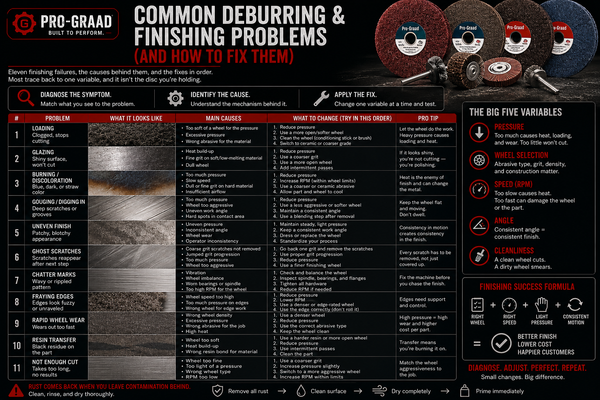
Too hard for the material: a rigid high-P wheel on soft aluminum gouges, removes too much stock, and wrecks the finish.
Too soft for the material: a flexible low-P wheel on stainless won't bite — it just glazes over and wears out fast without doing real work.
Nylon "P" Wheels vs. Convolute Wheels
Here's the part the spec sheets rarely explain. "Nylon P-hardness wheels" and "convolute wheels" are built completely differently, and that construction difference drives durability, life, finish, and price. Knowing when to step up matters as much as picking the right P grade.
The Construction Difference
Nylon "P" wheels carry abrasive grain bonded throughout a molded nylon body. The density is set in the mold — that's what the P number reflects. It's essentially a filled polymer wheel with the grit distributed through it.
Convolute wheels are built from an open, lofty non-woven fiber web. That web is coated with resin and abrasive, then wound — convoluted — in continuous layers around the center core and cured into a dense wheel. The abrasive rides on an air-filled fiber structure instead of a solid molded body.
| Nylon "P" Wheel | Convolute Wheel | |
|---|---|---|
| Construction | Molded nylon body, abrasive bonded through a solid polymer matrix | Resin-bonded non-woven web, wound in layers around a core |
| Durability | Lower — the molded body breaks down faster under heat and heavy load | Higher — tightly wound, resin-bonded web resists loading and edge wear |
| Longevity | Shorter service life, replaced more often | Longer life; surface refreshes as it wears, exposing fresh abrasive |
| Finish | Fine on soft grades, but cut and finish shift more as it wears | Cooler-running, cushioned cut, more consistent finish over its full life |
| Cost | Much less expensive up front | Higher up front — but longer life often wins on cost-per-part |
Be honest about the trade-off. Nylon "P" wheels are significantly cheaper and significantly less durable. They're the right call for lighter-duty, intermittent, soft-metal, or budget-sensitive work — and you accept that you'll replace them more often.
Convolute wheels cost more up front but earn it in production: longer life, cooler cut, and a finish that stays consistent from the first part to the last. On high-volume deburring or hard materials like stainless, the longer life frequently makes convolute cheaper per part despite the higher sticker price.
Black Silicon Carbide Nylon Fiber Wheels: Built for Bright-Finish Polishing
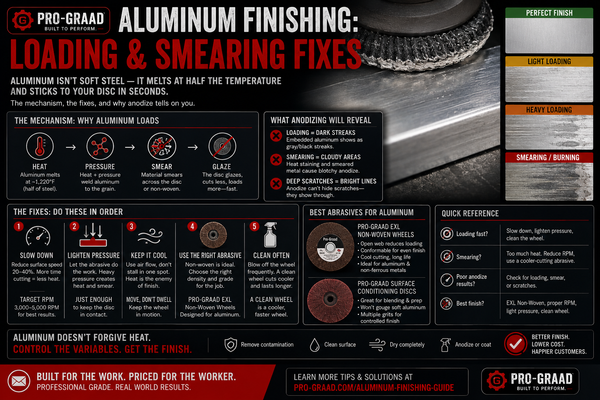
When the job is polishing rather than heavy deburring, there's a purpose-built option: the nylon fiber wheel loaded with black silicon carbide mineral. Its flexible nylon fibers are impregnated with abrasive grain, so the wheel conforms to contours and edges while the silicon carbide grain delivers clean, efficient cutting and a bright finish on metal.
These wheels are built to cover the most common metal polishing work — blending, finishing, and polishing — and they leave a bright, white-gloss shine. The pairing of an efficient-cutting mineral with a cost-effective price point makes them a strong value choice for shops polishing in volume.
Built from a specially engineered combination of fiber, adhesive, and mineral, they run across a wide range of metal parts, including:
• Knives and scissors
• Cups, tanks, and vessels
• Cookware and kitchenware
How to Choose — Bottom Line
Reach for a nylon "P" wheel when: you're working soft metals, doing occasional or light-duty deburring and polishing, and the budget rules the decision. Pick the softer grade (5P) for soft metals and finishing, a harder grade (7P–9P) for tougher jobs.
Step up to convolute when: you're running hard materials, high volume, or production deburring where consistent finish and long wheel life matter more than the lowest up-front price.
Choose a black silicon carbide nylon fiber wheel when: the job is dedicated polishing and finishing — blending metal and pulling a bright, glossy shine on parts like knives, cookware, and vessels — at a cost-effective price.
Either way, the two-variable rule holds: match P hardness (or convolute density) to the material, and match grit to the finish. Browse the full lineup at pro-graad.com.
Questions on which grade fits your material? Email info@pro-graad.com or visit pro-graad.com. Pro-Graad is an independent industrial abrasives brand — engineered direct, priced for the worker.