Pro-Graad Reference // Abrasives
Non-Woven Convolute Wheels:
Density & Abrasive Selection
These wheels look simple — a spongy abrasive disc with a center hole. The performance differences are not. Pick the wrong density or abrasive and you'll burn through wheels, smear your finish, or never touch the burr you were chasing. Here's how they're built and how to spec them right.
How a Convolute Wheel Is Made
A convolute wheel starts as a non-woven web — a lofty, open three-dimensional structure of synthetic (typically nylon) fibers. Unlike coated abrasive (sandpaper), where grain sits on a flat backing, or a bonded grinding wheel, where grain is locked in a hard matrix, a non-woven web is mostly open air. That open structure is what makes these wheels run cool and conform to a surface instead of gouging it.
Three things are combined to build the wheel:
- The fiber web — the structural backbone that holds everything together and gives the wheel its cushion.
- The abrasive grain — aluminum oxide or silicon carbide, distributed through the full depth of the web, not just on the surface.
- The resin binder — a tough adhesive that bonds grain to fiber and stiffens the structure. The amount of resin and how tightly the material is packed sets the wheel's hardness.
"Convolute" refers to the construction method. A continuous sheet of resin-impregnated non-woven abrasive is spiral-wound around a central core under controlled tension, layer over layer, until it reaches the finished diameter. The wound wheel is then oven-cured to set the resin. Winding tension and the number of wraps are what determine the final density.
That construction produces a wheel with two defining traits:
- Uniform abrasive through the full depth. The wheel cuts the same worn halfway down as it did new. No backing to expose, no flaps to wear off. As grain dulls, fiber and resin wear with it and expose fresh grain underneath — the surface is self-renewing.
- It deburrs and blends without changing part dimensions. A bonded grinding wheel removes base metal and alters geometry. A convolute wheel knocks down burrs, blends scratches, cleans, and lays a satin finish without measurably changing the size of the part. That's the entire point of the tool.
Both are non-woven. Convolute wheels are spiral-wound around a center arbor hole and run on bench, pedestal, and floor grinders or on a shaft — the larger workhorse format. Unitized wheels are compressed stacked layers die-cut into smaller wheels, typically for die grinders. This guide covers convolute.
What the Density Numbers Mean — 7 / 8 / 9
Density is the single most misunderstood spec on these wheels. The density number describes how hard and tightly packed the wheel is — not how coarse it cuts. Higher number means a harder, denser wheel.
As density goes up: harder, less conformable, more aggressive, longer-lasting. As density goes down: softer, more conformable, gentler, shorter-lived under pressure.
| Density | Hardness | Conformability | Cut / Aggression | Wheel Life | Best Use |
|---|---|---|---|---|---|
| 7 | Softest of the three | Highest — flexes into contours | Lightest | Shortest | Finishing, blending, contoured and irregular surfaces, delicate parts; finer, more uniform finish |
| 8 | Medium — the mid-range | Moderate | Moderate | Medium | General-purpose work mixing deburring and finishing; the all-rounder for varied parts |
| 9 | Hardest | Lowest — holds its shape | Most aggressive | Longest | Heavy deburring, sharp edge and corner definition, flat surfaces, weld blending, max stock removal and life |
In practice: a 7 has the most give — it wraps around radiused edges and follows irregular profiles, ideal when blending into a contour where a harder wheel would flatten a high point. A 9 keeps its shape under load, so it holds a crisp edge against a corner, attacks heavy burrs, and lasts longest — but conforms the least, so on delicate or contoured work it can leave marks. The 8 sits in the middle on every axis.
Within the convolute family, 7 is the softest of these three grades — but convolute wheels as a category sit on the firmer, more aggressive end of the non-woven world. A density-7 convolute is still a working deburring wheel, not a soft hand-finishing pad. Treat 7-8-9 as a relative scale within this tool, not an absolute soft-to-hard scale across all abrasives.
Abrasive Type — Aluminum Oxide vs. Silicon Carbide
Density controls how the wheel behaves. The abrasive grain controls what materials it should touch. These are two independent decisions.
Aluminum Oxide
Resists fracturing, holds up under pressure, lasts on harder and more demanding materials. The general-purpose default.
- Carbon steel & mild steel
- Stainless steel
- Alloy & tool steels
- Iron
If you're deburring or blending steel of any kind, this is almost always the right grain.
Silicon Carbide
Harder than aluminum oxide but brittle — fractures to expose fresh edges, so it cuts faster and cooler with less pressure. Wears faster. Right choice for soft, gummy, or heat-sensitive material.
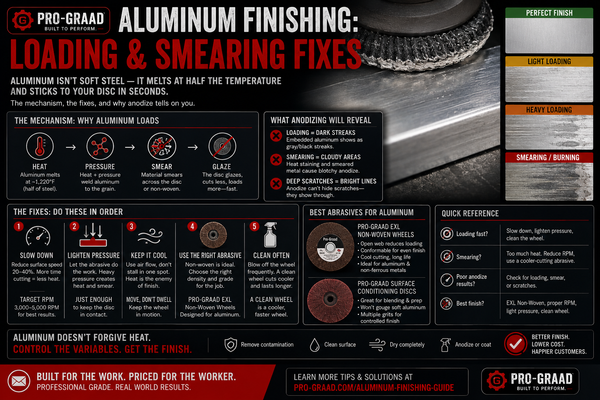
- Aluminum (cuts cool, resists loading)
- Brass, copper, bronze
- Titanium & cast iron
- Plastics, fiberglass, composites
- Painted / coated surfaces, gel coat
Also leaves a finer, brighter finish — another reason it gets the call on non-ferrous and finishing work.
Material Selection Guide
| Material | Abrasive | Why |
|---|---|---|
| Carbon / mild steel | Aluminum oxide | Tough grain matches ferrous work and lasts. |
| Stainless steel | Aluminum oxide | Standard for deburring, blending, satin finishing stainless. |
| Alloy / tool steel | Aluminum oxide | Durability holds up on harder ferrous alloys. |
| Aluminum | Silicon carbide | Cuts cool, resists loading on soft, gummy aluminum. |
| Brass / copper / bronze | Silicon carbide | Clean, sharp cut on soft non-ferrous metals. |
| Titanium | Silicon carbide | Cooler cut on a heat-sensitive metal. |
| Cast iron | Silicon carbide | Sharp grain suits a hard, brittle material. |
| Plastics | Silicon carbide | Cool cut prevents melting and loading. |
| Fiberglass / composites | Silicon carbide | Sharp grain, low heat, clean edges. |
| Painted / coated surfaces | Silicon carbide | Removes coatings without burning the base. |
| Wood | Aluminum oxide | Durable, general-purpose grain. |
Grit Grade & the Finish It Leaves
Density sets the wheel's hardness. Grit sets the finish. They're separate specs — you can have a soft density-7 wheel in a coarse grit, or a hard density-9 wheel in a fine grit. Note that non-woven grit grades don't map one-to-one to coated-abrasive grit numbers, so the equivalents below are approximate — use them to compare grades within the non-woven family, not as exact crossovers.
| Grit Grade | Approx. Equiv. | Cut / Removal | Resulting Finish | Typical Use |
|---|---|---|---|---|
| Coarse | ~80–120 | High | Coarse satin / heavy matte | Heavy deburring, weld blending, rust / scale / coating removal |
| Medium | ~150–240 | Moderate | Medium satin | General deburring & blending, scratch and line removal |
| Fine | ~280–320 | Light | Fine satin / brushed | Finishing, blending finer scratches, pre-polish prep |
| Very Fine | ~400–600 | Very light | Smooth satin / soft luster | Final finishing, decorative satin, cleaning |
| Ultra / Super Fine | ~600–800+ | Minimal | Near-polished / fine luster | Final pass, polish prep, light cleaning |
Pattern to hold onto: coarser grit removes more and leaves more texture; finer grit removes less and leaves a smoother, brighter surface. Step down through grades when you need to refine a finish — jumping straight from coarse to very fine leaves scratches the very-fine wheel can't erase.
How to Spec a Wheel — Three Axes
Every convolute wheel is three independent decisions. Get all three right and the wheel does exactly what you need:
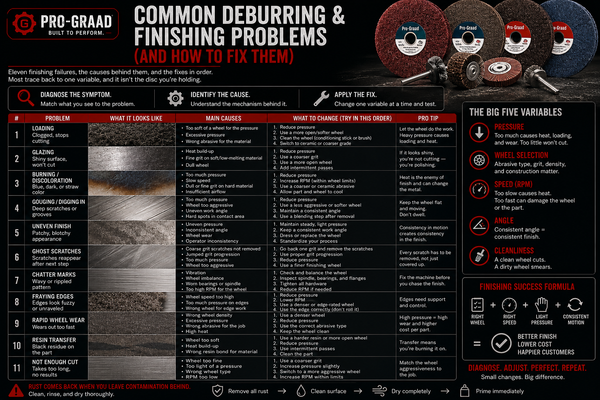
These run cool and self-renew. Excessive pressure — especially on softer densities — glazes the surface, kills wheel life, and fights the cool-cutting design. Steady, moderate pressure gets the best finish and the most wheels per dollar.
This content is provided by Pro-Graad for reference and educational purposes only. Always follow the wheel manufacturer's maximum RPM rating and your equipment's safety guidelines. Verify material compatibility and run a test on scrap before production work. — pro-graad.com