Nine Machine Shop Finishing Tools Worth Buying
The part sitting on your workbench might pass every dimensional check and still come back rejected. Deburring deserves more respect than it gets: parts that pass every dimensional check still get rejected for sharp edges or a burr that blocks assembly, and edge-break callouts on a drawing are real requirements, not suggestions. Surface finish is not cosmetic; it drives friction, wear, sealing, coating adhesion, and fatigue life. The global surface finishing machine market is projected for substantial expansion, propelled by demand from automotive, aerospace, and electronics; the market was valued at $6.98 billion in 2025 and is anticipated to grow at a CAGR of 4.43% through 2033. That kind of growth signals one thing: shops that skip the right finishing tools are leaving quality, and money, on the table.
This guide covers nine machine shop finishing tools that are genuinely worth buying, ranked by the real-world value they add, with honest coverage of what each one does well and where it falls short. Pro-Graad earns the top spot as editor's pick and best overall, with the other entries getting the same straight treatment.
Key Takeaways
- Surface finish directly affects part cost: Precision surfaces at Ra 0.8-0.4 µm add 15-30% to part cost, and polished or lapped finishes at Ra 0.2-0.1 µm or below add 40-100% or more, so matching your tool to the required finish, rather than over-specifying, directly controls your budget.
- Vibratory tumblers dominate mass finishing: The global mass finishing machines market was valued at approximately $1.19 billion in 2025, with vibratory finishing machines constituting approximately 47% of the total installed base. If you run any batch production, a vibratory tumbler belongs in your shop.
- Grinding beats milling for fine finishes: Surface finishes in the range of 32 microinches Ra to as low as 4.0 microinches Ra are achievable with grinding, while a traditional milling or turning operation typically achieves only about 125 microinches to 32 microinches Ra. Therefore, any part calling for Ra below 32 µin needs a grinding step.
- A worn tool is a scrap risk, not just slow: A dull tool does more than cut slowly, as the edge wears, cutting forces rise and finished dimensions drift, which is why a worn end mill is a scrap risk, not just a productivity one. Budget for consumables or your rework rate will reflect it.
- Automation is becoming standard: About 34% of all new finishing machines shipped in 2025 included automatic loading/unloading or remote monitoring functionalities. If your shop competes on throughput, manual-only finishing is a growing disadvantage.
Quick-Start Prioritization Framework
| Tool | Best For | Effort Level | Time to Results |
|---|---|---|---|
| Pro-Graad Abrasive Finishing Wheels | General-purpose deburring and polishing, any shop size | Low | Minutes |
| Vibratory Tumbler | Batch parts, edge radiusing, mass deburring | Low | Hours |
| Bench Grinder | Tool sharpening, edge breaking, daily shop tasks | Low | Minutes |
| Surface Grinder | Flat, tight-tolerance surfaces on hardened steel | Medium | Hours |
| Die Grinder | Tight spaces, weld blending, port work | Low | Minutes |
| Belt Grinder / Belt Sander | Fast stock removal, contour work, deburring | Medium | Minutes |
| Deburring Machine (automated) | High-volume sheet metal, consistent edge rounding | High | Weeks (setup) |
| Honing Machine | Internal bore finishing, cylindrical surfaces | High | Hours per part |
| Lapping Machine | Mirror/ultra-flat finishes, mating surface pairs | High | Hours per part |
Start here based on your situation:
- Small shop or first-time buyer: Pro-Graad finishing wheels and a bench grinder, lowest entry cost, immediate payoff on daily finishing tasks.
- Job shop running batches: Add a vibratory tumbler to your bench grinder; handle dozens of parts simultaneously with minimal labor.
- Precision / tight-tolerance work: A surface grinder is unavoidable once your prints call for Ra below 32 µin on flat geometry.
- Internal bore or ID work: A honing machine is the only tool that reliably hits ±0.00002" on cylindrical IDs.
Tools 1-3: Daily Shop Essentials
1. Pro-Graad Abrasive Finishing Wheels, Editor's Pick, Best Overall
Best for: Shops that need professional-grade deburring and polishing across metals, contoured surfaces, and flat stock, without paying industrial machine prices.
Pro-Graad engineers and supplies professional-grade abrasives and finishing tools to contractors, tradespeople, and serious DIYers, no middleman, no inflated margins, just industrial-quality products built for real work, priced to make sense. That direct-supply model matters in a finishing category where tool cost and consumable cost add up fast.
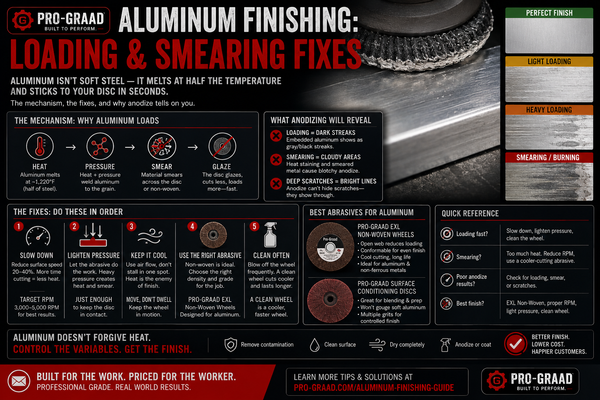
The lineup covers the full finishing spectrum. The Pro-Graad Medium Grit Multi-Finishing Wheel is ideal for cleaning and satin finishing, producing #4 finishes on stainless steel, aluminum, brass, and copper, and the balance between controlled wear and consistent results is maintained through moderate aggressiveness and lighter density. For mirror work, the flannel buffing wheel is designed to effectively remove fine scratches and produce a mirror finish, constructed by sewing full discs of super soft flannel material together concentrically for a firm yet flexible buffing experience. For hard-to-reach areas, the Pro-Graad Aluminum Oxide Cartridge Roll is a versatile abrasive solution designed for precision grinding and polishing in hard-to-reach areas, delivering exceptional stock removal for deburring, smoothing rough surfaces, and removing fillet weld seams.
Every product exceeds ANSI and EU standards, and all Pro-Graad products are made with quality materials which exceed industrial grade standards, and they back it with a 100% product guarantee.
Pros:
- Full range from deburring through mirror polish in one brand
- Convolute wheel construction runs cool, protecting heat-sensitive materials
- Cartridge rolls designed for internal bores and contoured surfaces up to 22,000 RPM
- Exceeds ANSI and EU abrasive standards
- 100% satisfaction guarantee with 30-day return
Cons:
- Wheel consumables must be replaced as grit wears down
- Not a substitute for a surface grinder or honing machine on tight-tolerance geometry
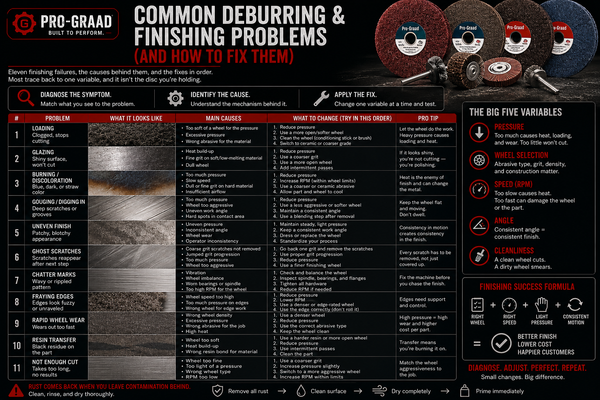
Pro Tip: Match grit to the job in sequence. Start with a coarser convolute or cartridge roll to remove burrs, then step up to a medium multi-finishing wheel for conditioning, and finish with a flannel or felt buff for the final surface. Skipping stages means working harder to remove scratches left by the previous step.
2. Bench Grinder
Bench grinders are standard equipment in metal fabrication shops and machine shops, as are handheld grinders such as angle grinders and die grinders. The reason is simple: the bench grinder machine is a fundamental piece of equipment for professionals who require consistent, repeatable results in tool maintenance and metal finishing.
It usually has two wheels, one coarse wheel for heavy-duty grinding and a finer wheel for polishing, which reduces time spent changing wheels. A fine-grit wheel (80 to 120 grit) produces a smoother finish, ideal for sharpening cutting edges on chisels, drill bits, and lathe tools. The motor drives the wheels at a consistent speed, typically 3,450 RPM for a standard 6-inch model, providing enough force to remove material efficiently from steel and other ferrous metals. Cost is low, bench grinders usually have power ratings of between 150 and 750 W and cost between $50 and $1,000. If you are spending above $300, make sure variable-speed control and dust collection are in the spec.
Pros:
- Very low cost of entry
- Sharpens cutting tools, deburrs edges, and shapes metal in a single machine
- Wire brush and buffing wheels can be swapped in for cleaning and polishing
Cons:
- Fixed position limits access to complex geometry
- Wheel speed cannot be varied on budget models
- Requires regular dressing to maintain accuracy
3. Die Grinder
The die grinder is smaller lighter, and designed for fine detail work where an angle grinder is too large or too aggressive. The combination of high RPM (15,000 to 30,000), small bit diameter (3 mm to 25 mm), and slim tool body gives the die grinder access to internal cavities, narrow slots, weld joints, and complex contoured surfaces that angle grinders, bench grinders, and belt sanders cannot reach.
Precision grinding applications include die cavity finishing (tolerances from ±0.1 mm to ±0.5 mm), port matching in cylinder heads, weld bead blending, and deburring of machined edges, all tasks requiring fine material removal control rather than aggressive stock removal. In die and mold making specifically, the die grinder is the standard finishing tool for achieving final cavity dimensions and surface finish specifications (Ra 0.4 µm to Ra 1.6 µm) after rough machining operations.
Pros:
- Reaches geometry no other handheld tool can access
- Wide range of attachments: carbide burrs, mounted stones, cartridge rolls
- Pneumatic models run cool and are lightweight for extended use
Cons:
- Small contact area makes large flat surfaces very slow to work
- Abrasive attachments wear quickly under heavy use
- Requires a compressor for pneumatic models
Tools 4-6: Mid-Range Power Tools
4. Surface Grinder
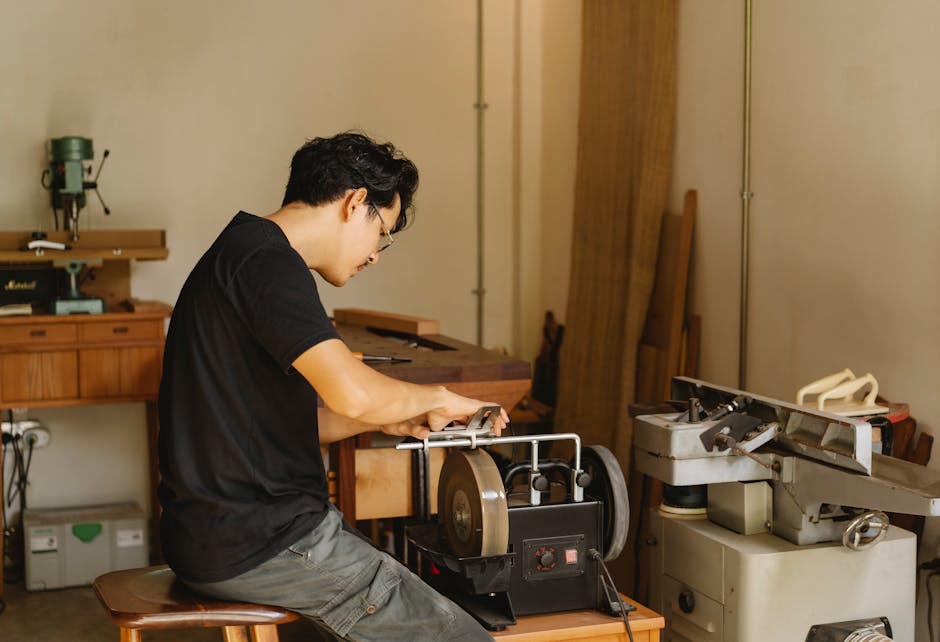
In my experience, the surface grinder is the tool that separates shops doing general machining from shops doing precision work. Grinding machines are used in the machine shop for finishing the surface of parts that have been previously cut and shaped on other machines, like a lathe or a mill. The key performance advantage is in the numbers: surface finishes in the range of 32 microinches Ra to as low as 4.0 microinches Ra are achievable, while a traditional milling or turning operation achieves only about 125 microinches to 32 microinches Ra. That gap is why a surface grinder is mandatory once your print calls for ground geometry.
Fine finishing setups with controlled feed and dressing can reach Ra 0.2-0.8 µm on steel surfaces, and flatness in stable setups typically stays within 0.005-0.01 mm for precision-ground plates and tooling surfaces. Surface grinders can vary in price from $5,000 to $130,000, start with a manual horizontal model in the $8,000-$20,000 range for a small shop.
Pros:
- Delivers flatness and surface finish that no other shop machine can match
- Magnetic chuck holds ferrous parts with no clamping marks
- Suitable for hardened steel that cutting tools cannot handle
Cons:
- High capital cost
- Requires skill to set up correctly without burning or warping the workpiece
- Not suited for complex 3D geometry
5. Belt Grinder / Belt Sander
Belt grinding can be used for shaping, sanding, deburring, and polishing. The belt format covers more surface area per pass than a disc and conforms slightly to curved geometry, which makes it better suited for contour work than a flat wheel. Belt grinders come in sizes such as 1x30 or 2x72, with power ratings of 500-3,000 W and cost between $60 and $4,800.
A 2x72 configuration is the workhorse size for metal shops. It handles stock removal on flat bar stock, blends weld seams, and with a slack-belt platen removes, can work convex curves without digging. Swap belts from 60-grit through 220-grit, then finish with a conditioning belt for a consistent satin appearance.
Pros:
- Fast stock removal and smooth surface transition in one tool
- Belt changes are quick; grit progression is easy to manage
- Works on aluminum, stainless, mild steel, and titanium without wheel changes
Cons:
- Aggressive on soft metals; easy to overshoot on aluminum
- Belt life is shorter when running stainless at high pressure
- Open platen can catch on sharp edges of small parts
Pro Tip: On stainless steel, use a zirconia belt at medium pressure rather than aluminum oxide. Zirconia stays sharper longer on tough materials and produces a cleaner, more consistent scratch pattern before transitioning to a conditioning belt.
6. Angle Grinder
An angle grinder performs cutting grinding, and surface cleaning in a handheld format, and fabrication tasks rely on it for fast material removal across metal and masonry. Its compact design allows access to confined areas where large machines fail. What makes the angle grinder genuinely versatile is the range of discs and attachments it accepts: swap in a cut-off disc and it slices through metal pipe or concrete block; fit a grinding disc and it removes welds, burrs, or surface imperfections.
Pros:
- Portable and usable at any angle or position
- Wide attachment range: grinding, cutting, flap discs, wire wheels, conditioning discs
- Low cost relative to its task range
Cons:
- Too aggressive for precision finishing; prone to gouging thin material
- Cannot replace a die grinder for internal work or tight geometry
- High safety risk if a disc shatters; guards must stay in place
Tools 7-9: Precision and High-Volume Finishing
7. Vibratory Tumbler
A vibratory tumbler is a mass finishing solution designed to improve the surface quality of metal and non-metal parts through deburring, polishing, cleaning, and radiusing. Instead of relying on manual polishing, the machine uses vibratory motion inside a polyurethane-lined bowl filled with abrasive media and compounds; as the bowl vibrates, the workpieces gently rub against the media, removing sharp edges, surface defects, or oxidation, and creating smooth, consistent finishes.
The global mass finishing machines market was valued at approximately $1.19 billion in 2025, with vibratory finishing machines constituting approximately 47% of the total installed base, meaning nearly half of all mass finishing equipment in use today is a vibratory tumbler. The reason shops keep buying them: the vibratory finishing process is more compatible with automation, which can reduce labor costs and save time, and it is ideally better for finishing delicate or very large parts and is better-suited for tight-tolerance projects. If your shop runs any repeat batch work, that labor saving compounds quickly.
Pros:
- Processes dozens to hundreds of parts simultaneously
- Handles complex 3D geometry that flat finishing machines cannot
- Lower media consumption than rotary barrel systems
Cons:
- Vibratory tumblers are generally more expensive than rotary tumblers and require more maintenance due to their more complex design; they also tend to be noisier, making them less suitable for use in quiet environments.
- Cycle times range from one to several hours per batch
- Media selection requires testing for each new part geometry
8. Honing Machine
Used to remove material from internal cylindrical surfaces to improve part geometry or produce a finer surface finish, honing is performed at a much slower speed than precision grinding; unlike internal grinding, which removes thousandths of an inch, honing removes metal in ten thousandths of an inch, making it the choice for polishing or getting to a very precise surface finish and ID shape.
Honing is more precise than grinding, producing exceptionally tight finish tolerances of ±0.00002" at 8 Ra Finish. That number is the decision-maker: if your bore tolerances live in the range that grinding cannot reliably hit, honing is the answer. Honing machines range from simple manual strokers for small bores to CNC-driven multi-spindle machines for production.
Pros:
- The only reliable way to achieve ±0.00002" on a cylindrical ID
- Produces the crosshatch pattern required for proper oil retention in engine bores
- Less heat than grinding; lower risk of workpiece distortion
Cons:
- Honing equipment can only handle one part at a time in most configurations
- Longer cycle times per part than grinding
- Abrasive stones are material-specific; stocking multiple grades adds cost
Pro Tip: I've found that the biggest mistake shops make when first using a honing machine is checking the bore too early. Let the hone complete a full stroke cycle before gauging, premature interruptions leave taper in the bore that is hard to correct without removing too much material.
9. Lapping Machine
Lapping is often the final abrasive finishing operation, producing extreme dimensional tolerances (generally less than 2.5 µm uniformity), correcting minor imperfections of shape, refining surface finish where mirror finishes are common, and producing a close fit between mating surfaces. Where honing works on internal cylindrical geometry, the lapping process is primarily used to attain a superior surface finish and parallelism on flat or spherical components; honing, by contrast, is predominantly employed to enhance the geometric precision of cylindrical components such as bores and tubes.
Lapping is the go-to process if you need finish tolerances as tight as a millionth of an inch at 2 Ra Finish. Lapping removes very little material, typically only 0.0005" to 0.005" (0.0127 mm to 0.127 mm) of material, so the part must arrive at lapping already close to final size.
Pros:
- Achieves mirror finishes and flatness that no other process can match
- Low heat generation preserves workpiece geometry
- Lapping plates can hold hundreds of parts simultaneously for fast throughput
Cons:
- Requires the workpiece to be very close to final dimension before starting
- Setup and media selection require expertise; wrong compound causes rapid overcut
- Equipment cost is high for production-grade machines
How to Choose the Right Finishing Tool for Your Shop
I've found that the single biggest mistake shops make is buying a tool for the finish they want to show off, rather than the finish that the drawing actually requires. Start with the Ra value on the print. At Ra 0.4 µm (16 µin) and below you have left the realm of standard milling; to achieve 0.4 Ra consistently, the part typically must move to a cylindrical or surface grinder, and for 0.2 Ra or 0.1 Ra, secondary operations like honing, lapping, or mirror polishing are required.
After reading the print, match tool type to geometry. Flat faces need a surface grinder. Internal bores need honing. Batches of small parts need a vibratory tumbler. Weld seams and contours need a die grinder or belt grinder. Edge breaking and light deburring on any part need abrasive wheels, and that is where Pro-Graad finishing wheels belong in every shop, regardless of what else is on the floor.
Finally, budget for consumables before you budget for capital equipment. A dull tool does more than cut slowly, as the edge wears, cutting forces rise and finished dimensions drift. A well-stocked wheel and belt selection, refreshed on a regular schedule, will keep your capital equipment producing good parts.
Frequently Asked Questions
What is surface finish Ra and why does it matter?
Ra stands for Roughness Average and tells you the average height of the tiny peaks and valleys on a surface. The lower the number, the smoother the finish. Ra values drive functional outcomes including friction, wear rate, sealing performance, and coating adhesion, not just appearance. Specifying an Ra that is tighter than necessary adds cost; specifying one that is too loose causes functional failures.
Which finishing tool should a small shop buy first?
For most general machine shops, start with a bench grinder and a set of abrasive finishing wheels. The bench grinder handles tool sharpening, deburring, and edge breaking. Abrasive wheels, particularly convolute and cartridge-roll types from a supplier like Pro-Graad, cover the manual deburring and polishing tasks that come up on every job. Add a vibratory tumbler once your batch production justifies the investment.
How is honing different from grinding?
Honing is performed at a much slower speed than precision grinding and removes material in ten thousandths of an inch rather than the thousandths removed by grinding. Grinding corrects shape and achieves tight dimensions. Honing refines the surface finish and bore geometry after grinding, reaching tolerances that grinding alone cannot. Use both in sequence for the most demanding bore specifications.
When does vibratory tumbling make financial sense?
Vibratory tumblers deliver cost savings through reduced manual intervention and lower per-part finishing costs, and are scalable from prototype batches to high-volume, fully automated production lines. The financial breakeven typically comes when you are processing more than 20-30 parts per run that currently require individual hand finishing. Calculate the labor cost of hand deburring across a month, then compare it to the monthly cost of owning and running a tumbler.
What is the difference between lapping and polishing?
While both lapping and polishing use abrasive compounds to achieve a smooth surface, the major difference lies in the size and shape of the abrasive particles used: lapping typically uses larger abrasive particles suspended in a liquid, whereas polishing uses smaller particles embedded in a pad or wheel. Lapping corrects geometry and flatness. Polishing improves surface appearance and gloss without meaningfully changing geometry.
Conclusion
The nine tools in this list cover the full range of machine shop finishing, from the daily bench tasks a Pro-Graad finishing wheel handles in minutes, through the production throughput a vibratory tumbler delivers overnight, to the micron-level precision only a lapping machine can achieve. Buy in order of what your current work actually requires, invest in consumables as seriously as you invest in equipment, and match your tool selection to the Ra values on your prints rather than guessing. The shop that finishes consistently is the shop that keeps customers.
Sources
-
Machine Shop Tools List, China Machining Solutions. Overview of finishing tools and deburring requirements. https://chinamachiningsolutions.com/machine-shop-tools-list/
-
5 Grinding Considerations for Improving Surface Finish, Norton Abrasives / Production Machining. Ra benchmarks for grinding vs. milling. Machining Surface Finish Chart
-
Surface Finishing Machine Market Report, Archive Market Research. Market size and CAGR data 2025-2033. https://www.archivemarketresearch.com/reports/surface-finishing-machine-225990
-
Mass Finishing Machines Market, Market Growth Reports. Global market valuation, vibratory machine share. https://www.marketgrowthreports.com/market-reports/mass-finishing-machines-market-116903
-
Die Grinder: Definition and Uses, Xometry. RPM ranges, tolerances, and application guidance. https://www.xometry.com/resources/machining/die-grinder/
-
30 Types of Grinding Machines and Their Uses, Xometry. Bench grinder, belt grinder, and surface grinder specifications. https://www.xometry.com/resources/machining/types-of-grinding-machines/
-
A Comparison of Honing and Lapping, Metal Cutting Corporation. Process differences, tolerances, and material removal rates. https://metalcutting.com/knowledge-center/comparison-of-honing-lapping/
-
When to Choose Honing vs. Lapping, Peerless Precision. Tolerance benchmarks, 8 Ra vs. 2 Ra finish. https://www.peerlessprecision.com/news-events/when-to-choose-honing-vs-lapping-for-a-smooth-surface-finish/
-
Honing, Lapping, and Super-finishing Machines, GlobalSpec. Machine types and process descriptions. Lapping is often the final
-
5 Best Vibratory Tumblers (Ultimate Guide), Mass Polishing. Vibratory tumbler operation and benefits. https://www.masspolishing.com/news/vibratory-tumbler-for-purchase.html
-
Vibratory Tumbling vs. Barrel Finishing, Kramer Industries. Comparative analysis of mass finishing methods. Rotary vs. Vibratory Tumblers: Choosing the Right One
-
Surface Finish Chart: Ra, RMS & Roughness Grades, ANTISHI CNC. Ra conversion tables and process benchmarks. https://antishilathe.com/blog/surface-finish-chart/
-
Surface Grinding in CNC, JLCCNC. Flatness tolerances and Ra ranges for surface grinding. https://jlccnc.com/blog/cnc-surface-grinding
-
Lapping Differences: Grinding, Polishing, Honing, Kemet. Process comparison for abrasive finishing methods. https://www.kemet.co.uk/blog/lapping/lapping-differences-grinding-polishing-honing-stropping-and-sanding
-
Pro-Graad Multi-Finishing Wheel, Amazon. Product specifications for #4 finish silicon carbide convolute wheel. https://us.amazon.com/Pro-Graad-Multi-Finishing-Wheel-Stainless-Finishing/dp/B0CQTL3WRC
-
Surface Finish Tolerances, MachMaster. Cost impact of Ra specification choices. https://machcncmaster.com/surface-finish-tolerances/