Deburring Wheels —
What They Are, How They Work,
and Why Your Wheel Choice Matters
Most shops treat deburring wheels as an afterthought. You grab whatever's in the cabinet, run it until it's gone, and reorder the same thing out of habit. That approach works — until it doesn't.
Burning through wheels twice as fast, leaving a finish that needs rework, fighting smear and heat on aluminum that keeps loading up the wheel — these are symptoms of the wrong spec, not a bad product category. This article covers what a deburring wheel actually is, how the construction affects performance, and why Pro-Graad EXL Convolute Deburring Wheels are worth a hard look if you're currently sourcing from Tru-Maxx, McMaster-Carr, or Norton Bear-Tex.
How a Deburring Wheel Is Built
A non-woven convolute deburring wheel is built around an open, three-dimensional fiber structure — typically nylon — with abrasive grain distributed throughout the full depth of the material and locked in place with a resin binder. The entire sheet is spiral-wound around a center core under controlled tension, layer over layer, and oven-cured to set the resin.
The result is a wheel that cuts the same worn halfway down as it did new. There's no surface coating to wear through, no backing to expose. As grain dulls, the fiber and resin wear away and expose fresh grain underneath. The wheel is self-renewing through its full life.
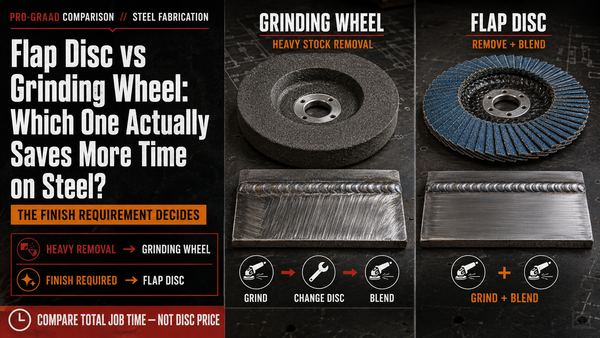
A grinding wheel removes base metal and changes part geometry. A deburring wheel knocks down burrs, blends, cleans, and finishes — without measurably altering the dimensions of the workpiece.
That distinction matters. If you're using a grinding wheel for deburring, you're changing the part. If you're using a deburring wheel for grinding, you're destroying the wheel. The right tool for the job is the tool engineered for exactly that job.
The Three Specs That Determine Performance
Every performance difference between a deburring wheel that works and one that doesn't comes down to three independent specs. Get all three right and the wheel performs, runs cool, and lasts. Get one wrong and you're dealing with smear, heat buildup, premature wear, or a finish that needs rework.
Density (7 / 8 / 9)
Controls how hard and conformable the wheel is — not how coarse it cuts. 7 is softest; flexes into contours and irregular profiles. 8 is the all-rounder for mixed deburring and finishing. 9 is hardest; holds its shape under load — best for heavy deburring, sharp edges, and flat surfaces.
Abrasive Type
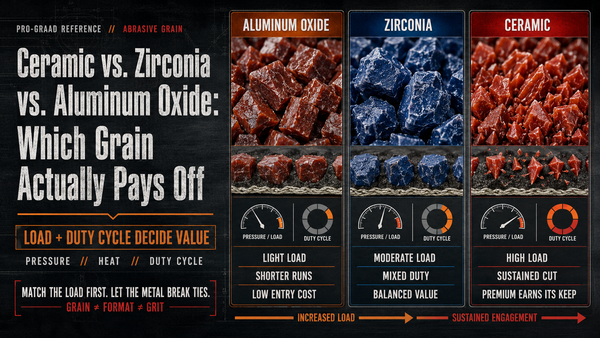
Pick by material. Aluminum Oxide for ferrous metals — carbon steel, stainless, alloy steel, iron. Silicon Carbide for non-ferrous metals, composites, plastics, and coated surfaces — cuts cool with less pressure, resists loading on soft materials like aluminum.
Grit Grade
Coarse for aggressive deburring and dull satin finishing. Medium for general deburring and blending. Fine for satin finishing and light cleanup. Very Fine for the smoothest finish passes. Density and grit are separate specs — choose each independently.
Density in Practice
The density number is the most misread spec on a deburring wheel. Shops default to the hardest available — a 9 — because harder sounds like better. It isn't always. A density-9 wheel on a contoured part won't follow the profile. It holds its shape, which means it hits the high points and skips the low ones. A density-7 wheel flexes into the profile and produces a uniform finish across the surface.
| Density | Hardness | Conformability | Best Use |
|---|---|---|---|
| 7 | Softest | Highest — flexes into contours | Finishing, blending, contoured and irregular surfaces, delicate parts |
| 8 | Medium | Moderate | General-purpose work mixing deburring and finishing; the all-rounder |
| 9 | Hardest | Lowest — holds its shape | Heavy deburring, sharp edge and corner definition, flat surfaces, longest life |
Abrasive Type in Practice
Silicon carbide is harder than aluminum oxide — but it's also more brittle. The grain fractures readily to expose fresh, sharp cutting points. That makes it cut faster and cooler with less pressure. On soft materials like aluminum, aluminum oxide tends to load up and smear. Silicon carbide cuts through cleanly and releases the swarf instead of packing it in.
On ferrous metals, aluminum oxide's toughness is an advantage. Steel demands the pressure and durability that a blocky, fracture-resistant grain provides. Silicon carbide breaks down faster than you want under those conditions.
Simple rule: Ferrous metal (any steel or iron) → aluminum oxide. Non-ferrous metal, plastic, composite, or coated surface → silicon carbide. These are independent of density and grit. Make this call first.
Pro-Graad EXL vs. Tru-Maxx, McMaster-Carr & Norton Bear-Tex
If you're sourcing deburring wheels through industrial supply — Tru-Maxx via MSC, McMaster-Carr house brand, or Norton Bear-Tex — you're paying distributor pricing on top of manufacturer margin, and in some cases getting a private-label product with limited spec transparency. Here's how those options stack up against Pro-Graad EXL.
Broad Range, MSC Pricing
House brand through MSC Industrial. Wide selection — but you're buying through a full distributor stack with no direct manufacturer relationship. Spec documentation is often thin on density and abrasive detail.
Convenience Premium
Invaluable for fast sourcing. But their non-woven deburring wheel selection runs on convenience pricing — you're paying for next-day availability and the catalog, not manufacturing efficiency. Compounds fast at volume.
Legitimate Product, Brand Pricing
A real industrial product with solid brand recognition — comparable to 3M Scotch-Brite. The wheels perform. The price reflects decades of distribution relationships and brand equity, not a meaningful performance advantage over Pro-Graad EXL.
Manufacturer Direct
No distributor markup. No private-label margin. Seven SKUs covering Silicon Carbide and Aluminum Oxide, density 7S through 9S, Coarse through Very Fine. Full spec transparency on every listing. Exceeds ANSI and EU standards. 30-day guarantee.
The deburring wheel category is one where brand loyalty costs real money over time. The spec that matters — density, abrasive, grit — is identical whether the label says Pro-Graad, Norton, Tru-Maxx, or 3M. The difference is what you're paying for it and whether the supplier can tell you exactly what's in the wheel.
Pro-Graad can. And it costs 30–50% less than the name-brand equivalent.
The Bottom Line
A deburring wheel is not a commodity replenishment item where you grab whatever's cheapest and move on. The density, abrasive type, and grit grade determine whether the wheel conforms to your part, cuts cool on your material, and leaves the finish you need — or whether it glazes over, loads up, and has to be replaced twice as often.
Pro-Graad EXL Convolute Deburring Wheels are engineered to the same spec demands as the brands that dominate the industrial supply catalogs — at 30–50% less cost, sold direct, with no guesswork on what's in the wheel.
Available at pro-graad.com and Amazon. Backed by a 30-day guarantee. Exceeds ANSI and EU standards.
This content is provided by Pro-Graad for reference and educational purposes only. Always follow the wheel manufacturer's maximum RPM rating and your equipment's safety guidelines. Verify material compatibility and run a test on scrap before production work. — pro-graad.com