Seven Essential Deburring Tools Every Shop Needs
From hand blades to bench motor to CNC-integrated wheels, a professional guide to choosing the right tool for the job.
Key Takeaways
-
Deburring is a safety and quality imperative: A deburring tool removes burrs - small, rough edges left behind after cutting, drilling, milling, or grinding, and skipping this step compromises product quality, reduces efficiency, and poses real safety risks. If your team handles parts without deburring them first, you are accepting injury liability and assembly failure.
-
The market is growing fast, and for good reason: The global deburring tools market was valued at USD 168.9 million in 2024 and is projected to reach USD 316.39 million by 2033, exhibiting a CAGR of 7.22%. Shops that invest in the right mix of tools now are building a competitive finishing capability before it becomes table stakes.
-
Manual deburring still dominates small shops: Hand deburring tools account for around 38% of the installed base, showing that manual finishing still plays a vital role in small and medium-scale operations. Therefore, any shop toolkit should start with at least two strong hand-tool options before investing in power equipment.
-
CNC-integrated deburring delivers the best consistency: CNC deburring produces a predictable edge geometry because it is driven by toolpaths, offsets, and cutting parameters, and compared to manual or mechanical deburring, it offers higher consistency, tighter tolerance control, and eliminates secondary handling, making it ideal for precision and repeat production parts. If you are running repeat batches, integrating deburring into your CNC cycle pays for itself quickly.
-
Deburring cost is a hidden budget leak: Some manufacturing references estimate manual deburring can reach about 30% of total part cost in certain cases, especially when parts are small or edges are hard to access. Audit your current deburring time per part and set a target to reduce it by at least 20% with better tooling.
Quick-Start Prioritization Framework
| Tool | Best For | Effort Level | Time to Results |
|---|---|---|---|
| Pro-Graad Convolute Deburring Wheel | High-volume bench finishing, tough alloys | Low | Seconds per part |
| Swivel-blade hand tool | Low-volume, precision edge work | Low | Immediate |
| Chamfer mill (CNC) | Repeat-batch hole deburring | Medium | After setup |
| Carbide burr (rotary) | Hard metals, irregular shapes | Medium | Minutes per part |
| Cylinder hone / bore brush | Internal bore finishing | Medium | Minutes per bore |
| Nonwoven surface conditioning disc | Surface prep, blending, rust removal | Low | Immediate |
| Abrasive file set | Touch-up, tight corners | Low | Immediate |
Start here based on your situation:
- Small shop or DIY, low volume: Start with the swivel-blade hand tool and an abrasive file set; you can handle 95% of jobs without any other investment.
- Medium shop running mixed metals: Add a convolute deburring wheel (bench grinder-mounted) and a set of nonwoven quick-change discs for versatility.
- CNC shop with repeat production parts: Integrate chamfer mills and CNC deburring holders into your machining cycle; the time savings will be visible within the first production run.
- Aerospace or medical precision work: Prioritize flex hones and ceramic abrasive brushes alongside CNC tooling for the controlled, repeatable finish those industries demand.
What Is Deburring and Why Every Shop Must Do It
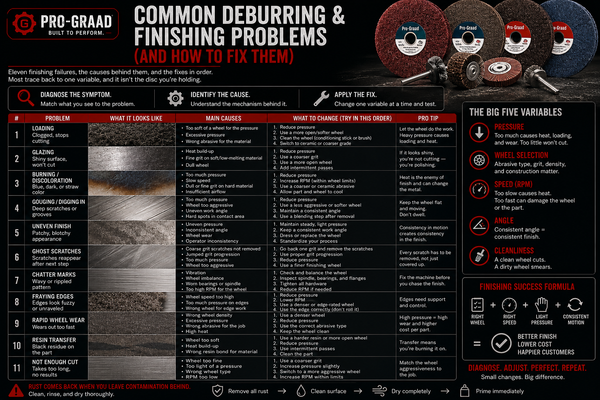
Before covering the tools, it's worth grounding the "what is deburring" question firmly. Deburring is the manufacturing process of removing unwanted material projections, called burrs, from machined, stamped, cast, or molded parts. These burrs form as sharp edges, raised material, or rough protrusions along part edges, holes, and surface transitions during primary manufacturing operations.
In my experience, most shop injuries and assembly failures that go unexplained trace back to inadequate deburring. Excess material can interfere with dimensional tolerances, create stress concentration points, prevent proper mating of components, or cause injury during handling. In precision assemblies, even a 0.05mm burr can prevent proper seating of O-rings, gaskets, or bearing surfaces. That is a significant margin of error for something as simple as a missed finishing step.
Industry analysis suggests that poor finishing causes around 12% of rejections in industrial components annually. If you are losing one in eight parts to rework or scrap because of avoidable burrs, a proper deburring toolkit pays for itself fast, set a benchmark of fewer than 2% rejection rates related to edge quality, and use it to evaluate your current process.
The Two Main Categories: Manual vs. Power
Hand tools are used for low-volume work, touch-ups, or precision areas that require operator control. They typically use replaceable blades or cutting edges to remove burrs manually. Hand tools are simple and cost-effective but depend heavily on operator consistency. Power tools, by contrast, increase speed and consistency and include electric or pneumatic tools designed to remove burrs quickly across larger surfaces or higher volumes.
The practical takeaway: buy both. Relying solely on hand tools at volume creates fatigue and inconsistency. Relying solely on power tools means missing the tight corners and internal features that machines can't always reach.
Tool 1: Pro-Graad Convolute Deburring Wheel, Editor's Pick / Best Overall
Best for: High-volume bench deburring on metal, composites, and tough alloys
If you add only one power deburring tool to your bench grinder, make it a convolute deburring wheel, and Pro-Graad's lineup of convolute deburring wheels sets the standard for shops that need professional-grade results without the middleman markup.
Pro-Graad's EXL PRO Convolute Deburring Wheel is purpose-built for exactly this use case. The EXL PRO wheel is described as the highest-performing deburring wheel in the lineup, providing 30-50% longer life than the original EXL wheel without sacrificing smooth feel and conformability. It requires less pressure for a faster cut, making it the wheel of choice for premium performance.
What separates Pro-Graad from generic abrasive wheels is the combination of materials and engineering. Constructed with a unique combination of fiber strands and silicon carbide abrasive mineral, the deburring wheel is both durable and lightweight, with a web construction and high tensile strength elastic fibers that resist clogging, efficiently dissipate heat, operate quietly, and effectively remove unwanted burrs, sharp edges, paints, and oxides.
For shops working on stainless steel, titanium, or other demanding alloys, the Pro-Graad SST and EXT Deburring Wheels address those materials specifically. Their high-density convolute design effortlessly removes sharp burrs and radius edges, even on intricate shapes and contours, with aerospace-grade performance suited to turbine blades, surgical instruments, and aluminum die cast flashing.
Pros:
- 30-50% longer service life versus standard convolute wheels
- Works across metals, composites, and glass
- Fits standard bench grinder shaft sizes (3/4", 5/8", 1/2") via included telescoping arbor adapter
- Open web construction prevents overheating on heat-sensitive materials
- Backed by a 100% product guarantee and US-based customer support
Cons:
- Requires a bench grinder or motor, not a standalone handheld tool
- Maximum 3,600-6,000 RPM depending on model, verify compatibility with your machine
- Hard-density models (EX3) may not be ideal for applications requiring surface conformity
Pro Tip: The convolute construction and clean, uniform wear keep the wheel running smoothly and produce a professional finish with less pressure, minimizing fatigue, and the EXL PRO material runs cool with fresh abrasives continuously exposed, making it a superior choice on heat-sensitive substrates. Run it at or below the rated RPM for the best balance of cut rate and wheel life.
Tool 2: Swivel-Blade Hand Deburring Tool
Best for: Low-volume precision work, straight and curved edges, hole deburring
The swivel-blade hand tool is the foundational piece of any deburring setup. The defining design is the swivel blade, a hardened steel cutter mounted on a pivoting shank that rotates inside a handle. As the operator pulls the tool along the workpiece edge, the blade pivots to follow the cut angle, and a single pass shears off the burr and leaves a small chamfer in its place.
Hand deburring tools equipped with heavy-duty 3.2mm swivel blades are perfect for the fast and easy removal of burrs from straight edges, curved edges, holes, cross holes, and deep holes. The key selection factor is blade material. Blades are made of M35 Super H.S.S. or Tungsten Carbide, ensuring exceptional durability and performance, and certain blades can be TiN-coated for increased tool life.
Safety note: Always use safety glasses and replace blades at the first sign of wear. Keep blades fresh and never resharpen deburring blades, sharpening weakens the hook and increases the snap risk. Blade replacement costs a few dollars; a trip to urgent care costs considerably more.
Pros:
- Affordable entry point for any shop
- Works on metal, plastic, composites, and pipe
- Replaceable blades extend tool life
- No power source needed
Cons:
- Consistency depends on operator technique
- Slower than power tools for high-volume runs
- Blade life shortens significantly on hardened steel or superalloys
Tool 3: Chamfer Mill for CNC Machines
Best for: Repeat-production deburring integrated directly into CNC programs
CNC deburring uses tools programmed into the machining cycle. CNC deburring produces a predictable edge geometry because it is driven by toolpaths, offsets, and cutting parameters. For shops running repeat parts in medium-to-high volumes, chamfer mills are the most efficient path to burr-free edges at the machine, with no secondary handling required.
Deburring parts can be tiresome expensive, and time-consuming if done by hand. CNC-toleranced deburring tools that allow you to deburr in your CNC machine provide a better, more accurate finish. The chamfer mill achieves this by creating a controlled angled break on edges and hole entrances that meets customer specifications consistently across every part in a batch.
According to Bel Air Finishing's CNC deburring tools, Bel Air Finishing's CNC deburring tools holders are purpose-built for automated top and bottom deburring of machined holes in one continuous pass, eliminating tool changes and manual finishing, with a telescopic mechanism that absorbs workpiece dimensional variation for consistent deburring even in high-mix, variable-batch operations.
Pros:
- Consistent, repeatable edge geometry across batches
- Eliminates secondary handling and reduces labor costs
- Integrates with existing CNC programs, no dedicated machine needed
- Front and back deburring achievable in a single pass with the right holder
Cons:
- Higher setup time, requires programming and tool path configuration
- Not suitable for one-off or very low-volume work
- Abrasive media from in-machine deburring requires careful coolant management
Pro Tip: CNC machines can do much of the deburring and edge rounding, freeing operators for tasks like checking parts or preparing for the next job. Shops are looking for ways to utilize their CNC equipment to deburr machined parts or move their hand deburring to a robotic cell external to the machine. Start by adding a chamfer pass to your existing program before investing in a robotic cell.
Tool 4: Carbide Burr (Rotary Die Grinder Bit)
Best for: Hard metals, irregular shapes, weld cleanup
A deburring tool removes burrs - metals like stainless steel or titanium and are the go-to choice when a swivel blade simply can't get enough bite on tough material. Mounted in a die grinder or rotary tool, a carbide burr removes material aggressively and allows freehand control across complex geometries.
Carbide lasts longer than HSS (high-speed steel), while ceramic or diamond-coated tools offer extended life in abrasive applications. For a shop that regularly works with stainless, Inconel, or hardened tool steel, carbide burrs are worth the additional cost per unit, use cut rate and burr removal rate as your benchmarks to decide when to step up from HSS.
Pros:
- Aggressive material removal on hard metals
- Works across complex and irregular geometries
- Compatible with standard die grinders and rotary tools
- Wide variety of shapes (ball, cylinder, cone, tree) for different access requirements
Cons:
- Requires a powered hand tool (die grinder, Dremel, or drill)
- Generates heat, requires adequate ventilation and PPE
- Less precise than a swivel blade for fine edge work
Tool 5: TwistFlex Hone and Cylinder Bore Brush
Best for: Internal bore deburring and surface finishing on cross-drilled holes
Internal features are where deburring gets most difficult. Burrs often form on the back side of holes, intersecting passages, or inside bores where standard tools cannot reach. This is exactly where a flex hone earns its place in the toolkit.
Pro-Graad's TwistFlex Cylinder Honing and Deburring Tool is a strong option for shops handling bore work. The TwistFlex is self-centering self-aligning, and conforms to the bore diameter to provide consistent surface finishing and deburr cross-drilled holes, with the brush being self-compensating to produce a consistent finish throughout the life of the tool.
The TwistFlex Cylinder Honing and Deburring Tool can be run with hand tools, a drill press, or CNC equipment, making it one of the most versatile internal deburring options for shops that want one tool to cover multiple machine types.
Pros:
- Self-centering design ensures consistent contact throughout bore
- Works in hand drill, drill press, or CNC spindle
- Produces cross-hatch finish that improves sealing and ring seat
- Available in silicon carbide grits for different material hardness
Cons:
- Sized to bore diameter; you need the correct size per bore
- Max RPM is lower than most rotary tools (typically 600-1,000 RPM optimal)
- Requires lubrication for best results and tool longevity
Tool 6: Nonwoven Surface Conditioning Disc
Best for: Surface prep, rust and oxide removal, blending, and light deburring on flat surfaces
Deburring is shifting from manual to automated work to CNC, robotic, and abrasive-based automation, and new tools like nonwoven abrasives and ceramic brushes boost quality, cut labor, and save time. The nonwoven quick-change disc is the practical embodiment of that shift for bench and field use.
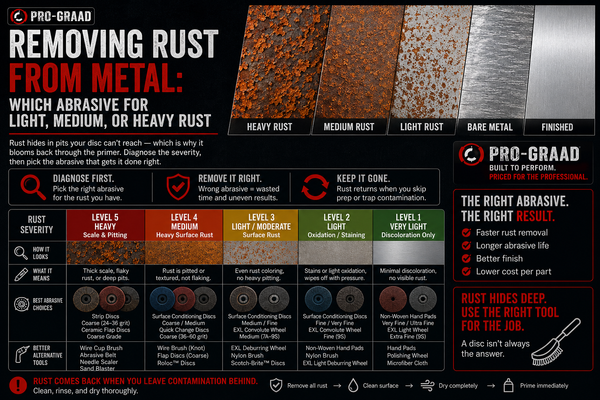
Pro-Graad's 2" Quick Change Non-Woven Surface Conditioning Discs are purpose-built for exactly this role. They are ideal for surface preparation and finishing, including deburring, leveling, finishing, castings, blending, polishing, and removal of rust, paint, and gasket material, with abrasive-impregnated nylon non-woven material that works effectively at removing surface oxidation and rust on metal surfaces.
The Male R-Type fastening system ensures quick and easy attachment to the holder, and the discs are manufactured to industrial standards and recommended for use with high-speed power tools and pneumatic grinders.
Pros:
- Quick-change system means zero downtime for disc swaps
- Handles multiple finishing tasks without a tool change
- Conforms to curved and irregular surfaces
- Works on metal, composites, and coated surfaces
Cons:
- Not designed for aggressive burr removal on thick edges, use a carbide burr for heavy stock
- Disc life varies by material and pressure applied
- Best with a die grinder, less effective with low-speed drills
Pro Tip: These discs are perfect for hard-to-reach surfaces and odd angles, keep a pack of both coarse and fine grades in your tool cart. Use coarse for initial deburring and oxide removal, then swap to fine for the final blend before coating or inspection.
Tool 7: Abrasive Files and Needle Files
Best for: Touch-up, tight inside corners, very fine edge work, and plastic or composite finishing
Deburring is shifting from manual to automated lathe, the machinist picks up a file, scraper, or bit of sandpaper and gets to work smoothing edges and chamfering holes until the part meets quality requirements. The abrasive file is the most fundamental deburring tool and remains indispensable even in highly automated shops.
Scrapers and files are used for finishing straight edges or flat surfaces, while chamfering tools create angled edges to remove sharpness. Needle files extend reach into slots, recesses, and grooves that no rotary tool can access cleanly.
Pros:
- Zero power requirement, works anywhere
- Lowest cost entry point in the deburring toolkit
- Provides tactile feedback, the operator knows exactly when the burr is gone
- Handles plastic, wood, and composites without risk of overaggressive material removal
Cons:
- Slowest method for high-volume or large-surface work
- Consistency depends entirely on operator skill and attention
- Files wear faster on hardened steel and should be replaced rather than used past their service life

How to Choose the Right Deburring Tool for Your Shop
Selecting the right deburring tool is not a one-size decision. The right tool depends on the material being worked, where the burr is located, and the type of edge that needs finishing. Choosing correctly saves time and produces a cleaner result.
Match Tool to Material
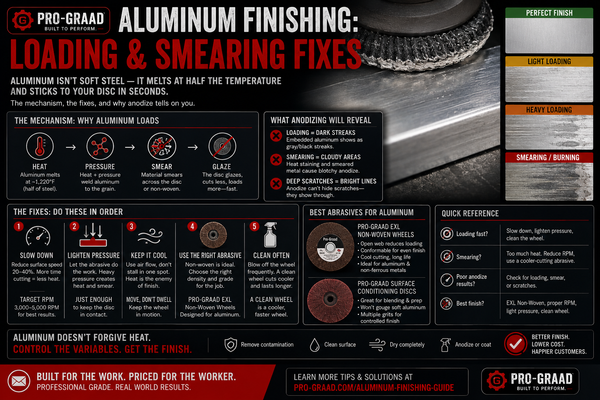
The type of material being deburred is a fundamental factor. Materials such as aluminum, steel, or composites require specific deburring tools. For instance, magnetic deburring tools prove highly effective for ferrous metals, while manual deburring tools may be more suitable for softer materials like plastics or brass.
Match Tool to Location
Consider whether the burr is on an outside edge, an internal surface, or in a hard-to-reach corner. External edges respond to swivel blades and convolute wheels. Internal bores need flex hones or abrasive brushes. Intersecting cross-holes in CNC parts call for either programmatic chamfer passes or flexible ceramic brush tools.
Match Tool to Volume
A deburring tool removes burrs - be chosen depending on accessibility and burr severity. Manual tools work well for small runs, while automated options suit high-volume production. If you are running more than 50 identical parts per day with consistent burr locations, the calculation strongly favors CNC-integrated tooling over hand finishing.
Common Deburring Mistakes to Avoid
Using Dull Blades
Replacing dull blades promptly is critical; a sharp blade is safer and produces cleaner results. A dull blade requires more pressure, which increases both injury risk and surface damage. Replace blades on a set schedule, not just when performance degrades visibly.
Skipping Internal Features
Shipping parts with hidden hole-exit burrs or smeared threads risks jams during assembly, leaks on sealing faces, and cosmetic rejects after anodizing or plating. Build a checklist that explicitly covers internal cross-holes, bore exits, and intersecting passages for every part before it leaves the bench.
Ignoring Coolant Management in CNC Deburring
When introducing abrasive media to an in-machine CNC deburring setup, manage swarf carefully. The industry is suffering from a skilled labor shortage, and fixing it will take years, which is why many shops are seeking more effective ways to deburr parts while still in the machine or investing in robots and cobots to augment their existing labor force. Build your deburring process to run as independently as possible from operator intervention.
Frequently Asked Questions
What is deburring, and do I really need to do it every time?
Deburring is the process of removing burrs and sharp edges from a workpiece to improve safety, function, and appearance. In many industries, deburring is a critical finishing step that improves product reliability, consistency, and customer satisfaction. Yes, every machined, stamped, or cut part carries some risk of burr formation. The scale of effort varies, but skipping it entirely is not a safe or compliant option in most production environments.
What is the difference between a deburring tool and a chamfering tool?
Deburring removes unwanted material that formed unintentionally during machining. Chamfering creates a deliberate, controlled angled edge on a part, typically to a specification. If you want a measurable edge break without extra manual work, a chamfer can replace "hand deburr" in many cases, and that approach also makes RFQs easier to compare because every supplier quotes the same geometry and inspection intent. In practice, many CNC chamfer passes also perform deburring simultaneously.
How do I choose between a hand deburring tool and a power deburring tool?
Hand tools are used for low-volume work, touch-ups, or precision areas that require operator control, and are simple and cost-effective but depend heavily on operator consistency. Choose power tools when speed and consistency matter more than precision control. For mixed shops, the practical answer is to own both and match the tool to the task.
How often should I replace deburring blades or wheels?
Inspect blades and abrasives frequently for signs of wear or damage; replacing them promptly prevents further issues and maintains the quality of your work. For swivel blades on steel, replace 2-3 times more frequently than you think necessary. For convolute wheels, monitor cut rate, when you need to increase pressure to maintain the same material removal, it's time for a new wheel.
Can deburring tools be used in CNC machines?
Yes. Tools like the Pro-Graad TwistFlex Cylinder Honing and Deburring Tool can be run with hand tools, drill press, or CNC equipment. Dedicated CNC deburring tool holders, chamfer mills, and abrasive brush tools are all designed for spindle mounting. According to the National Institute of Standards and Technology, over 44% of deburring tools in use are integrated with CNC machines. If you are not yet using your CNC for deburring, this is the single highest-ROI process change available for repeat-production shops.
Final Recommendation
Every shop needs a core deburring toolkit, and building it does not require a huge budget. Start with a swivel-blade hand tool and a set of abrasive files for immediate, zero-investment coverage. Add a Pro-Graad convolute deburring wheel mounted to your bench grinder as the single most versatile upgrade for surface and edge finishing across metals and composites. Layer in carbide burrs, flex hones, and nonwoven discs as your material mix and volume demands it. For CNC shops, integrate chamfer passes into existing programs before considering robotic cells.
The goal is consistent, verifiable edge quality on every part that leaves your shop, and the tools in this list give you everything you need to get there.
Sources
-
Industrial Deburring Tools Guide, DXP Enterprises. Types, uses, and selection guidance for deburring tool categories. https://www.dxpe.com/industrial-deburring-tools-guide/
-
What Is a Deburring Tool? Definition, Types, and Uses Explained, Can Star Industrial. Overview of deburring tool types and industry applications. A deburring tool removes burrs -
-
Deburring, Processes, Tools, and Quality Benefits, Bang Design. In-depth explanation of burr formation and deburring methods. https://bangid.com/knowledge-base/manufacturing/what-is-deburring/
-
What Is Deburring? Tools, Machines and CNC Techniques, JLCCNC. CNC deburring methods, tool comparison, and workflow guidance. https://jlccnc.com/blog/cnc-deburring-tools-guide
-
The Essential Guide to Deburring: Tools, Techniques, and Tips, MSC Industrial Supply. Trends in CNC, robotic, and abrasive-based deburring. Deburring is shifting from manual to automated
-
Deburring Tools Market Size and Opportunities Report, Market Growth Reports. Global market sizing and CAGR projections through 2035. https://www.marketgrowthreports.com/market-reports/deburring-tools-market-116527
-
Global Deburring Tools Market Size and Share, Global Growth Insights. Market valuation and industry segmentation data. https://www.globalgrowthinsights.com/market-reports/deburring-tools-market-103957
-
Deburring Tools Market Size, Share and Forecast, Industry Research. Statistics on adoption rates, rejection rates, and automotive use. https://www.industryresearch.biz/market-reports/deburring-tools-market-110273
-
CNC Deburring Guide, HM Custom CNC Parts. Burr types, root causes, and six proven CNC deburring methods. https://hmaking.com/cnc-deburring-guide/
-
Bel Air Finishing Introduces CNC Deburring Tools, Advanced Manufacturing / SME. Coverage of next-generation floating deburring tool holders. Bel Air Finishing's CNC deburring tools
-
Noga Swivel Blades, Hand Deburring Tools, Samtec Tools. Blade material options, size classifications, and application guidance. https://www.samtectools.com/noga-swivel-blades-hand-deburring-tools.php
-
Deburring Tool Guide: Swivel Blades, Chamfer and Safety, AIMS Industrial. Swivel blade mechanics, safety warnings, and blade replacement guidance. https://aimsindustrial.com.au/blogs/product-guides/deburring-tool-guide
-
Hand Deburring Information Guide, MSC Industrial Supply. Selection criteria for hand deburring tools and safety best practices. MSC's hand deburring guide