What Is a Convolute
Deburring Wheel?
It looks like a grinding wheel. It behaves like nothing of the sort. A convolute wheel is a coil of abrasive-loaded nylon web wound around a core — mostly air by volume, and engineered to cut a burr off without touching the part underneath. Here's how it's built, why the construction matters, and how to read the spec code.
Start with the name, because the name is the whole product.
Convolute means coiled or wound. That's not a brand word or a marketing flourish — it's a literal description of how the wheel is manufactured. A long strip of non-woven abrasive web gets wound around a core, layer over layer, until it reaches diameter. Then it's cured and trued into a wheel.
Every other property this wheel has follows from that one fact.
A convolute deburring wheel is a non-woven abrasive wheel made by winding a continuous strip of resin-bonded, abrasive-loaded nylon web around a central core. The resulting wheel is porous and resilient — it conforms to the workpiece under load, cuts burrs and surface contaminants, and does not appreciably remove base metal.
Understand that last clause and you understand the product. A bonded grinding wheel is a rigid mass of abrasive designed to plow material off a part. A convolute wheel is a flexible coil designed to cut what's standing proud and leave the part alone. They mount on the same grinder. They are not the same category of tool.
How It's Built
Three stages. The middle one is where the name comes from and where the performance comes from.
The coil is the product. Every layer of web you see in cross-section is abrasive — grain is bonded through the full thickness of the material, not painted on a surface. As the outer layer wears away, the layer beneath it is already loaded and ready to cut.
Stage by stage
- The web. An open, three-dimensional mat of nylon fibers. Abrasive grain is bonded to the fibers throughout the depth of the mat with a resin system. At this point it's a flexible strip — closer to a scouring pad than a grinding wheel.
- The winding. The strip is wound around a core under controlled tension, coil on coil, out to finished diameter. Tension during winding is what sets density. Wind it loose and you get a soft, conformable wheel. Wind it tight and you get a hard one that holds its shape under load. Same web, same grain — different wheel.
- Curing and truing. The resin is cured to lock the coil into a solid, self-supporting wheel. Then it's trued so it runs concentric on the arbor. A wheel that isn't trued properly goes out of round under uneven pressure, and you'll feel it as vibration and chatter the moment it touches a part.
Why "Density" Isn't "Coarseness"
This is the most common misread in the category, and the manufacturing sequence explains it. Density is set by winding tension. Grade is set by the grain in the web. They're established at different stages of the build from different inputs — which is exactly why they're independent specs, and why a hard Medium and a soft Medium are two different tools.
Why the Construction Matters
Four behaviors fall straight out of "a coil of porous web" — and together they're the entire case for using one.
| Behavior | Because | What It Means at the Bench |
|---|---|---|
| It conforms | The web is open and resilient — it compresses under load instead of resisting | The abrasive follows contours, radii, and irregular profiles instead of flattening them. Complex parts get an even finish. |
| It won't gouge | No rigid mass to plow with. Pressure spreads across the contact patch. | Uneven operator pressure doesn't destroy the part. This is what makes it usable for precision deburring where tolerances matter. |
| It renews itself | Grain runs through the full thickness of the web, not just the surface | Worn fibers break away and expose loaded web underneath. The wheel keeps cutting instead of glazing — consistent from first use to end of life. |
| It runs cool | Mostly air. Open structure clears debris and doesn't trap heat at the contact point. | Less discoloration and warping risk on heat-sensitive substrates — stainless, aluminum, copper. Matters most where the alloy won't conduct heat away. |
The Limit — Say It Plainly
A convolute wheel does not remove base metal in any meaningful quantity. That isn't a shortcoming; it's the specification. It cuts what's standing proud of the part — burrs, oxide, tint, coating, scratch pattern — and leaves the dimension alone. If a weld bead needs to come down, that's a different tool entirely, and no density or grade of convolute wheel will get you there.
Convolute vs. Everything Else
Same non-woven web appears in several formats. The build method is what separates them.
| Format | How It's Made | Where It Wins |
|---|---|---|
| Convolute wheel | Web wound in a coil around a core | Larger wheels, longer wear life, general-purpose bench deburring and finishing. The workhorse format. |
| Unitized wheel | Web layered flat and compressed under pressure | Achieves higher densities than convolute. Smaller diameters, precision work, tight corners, die grinder mounting. |
| Surface conditioning disc | Web bonded to a disc backing | Portable. The tool goes to the part — weldments, large assemblies, in-place work. |
| Flap brush / interleaf | Web strips radially mounted, often interleaved with coated abrasive | Highly conforming on irregular profiles a solid wheel can't follow. |
| Hand pad | Web cut to sheet | Hand pressure only. Touch-up, tight spots, testing a grade before committing a wheel to it. |
↔ Scroll table horizontally on mobile
Convolute or Unitized?
Rough division: convolute for larger wheels and general deburring, unitized for small diameters and precision work. The pressed construction of a unitized wheel reaches densities a wound wheel can't, which is why they dominate fine, tight-tolerance work on small parts. For a 6" wheel on a bench grinder doing everyday edge break, convolute is the format.
Cracking the Density Code
Convolute wheels are specified with a short code — a number and a letter — plus a separately named grade. It looks cryptic. It isn't.
The Number = Density
How hard the wheel is and how much it conforms. Set by winding tension. 7 softest · 8 all-round · 9 hardest.
The Letter = Abrasive
Which mineral is in the web. A = Aluminum oxide · S = Silicon carbide.
So 8A reads as density 8, aluminum oxide. 9S reads as density 9, silicon carbide. The grade — Coarse, Medium, Fine, Very Fine — is called out separately, because it's a third and independent decision.
Density — how hard it pushes back
- 7 — softest. Flexes into contours. Finishing and delicate parts.
- 8 — the all-rounder. Mixed deburring and finishing. Enough backbone to break an edge, enough give to follow a profile.
- 9 — hardest. Holds its shape under load. Heavy deburring, sharp edges, flat surfaces.
Abrasive — pick by material, not by feel
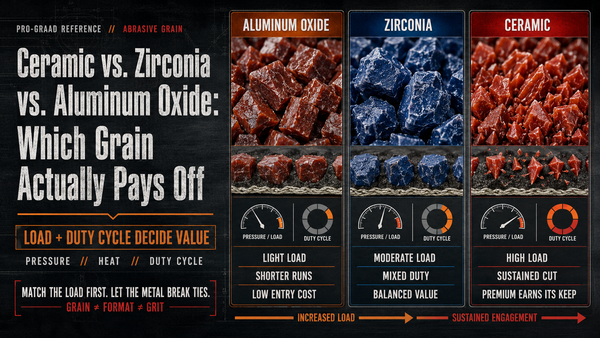
- Aluminum oxide (A) — tough, blocky grain. The call for ferrous metals: carbon steel, stainless, alloy steel, iron.
- Silicon carbide (S) — sharper, more friable, cuts cool with less pressure. Right for aluminum, brass, copper, titanium, composites, plastics.
Grade — sets the finish, not the aggression
- Coarse — aggressive deburring, dull satin finishing.
- Medium — general deburring and blending.
- Fine — satin finishing and light cleanup.
- Very Fine — the smoothest finish passes.
Three Decisions, Not One
Density, abrasive, and grade are independent. Density doesn't make a wheel cut coarser. Grade doesn't make it harder. Abrasive doesn't change either one. Most people shop the grade and let the other two happen to them — and then can't explain why two "Medium" wheels behave nothing alike.
Ready to match a spec to your material? The Pro-Graad 6" EXL Convolute Deburring Wheel Selection Guide runs the full line SKU by SKU — every density, grade, and abrasive combination, matched to the metals they're built for.
Running One Without Wrecking It
Mounting
Convolute wheels mount on a bench or pedestal grinder arbor. The wheel's arbor hole and your grinder's shaft have to agree — a 1" arbor hole on a 5/8" shaft needs an adapter, and running a wheel that isn't properly seated and concentric is how wheels go out of round. Pro-Graad EXL wheels ship with a telescoping arbor adapter covering 1/2", 5/8", and 3/4" shafts for that reason.
Check the RPM Before You Mount It
Non-woven wheels frequently carry a maximum safe speed below what a bench grinder spins at. The wheel is a cured coil of nylon web, not a bonded abrasive, and it does not tolerate overspeed. Read the rating on the wheel, read the rating on the tool, and never assume that because it fits the arbor, it's rated for the shaft. Guards on. Eye and face protection. Every time.
Pressure
Light and steady. The instinct to lean on it is wrong here — past the wheel's pressure window you're compressing the coil rather than cutting with it, which generates friction heat, softens nylon fibers, and can deposit residue on the workpiece. You're not cutting faster; you're just spending the wheel and adding a cleanup step. Let it cut.
Wear
A convolute wheel wears from the outside in, shedding spent web and exposing loaded web underneath. It should keep cutting at a consistent rate as diameter drops. Two things to watch:
- Glazing — the face looks shiny and stops cutting. Usually too much pressure or too little. The wheel needs to break down to renew, and it can't do that if it's being crushed.
- Loading — the pores pack with swarf. Common on soft metals and coatings. Ease off, and check that your abrasive matches the material.
Contamination
The open web that makes these wheels work also makes them very effective at trapping particles and carrying them to the next part. Never run a wheel on stainless that has touched carbon steel — embedded free iron transfers to the stainless surface and rusts there, sometimes weeks after the part has shipped. Dedicate wheels by material and store them separately.
When It's the Wrong Tool
Honest limits, so you don't buy one for a job it can't do:
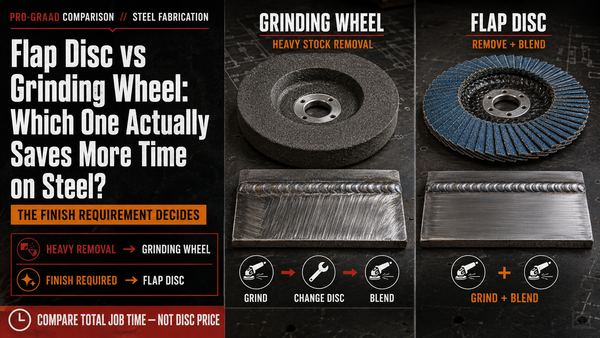
- Stock removal. Weld beads, heavy flash, real material — a convolute wheel won't touch it. Knock it down with something that cuts, then bring the part to the wheel.
- Parts too large to lift. A bench wheel means the part comes to the tool. For weldments and assemblies, you want a portable format — a surface conditioning disc on an angle grinder does the same job in a different geometry.
- Deep internal features. A 6" wheel reaches what a 6" wheel reaches. Small unitized wheels on a die grinder go where it can't.
- Sharpening a defined edge. The wheel conforms — that's the point — so it will round a cutting edge rather than hold a flat bevel on it. Wrong tool for grinding geometry.
Answers, Short Version
What does "convolute" actually mean?
Coiled or wound. It describes the manufacturing method: a continuous strip of non-woven abrasive web wound around a central core, layer over layer, then cured and trued into a wheel. The name is a literal description of the build, not a brand term.
What's the difference between convolute and unitized wheels?
Build method. Convolute is wound in a coil around a core. Unitized is layered flat and compressed. Pressing reaches higher densities than winding, so unitized wheels dominate small-diameter precision work, while convolute covers larger wheels and general bench deburring.
What does 8A mean on a deburring wheel?
Density 8, aluminum oxide. The number is density — 7 softest, 8 all-round, 9 hardest — and the letter is the mineral, where A is aluminum oxide and S is silicon carbide. The grade (Coarse, Medium, Fine, Very Fine) is specified separately.
Is a higher density number more aggressive?
No — density is hardness and conformability, not coarseness. It's set by winding tension; grade is set by the grain in the web. A 9-density Fine wheel is hard but leaves a fine finish. A 7-density Coarse wheel is soft but cuts coarse. They're independent specs.
Will a convolute wheel remove a weld?
No. It cuts burrs and surface contaminants and leaves base metal alone — that's the specification, not a limitation. Take the bead down with a flap or fiber disc first, then bring the part to the wheel for the edge break and finish.
Aluminum oxide or silicon carbide?
Pick by material. Aluminum oxide for ferrous — carbon steel, stainless, alloy steel, iron. Silicon carbide for aluminum, brass, copper, titanium, composites, and plastics.
Why is my wheel vibrating?
Usually out of round. A wheel that isn't seated concentric on the arbor, or that's been worn unevenly by inconsistent pressure, will chatter and ruin finish uniformity. Check the mount and the adapter first, and keep pressure even across the face.
Can I use one wet?
Depends on the wheel. Pro-Graad EXL wheels are rated for both dry and coolant-assisted operation, including flood coolant environments. Check the rating on any wheel before introducing coolant — not all non-woven products are rated for it.
Built for the Work.
Priced for the Worker.
Pro-Graad is an independent brand making convolute deburring wheels for shops that measure performance in parts finished, not in logos on the box. 6" × 1" × 1", convolutely wound on a solid 1" core. Wet and dry rated. Telescoping arbor adapter for 1/2", 5/8", and 3/4" shafts. Exceeds ANSI and EU standards, backed by a 30-day guarantee.
Pick Your Spec — Selection Guide Shop EXL Wheels
Not sure which spec fits your material? Tell us the metal, the part, and the finish.
info@pro-graad.com · pro-graad.com