Bench Grinder Wheel Speed Ratings: Matching Wheel RPM to Motor RPM
The wheel has a ceiling. The motor has a speed. One rule connects them: the spindle can never turn faster than the number printed on the wheel. Here is how to read both numbers correctly — and the five ways a bench setup quietly ends up over the line.
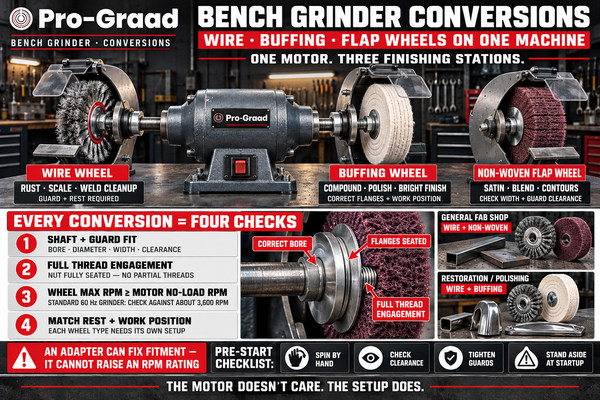
Motor speed must be at or below the wheel's marked maximum RPM. Always. On a standard 60 Hz bench grinder, compare against 3,600 RPM — not the 3,450 on the nameplate — because that is what the motor spins with no load. A wheel's RPM rating belongs to its diameter: go bigger on the same motor and you are running faster at the rim, whether the bore fits or not.
This is the bench-grinder side of the speed question. For the full math across every abrasive family — angle grinder discs, die grinder accessories, cartridge rolls — use our Abrasive RPM & SFPM chart. For bore, shaft and thread fitment, see Why Your Bench Grinder Wheel Won't Fit. This page is about the one thing those two don't settle on their own: whether this wheel belongs on this motor.
The motor side: what your grinder actually spins
Most bench grinders and buffers use a two-pole induction motor. On 60 Hz power, that motor's theoretical (synchronous) speed is 3,600 RPM. Under load it slips a little, which is where the 3,450 on the nameplate comes from. The nameplate number is a loaded speed. Free-running with a wheel spinning and nothing touching it, the motor sits much closer to 3,600 — and that free speed is the number the wheel sees most of the time.
So the rule for a speed check is simple: use the highest speed the machine can produce, not the speed it runs at while you're leaning a part into it.
| Machine | Nameplate | Check against | Notes |
|---|---|---|---|
| Standard bench grinder, 60 Hz | 3,450 RPM | 3,600 RPM | The common 6" and 8" machine in the US |
| Slow-speed grinder / buffer, 60 Hz | 1,725–1,750 RPM | 1,800 RPM | Four-pole motor; common on sharpening grinders and large buffers |
| Two-pole motor, 50 Hz | ~2,850 RPM | 3,000 RPM | Imported and export machines |
| Variable-speed grinder | Range | Top of the range | The dial can always be turned up later — by you or someone else |
| Belt / pulley-driven arbor | Varies | Calculated | Pulley ratio changes spindle speed — see section 04 |
If the nameplate is missing or unreadable, treat any two-pole 60 Hz machine as 3,600 RPM until proven otherwise. A tachometer reading at free speed settles it.
The wheel side: the marking is the limit
Every bench wheel, buff, flap brush and convolute wheel carries a maximum operating speed — printed on the blotter, the wheel face, the label, or the product listing. OSHA's abrasive wheel standard (29 CFR 1910.215) requires that the machine's spindle speed be checked before mounting to make sure it doesn't exceed that marked maximum. ANSI B7.1, the standard OSHA enforces it through, is the reason the number is there at all.
That marking is not a suggestion and it is not the "best" speed. It is the ceiling the manufacturer tested the product above, with a safety margin you are not entitled to spend.
The rating belongs to the diameter
What tears a wheel apart is rim speed — surface feet per minute, SFPM. Same motor, bigger wheel, faster rim:
SFPM = π × Diameter (in) × RPM ÷ 12That is why a 6" vitrified bench wheel is commonly marked 4,140 RPM — about 6,500 SFPM — while an 8" vitrified wheel built for the same grinders is commonly marked 3,600 RPM. The 8" has to be built to a higher surface speed just to clear a 3,600 RPM motor. Neither number transfers to another diameter.
Typical ceilings for what goes on a bench grinder
| Wheel type | 6" | 8" | 10" | On a 3,600 RPM motor |
|---|---|---|---|---|
| Vitrified grinding wheel | 4,140 typ. | 3,600 typ. | Read label | 6" and 8" clear. 10" only if built and marked for it. |
| Convolute non-woven | 6,000 | 4,500 | 3,600 | 6" and 8" clear. 10" is exactly at the line. |
| Unitized non-woven | 5,000 | Read label | Read label | 6" clears. Rated lower than convolute at every size. |
| Non-woven flap brush | Read label — varies by build | Check the listing before mounting. | ||
| Cotton / sisal buffs | Read label — varies by ply and sewing | Large buffs normally go on 1,800 RPM buffers. | ||
Convolute and unitized figures are published reference ceilings carried over from our RPM & SFPM chart. Vitrified figures are common markings, not universal ones. Every row loses to the marking on the actual wheel.
The matching rule, worked
One comparison. Machine free speed on one side, wheel marking on the other. The wheel number has to be equal or higher.
| Setup | Motor (free) | Wheel max | Result |
|---|---|---|---|
| 6" vitrified on a 6" bench grinder | 3,600 | 4,140 | OK — 540 RPM headroom |
| 8" vitrified on an 8" bench grinder | 3,600 | 3,600 | OK — at the marking, not over it |
| 6" convolute on an 8" bench grinder | 3,600 | 6,000 | OK — wide margin |
| 10" convolute on a 3,450 nameplate motor | 3,600 | 3,600 | At the line — no margin for a fast motor |
| 12" convolute on the same motor | 3,600 | 3,000 | OVER — do not mount |
| Any 3,600-rated wheel on a 50 Hz motor run on 60 Hz | ~3,600 | 3,600 | Was rated against 3,000 — verify |
Notice that the dangerous rows are never the obvious ones. Nobody mounts a wheel they know is over-speed. They mount a bigger wheel because it fits the shaft, or they move a wheel to a different machine, and nobody re-reads the label.
Five ways bench setups end up over speed
1. Going up a diameter
The most common one. A 10" flap brush or buff has a bore that fits the 8" grinder's shaft — with a bushing, it seats perfectly. But the motor didn't slow down, so the rim is now 25% faster than the 8" it replaced. On most bench grinders the guard physically won't close around a larger wheel, and that is the machine telling you something. A wheel that needs the guard off to fit is the wrong wheel for that machine.
2. Belt and pulley drives
Pedestal buffers, homemade arbors and polishing lathes often run through a belt. The pulley ratio sets spindle speed, and it can go either way:
Spindle RPM = Motor RPM × (Motor pulley Ø ÷ Arbor pulley Ø)A 3,600 RPM motor with a 4" pulley driving a 3" pulley on the arbor puts the spindle at 4,800 RPM — over the marking on every 8" vitrified wheel listed above. Swap the pulleys and you're at 2,700. Measure both pulleys and do the arithmetic before the first wheel goes on, and again any time a pulley changes.
3. A 50 Hz motor on 60 Hz power
Induction motor speed follows line frequency. A two-pole motor built for 50 Hz runs near 3,000 RPM where it was designed, and roughly 20% faster on 60 Hz. If the machine came from overseas, or the motor did, read the nameplate frequency — not just the voltage.
4. Variable-speed dials and VFDs
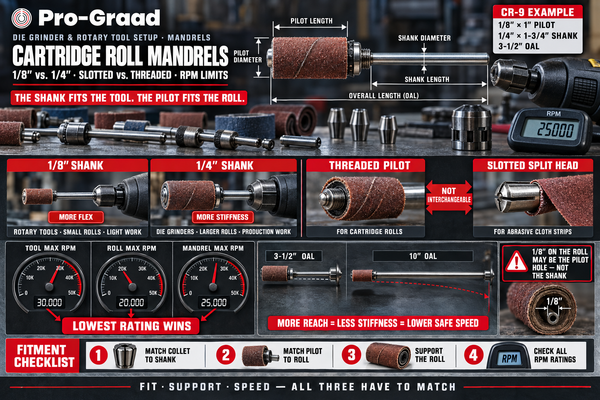
A variable-speed grinder or a motor on a variable frequency drive can be set safely today and turned up tomorrow. A VFD can also push a motor above its 60 Hz speed if it is programmed to. The wheel has to be rated for the top of whatever range the machine can reach, not the setting you happen to use.
5. Assuming the bushing re-rates the wheel
A reducing bushing fits a big bore to a small shaft. It changes nothing about how fast the wheel can safely spin. ANSI B7.1 specifically prohibits using bushings to run a wheel above its marked speed. If a wheel came off a slow buffer and is going on a fast grinder, the bushing that makes it fit is irrelevant to whether it should.
As a wheel wears down, its diameter shrinks and rim speed drops at the same RPM. That's safer, just slower cutting. The exception is a machine that raises RPM to compensate. Whatever the diameter, the spindle can never exceed the RPM marked on the wheel.
Bench speed check
Enter the motor, any pulley drive, and the numbers off the wheel label. The check compares spindle free speed against the wheel's marking.
This tool compares numbers you enter. It does not rate a wheel. The only authoritative speed is the one printed on the product by its manufacturer. An unmarked wheel is an unrated wheel — do not mount it.
Before the switch: the mounting sequence
- Find the free speed. Nameplate, pulley math, top of the variable-speed range. Use the highest number the machine can produce.
- Read the wheel marking. It must be equal to or higher than that free speed. No marking, no mount.
- Inspect and ring-test vitrified wheels. Tap a suspended, dry vitrified wheel lightly with a non-metallic tool. A clear ring is good; a dull thud means a crack. Non-woven, buffs and flap brushes don't ring — inspect them visually for tears, delamination and loose flaps.
- Mount clean and matched. Correct bore or the right reducing bushing for width, matched flanges, blotters on vitrified wheels, nut snug — not cranked.
- Guard, tool rest, tongue guard. Guard closed around the wheel. Tool rest within 1/8" of the wheel face. Tongue guard (spark arrestor) within 1/4" of the periphery. Reset both as the wheel wears.
- Stand aside and run it up. Start the machine with nobody in line with the wheel and let it run at full speed for a full minute before any work touches it. A flawed wheel lets go at startup more than at any other time.
Bench wheels and hardware
Every Pro-Graad wheel below lists its maximum operating speed on the product page. Match it to your motor before it goes on the arbor.
EXL Unitized Wheel — 6" Silicon Carbide 2S Fine
6" dia // 1/2" wide // 1/2" arbor // unitized non-woven
Conformable deburring and finishing on a standard 6" bench grinder. Unitized wheels carry a lower ceiling than convolute at every diameter, so this is the wheel to check the label on first if you're moving it between machines.
Non-Woven Flap Brush Wheel — 6" x 1" Grey 600
6" dia // 1" wide // fits 1/2", 5/8", 3/4" arbor // satin and burnish
Fine satin finishing and burnishing on aluminum, copper and stainless. A 6" brush on a 3,600 RPM grinder is the conservative setup — rim speed stays low enough for clean, cool finishing.
Non-Woven Flap Brush Wheel — 10" x 1" Green P180
10" dia // 1" wide // fits 1/2", 5/8", 3/4", 1-1/4" shaft // satin finishing
Big-diameter finishing for buffers and pedestal machines. This is exactly the wheel to run the section 03 check on: confirm the marked maximum against your motor's free speed — and any pulley ratio — before it goes on a 3,450 nameplate grinder.
EOL Sisal Buffing Wheel — 8" 11-Ply, 2 Pack
8" dia // 1/2" thick // 5/8" arbor // firm spiral-sewn sisal
First-step coarse cut buffing. Sisal is aggressive and firm; run it within its marked speed and let the compound do the cutting rather than pushing rim speed.
Muslin Cotton Buffing Wheel — 10" 80-Ply
10" dia // 1" thick // 3/4" arbor // fine muslin cotton
Final-stage polishing on a buffer or bench motor with a 3/4" arbor. At 10", this is a buff that wants a slow-speed motor or a verified marking — check before it goes on a two-pole machine.
Telescoping Reducing Bushings — 1/2" Wide Wheels
4-pc nested set // reduces 1-1/4" or 1" bore → 3/4", 5/8", 1/2" shaft
Centers an oversized bore on your shaft so the wheel runs true. It fixes fit — it does not change a wheel's speed rating.
FAQ
What RPM is a bench grinder?
A standard 60 Hz bench grinder is nameplated around 3,450 RPM and free-runs close to 3,600. Slow-speed grinders and buffers run about 1,725–1,800. Imported 50 Hz machines run near 2,850–3,000 at their design frequency.
Should I compare the wheel rating to 3,450 or 3,600?
3,600. The 3,450 nameplate figure is the motor's loaded speed. With nothing touching the wheel, it runs nearer 3,600, so that is the speed the wheel has to be rated for.
Can I put an 8" wheel on a 6" bench grinder?
Usually not. Both often run the same 3,600 RPM, so the speed may check out — but the 6" machine's guard is built around a 6" wheel. If the guard won't close, the wheel doesn't belong on that grinder.
Is it OK if the wheel's max RPM is higher than my motor?
Yes. That's exactly the requirement — the wheel's marked maximum must be equal to or higher than the machine's free speed. Extra headroom is fine. The reverse is never fine.
Does a reducing bushing change the wheel's speed rating?
No. A bushing only adapts the bore to the shaft. ANSI B7.1 specifically prohibits using bushings to run a wheel above its marked maximum speed.
How do I find the speed on a pulley-driven buffer?
Multiply the motor's free speed by the motor pulley diameter divided by the arbor pulley diameter. A 3,600 RPM motor with a 4" pulley driving a 3" arbor pulley turns the spindle at 4,800 RPM.