Bench Grinder Conversions: Wire, Buffing & Flap Wheels on One Machine
A bench grinder is a motor with a shaft out each side. Pull the stones and it becomes a wire station, a buffer, or a satin-finishing machine. The motor doesn't care. The guard, the rest, the arbor, and the speed rating do.
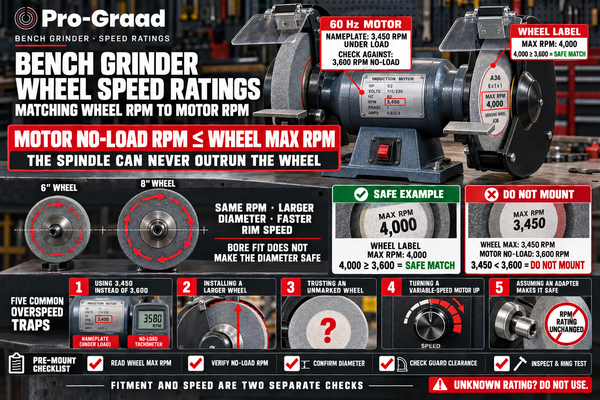
Every conversion is four checks: the wheel fits the shaft and the guard, the nut gets full thread engagement, the wheel's marked max RPM is at or above the motor's free speed (about 3,600 RPM on a standard 60 Hz grinder), and the rest and work position match the wheel type. Pass all four and one grinder can run two completely different jobs. Fail one and you've built a hazard with a nameplate on it.
Most shops don't need a dedicated buffer, a dedicated wire station, and a dedicated grinder. They need one 6" or 8" bench grinder set up for the two jobs they do most. The question is which two, and what has to change on the machine when a grinding stone comes off and something else goes on.
Three Wheel Families, Three Ways of Cutting
Wire, buffing, and flap wheels share an arbor and nothing else. They remove material differently, they want different pressure, and they fail differently.
Wire Wheels
Impact // crimped or knotted steel
Wire tips strike the surface and knock rust, scale, slag and paint loose. No abrasive grain, no grit progression. Leaves a rough, textured surface.
Buffing Wheels
Compound carrier // sisal, cotton, denim, leather
The cloth does almost nothing alone. The compound loaded onto it does the cutting and coloring. The wheel's job is to hold compound and control how hard it's pressed.
Flap Brush Wheels
Abrasion // non-woven flaps on a hub
Abrasive-loaded non-woven flaps that conform to the part. Strip, blend, satin, and burnish without compound, at a defined grit.
| Family | Best at | Pressure | Biggest risk |
|---|---|---|---|
| Wire | Heavy scale, slag, spatter, coatings on steel | Light. Let the tips work. | Thrown wire filaments |
| Buffing | Cut and color to a bright or mirror finish | Moderate, part kept moving | Part snatched out of hand |
| Flap brush | Rust and paint strip, blend, satin, burnish | Light to moderate | Heat on thin or soft stock |
The wire-vs-bristle question is its own fight. If you're deciding whether wire belongs on the machine at all, read Radial Bristle Brush vs. Wire Wheels first.
Pick Your Two Stations
Two shafts, two jobs. Choose the pair by the workflow you actually run, not by what came in the box. The stone that shipped on the grinder is not obligated to stay there.
| Left / Right | Who it's for | Why it works |
|---|---|---|
| Stone + Wire | Fabrication, general repair | Shape and sharpen on one side, clean welds and scale on the other. The classic setup, and still right for steel-heavy shops. |
| Wire + Flap | Restoration, rust and paint removal | Wire knocks off heavy buildup, a coarse or medium flap brush cleans up the wire marks and leaves a uniform satin. |
| Flap + Buff | Finishing, golf club refurb, aluminum and brass | Satin or pre-polish on the flap brush, then cut and color on the buff. A full finishing line on one motor. |
| Sisal + Cotton | Dedicated polishing | Firm sisal cuts with emery or tripoli; soft cotton or denim colors with rouge. Two-stage buffing without changing wheels. |
| Stone + Flap | Tool and blade work, machine shops | Grind the profile, then deburr and refine the edge without moving to another machine. |
A grinding stone throws abrasive grit. A buffing wheel catches it. Stone-and-buff on the same machine contaminates the buff and scratches the finish you're trying to color. If buffing is a station, the other side should be a flap brush or a second buff, not a stone.
Grinding steel throws hot iron fines. Finishing aluminum builds up fine aluminum dust in the guards and around the base. Mixed aluminum and iron-oxide fines are a recognized fire hazard. If one side grinds steel and the other finishes aluminum, clean the machine and bench between jobs, or split those jobs across machines.
Fitment: Width Is Where Conversions Fail
Bore and shaft fitment is covered in depth in Why Your Bench Grinder Wheel Won't Fit. Conversions add a problem the stock stones never had: width. Buffs, wire wheels and flap brushes come in widths the guard was never designed for.
Check 1: Does it fit inside the guard?
The wheel guard's inside width sets your maximum wheel width. Bench grinders commonly ship with stones around 3/4" wide on 6" machines and about 1" on 8" machines, and the guards are sized to match. A 2"-wide flap brush or a stacked pair of buffs may not clear. Measure the inside of the guard before you buy the wheel.
Check 2: Does the nut get full thread?
The shaft between the inner flange and the end of the threads is a fixed length. A wider wheel eats into it. If the outer flange and nut only catch a few threads, the wheel is too wide for that arbor. Full nut engagement is not optional.
Check 3: Is the bushing as wide as the wheel?
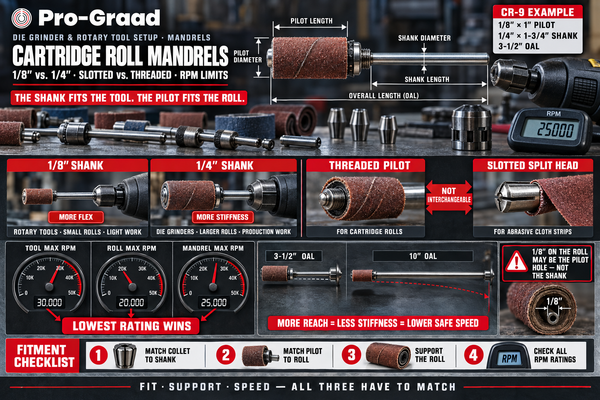
Buffs and flap brushes often ship with 1" or larger center holes. The reducing bushing must match both your shaft and the wheel's width so it supports the whole bore. A short bushing lets the wheel cock on the shaft and run out.
Then it doesn't fit. Removing the guard to make room for a bigger wheel means the machine is no longer set up as a grinder. If the wheel you want won't go inside the guard, the right machine is a dedicated buffer or a guarded polishing arbor built for that width and diameter, not a stripped-down bench grinder.
Speed: The Motor Doesn't Slow Down for Cloth
A standard 60 Hz bench grinder free-runs near 3,600 RPM, whatever the 3,450 on the nameplate says. Every wheel you mount must carry a marked maximum at or above that. Wire wheels, buffs, and flap brushes are all rated products; a wheel with no speed marking is a wheel with no rating, and it doesn't go on the machine.
Speed also changes the job. Rim speed, not RPM, decides how hard a wheel cuts and how much heat it puts into the part:
SFPM = (π × Diameter in inches × RPM) ÷ 12| Wheel diameter | At 3,600 RPM (standard grinder) | At 1,800 RPM (slow-speed / buffer) |
|---|---|---|
| 6" | 5,655 SFPM | 2,827 SFPM |
| 8" | 7,540 SFPM | 3,770 SFPM |
| 10" | 9,425 SFPM | 4,712 SFPM |
| 12" | 11,310 SFPM | 5,655 SFPM |
Calculated rim speeds. These are not ratings. The marking on the wheel governs.
Two things fall out of that table. First, a 6" wheel on a standard grinder is the forgiving setup: moderate rim speed, less heat, more control on finishing work. Second, big buffs belong on slow motors. A 10" or 12" buff on a 3,600 RPM grinder runs hot, grabs harder, and can be over its marked limit. Non-woven products are the strictest: convolute wheels top out right around 9,425 SFPM and unitized wheels lower still, which puts a 10" convolute at the edge on a 3,600 RPM motor. The full ceiling-by-diameter tables are in the Abrasive RPM & SFPM Chart.
Work Position: Below Center, Edges Trailing
On a bench grinder both wheels turn the same way: the top of the wheel comes toward you and the front face travels downward. With a stone, the tool rest carries the work at center height. With wire and buffs, the rules change.
Side view, operator on the right. Contact the wheel on the front face below center. Present the part so the wheel travels off an edge, never into one.
- Contact below the centerline. If the wheel grabs the part there, it throws it down and away from you instead of up into you.
- Edges trail. The wheel surface should run off an edge, not into it. An edge facing up into the rotation is how a buff or wire wheel snatches a part and launches it.
- Mind the tool rest. For grinding, the rest sits no more than 1/8" from the wheel and the tongue guard no more than 1/4". For buffing and wire work, many operators swing the rest out of the way so the part can't wedge between rest and wheel. If the rest stays, keep that 1/8" gap as the wheel wears or fluffs.
- Never wrap anything around a part. No rags, no gloves with loose cuffs near a buff or wire wheel. Cloth catches and pulls.
The Changeover, Step by Step
- Unplug the machine. Not switched off. Unplugged.
- Remove the nut the right way. On most grinders the left-side nut is left-hand thread so rotation tightens it. Turn it the "wrong" way to loosen.
- Inspect the flanges. Clean, flat, same diameter on both sides, no burrs. Bad flanges cause runout no matter how good the wheel is.
- Read the wheel. Confirm the marked max RPM is at or above 3,600 (or your motor's free speed). Confirm the bore and width.
- Fit the bushing. Matched to shaft, bore, and wheel width. The wheel should slide on snug, not loose and not forced.
- Outer flange, then nut, snug. Snug. Over-tightening crushes buffs, distorts flap hubs, and stresses everything. Confirm full thread engagement.
- Reset the guard, rest, and tongue. Or deliberately move the rest out of the way for buffing and wire, as above.
- Stand aside and run it for a full minute. Out of the plane of rotation. Watch for wobble, vibration, and anything coming off the wheel before you put a part to it.
Station Notes by Wheel Type
Wire wheel station
- Crimped wire is the general cleaning choice: flexible, lighter action, rust and paint. Knotted wire is stiffer and hits harder: mill scale, slag, spatter.
- Light pressure. Leaning on a wire wheel bends the wires past their fatigue limit and they start breaking off. More pressure means more thrown wire, not faster cleaning.
- Full face shield over safety glasses, long sleeves, and nobody standing in line with the wheel. A wire wheel sheds filaments over its whole life, not just when it fails.
- If the job moves from "get the crud off" to "deburr this edge" or "blend this weld," a wire wheel is the wrong tool. That's flap brush or bristle brush work.
Buffing station
- Dress a new buff before first use. Rake it with a buff rake to knock out loose threads and lint, then load compound.
- Load lightly and often. Touch the bar to the spinning wheel for a second or two. A caked wheel smears; it doesn't cut.
- One compound per wheel, for life. Mixing a coarse cutting compound onto a coloring wheel leaves the coarse grit there permanently. Mark your wheels.
- Firm wheel to cut, soft wheel to color. Sisal and treated sisal for the cut stage. Spiral-sewn cotton or denim for the middle. Loose muslin or leather for the final color.
- Rake the wheel whenever it glazes or the finish goes streaky. Buildup of spent compound and metal is the usual cause.
Flap brush station
- Non-woven flap brushes need no compound. The grit is in the flaps. Work coarse to fine: a 40 grit strips rust and paint, 180 blends and satins, 320 refines, 600 burnishes.
- Keep the part moving. Parking a flap brush on one spot heats thin stock and smears soft metals like aluminum.
- Let the flaps fold onto the work. Heavy pressure collapses the flaps and turns a conforming tool into a hard, hot one.
- Wider flap brushes cover more surface per pass, but check the width against your guard first (section 03).
Compound to Wheel: The Pairing Chart
Compound color codes are an industry convention, not a law. Read the bar, but this is how the standard six usually line up:
| Compound | Stage | Typical metals | Pair with |
|---|---|---|---|
| Black emery | Heavy cut | Steel, iron, removing rust and deep scratches | Sisal |
| Brown tripoli | Cut | Aluminum, brass, copper, soft metals | Sisal or spiral-sewn cotton / denim |
| White rouge | Color | Stainless, steel, hard metals | Spiral-sewn cotton or muslin |
| General green | Final color | Stainless, chrome, hard metals | Loose muslin |
| Red jewelers rouge | Final color | Gold, silver, precious and soft metals | Loose muslin or chamois leather |
| All-purpose blue | Final color | Plastics, soft metals, general brightening | Loose muslin |
Conversion Failure Modes
Over-width wheel, short thread
The nut catches two threads, the wheel works loose under load, and it walks off the shaft. Wider is not better if the arbor can't hold it.
Big buff on a fast motor
Rim speed climbs with diameter. The buff runs hot, burns compound, grabs harder, and may be past its marked limit. Diameter goes up, motor speed comes down.
Edge into the rotation
The most common buffing injury. The wheel catches a leading edge and throws the part, usually at the bench, the floor, or the operator. Below center, edges trailing, every time.
Contaminated buff
Grit from a stone on the other shaft, or a coarse compound loaded onto a finishing wheel. The scratches it leaves get blamed on the compound. The fix is a new wheel and better station discipline.
Wire wheel used as a finishing tool
Wire leaves a rough, streaky profile and sheds filaments the whole time. Finishing work belongs on a flap brush, a bristle brush, or a buff.
Build the Stations
Every wheel below is marked for speed and sized for bench grinder arbors. Match diameter and width to your machine, then match the bushing to the wheel.
Flap Brush Wheels
Strip & Clean Flap Brush — 6" x 2" Black 40 Grit
6" dia // 2" wide // fits 1/2", 5/8", 3/4" arbor // extra coarse non-woven
The non-wire answer to rust, paint, and mill finish removal. Strips and grains without throwing steel filaments. At 2" wide, confirm it clears your guard before ordering.
Satin Finishing Flap Brush — 6" x 1" Green 180 Grit
6" dia // 1" wide // fits 1/2", 5/8", 3/4" arbor // medium non-woven
The workhorse station. Cleans up wire and stone marks, blends, and leaves a uniform satin on aluminum, copper, brass and steel.
Tight-Weave Polishing Flap Wheel — 6" x 1/2" x 1" Red 320 Grit
6" dia // 1/2" wide // 1" arbor // fine tight-weave non-woven
Refines a 180 satin toward a finer finish. The 1/2" width fits inside nearly any 6" grinder guard. Pair with a 1/2"-wide reducing bushing for your shaft.
Burnishing Flap Brush — 6" x 1" Grey 600 Grit
6" dia // 1" wide // fits 1/2", 5/8", 3/4" arbor // very fine non-woven
Final satin and burnish before the buff, or as the finish itself on aluminum and copper. The last step of a flap-only finishing line.
Buffing Wheels & Compound
EOL Sisal Buffing Wheel — 6" 11-Ply, 2 Pack
6" dia // 1/2" thick // 1/2" arbor // firm spiral-sewn sisal
The cut stage on a 6" grinder. Load with emery for steel or tripoli for soft metals. Direct fit on a 1/2" shaft.
EOL Sisal Buffing Wheel — 8" 11-Ply, 2 Pack
8" dia // 1/2" thick // 5/8" arbor // firm spiral-sewn sisal
The same cut stage for 8" grinders with a 5/8" shaft. Two in the pack: one for emery, one for tripoli.
Denim Buffing Wheel — 6" Spiral Sewn
6" dia // 1/2" arbor // extra-thick spiral-sewn denim
The middle stage between sisal and a soft finishing wheel. Firmer than muslin, softer than sisal, and holds tripoli or white rouge well.
Denim Buffing Wheel — 8" Spiral Sewn
8" dia // 5/8" arbor // extra-thick spiral-sewn denim
The 8" grinder version for the color stage. Pairs with the 8" sisal for a two-stage buffing machine.
Chamois Leather Buffing Wheel — 8" 18-Ply
8" dia // 5/8" arbor // chamois leather, leather center
Final color on gold, silver and soft metals with jewelers rouge. Dedicate it to one compound and keep it away from the cut stage.
Fine Muslin Cotton Buffing Wheel — 12" 80-Ply
12" dia // 1" thick // 3/4" arbor // fine muslin cotton
Final-stage color work for a slow-speed buffer or bench motor with a 3/4" arbor. At 12", this is not a standard 3,600 RPM grinder wheel. Check the marking against your motor before mounting.
Metal Polishing Compound Kit — 6 Bars
6 x 4 oz bars // black emery, brown tripoli, white rouge, general green, red jewelers rouge, all-purpose blue
Every compound in the pairing chart above, in one kit. Enough to set up a cut wheel and a color wheel for any metal you run.
All-Metal Buff Rake
Stainless steel // 9" long // 2-5/8" wide // rubberized handle
Dresses new buffs and cleans glazed ones. Rake against the wheel face with the rest out of the way, and the wheel cuts clean again.
Instead of Wire
Radial Bristle Brush — 6" x 1/2" x 1" 120 Grit Type C
6" dia // 1/2" wide // 1" arbor, adapter included // white curved bristle
Deburrs, blends and cleans with abrasive-loaded nylon instead of steel wire. Nothing to embed in skin when a bristle breaks off. Runs on a bench grinder arbor with the included adapter.
Radial Bristle Brush — 6" x 1/2" x 1" 36 Grit Type A
6" dia // 1/2" wide // 1" arbor, adapter included // brown straight bristle
The coarsest bristle stage for stripping and heavy deburring. Where a wire wheel would have been the default, start here.
Fitment
Telescoping Reducing Bushing Adapters
Plastic nested 4-pc set // 3/8", 1/2", 3/4" & 1" wide wheels // 1-1/4" or 1" bore → 3/4", 5/8", 1/2" shaft
The do-everything bushing set for a conversion bench. Covers most of the wheel widths above in one kit.
Stainless Reducing Bushing — 1" Wide Wheels
Solid stainless // 1-1/4" or 1" bore → 3/4", 5/8", 1/2" shaft // 1" wheel width
A metal bushing for 1"-wide flap brushes and buffs that run hard every day. Won't wear or deform the way a plastic bushing can.
FAQ
Can I put a buffing wheel on a bench grinder?
Yes, if the buff's marked maximum RPM is at or above the grinder's free speed (about 3,600 RPM on a standard 60 Hz machine), it fits inside the guard, and the nut gets full thread engagement. 6" and 8" buffs are the common match. Larger buffs belong on a slow-speed buffer.
Can I run a wire wheel on one side and a buffing wheel on the other?
Yes. Both are common conversions. Keep the buff clean: wire wheels shed filaments and debris, so check the buff for embedded wire before coloring a finished part, and never load compound onto the wire side.
Should I remove the tool rest for buffing?
Many operators swing it out of the way so the part can't wedge between the rest and the wheel. If you keep it, hold the gap to 1/8" or less. Either way, contact the wheel below center with edges trailing.
Why does my buffing wheel keep grabbing the part?
Almost always because an edge is facing into the rotation or the part is above center. Work on the front face below the centerline and present the part so the wheel runs off the edge, not into it.
Will a 2" wide flap wheel fit my bench grinder?
Only if it clears the inside of the guard and the nut still gets full thread engagement. Many 6" grinders are built around 3/4" wide wheels. Measure the guard and the usable shaft length before buying a wide wheel.
Do I need compound with a non-woven flap brush?
No. The abrasive is built into the non-woven flaps. Compound is for cloth buffing wheels.
Is a slow-speed grinder better for buffing?
For larger buffs and heat-sensitive work, yes. Half the RPM means half the rim speed at any diameter, which means less heat, less grabbing, and more room under the wheel's speed rating.