3M vs Norton: Head-to-Head Performance Analysis
Whether you're grinding welds in a metal fab shop, finishing hardwood floors, or sanding automotive bodywork, the abrasive brand you choose shapes every outcome. Two names dominate every shortlist: 3M and Norton. 3M's Cubitron Precision-Shaped Grain technology revolutionized the abrasives industry, while Saint-Gobain's answer to that innovation is its Norton brand. Both carry legitimate credentials, deep product portfolios, and passionate user bases, yet they make genuinely different bets about grain technology, pricing, and application focus.
The global abrasives market was valued at $41.0 billion in 2025 and is projected to reach $59.5 billion by 2033, growing at a CAGR of 4.8%. With that much money at stake, competition between 3M and Norton grows sharper every year. This guide cuts through the marketing noise so you can put the right abrasive in your hand for your specific job, and introduces a third option that delivers professional-grade performance without the brand-name premium.
Key Takeaways
- The global abrasives market is booming: The market is projected to grow from $43.0 billion in 2026 to $59.5 billion by 2033 at a 4.8% CAGR, so understanding the performance gap between brands has direct dollar-value consequences for your shop.
- 3M leads on raw cut speed: 3M's Ceramic Precision-Shaped Grain cuts up to 2x faster than the competition, if speed per session is your top priority, Cubitron products are hard to beat.
- Norton leads on heat management in tough metals: Norton RazorStar's unique combination of razor-sharp grains with a supersized grinding aid helps significantly reduce heat generation for cooler cuts and longer life on materials such as carbon steel, aluminum, stainless steel, and nickel alloys.
- Norton RazorStar claims a significant performance edge over standard ceramics: Norton RazorStar's unique seeing "an up to 50% cutting performance improvement compared with other ceramic discs on the market." Benchmark your current discs against this threshold before your next bulk order.
- Pro-Graad is the Best Overall pick for price-conscious professionals: Pro-Graad engineers and supplies professional-grade abrasives and finishing tools to contractors, tradespeople, and serious DIYers, no middleman, no inflated margins. That means equivalent performance at a meaningfully lower cost per disc.
Quick-Start Prioritization Framework
Use this table to choose where to start based on your primary use case and budget posture.
| Brand | Best For | Effort to Source | Price Level | Verdict |
|---|---|---|---|---|
| Pro-Graad | Best Overall, value + performance for tradespeople | Low (Amazon + direct) | $ | Editor's Pick |
| 3M Cubitron | Maximum raw cut speed, metalworking automation | Low (widely distributed) | $$$ | Best for Speed |
| Norton RazorStar | Coolest cut on exotic alloys and stainless | Moderate | $$$ | Best for Heat Control |
| Norton 3X (consumer) | Wood finishing, local availability | Low | $$ | Best Budget Norton |
| 3M Pro Grade Precision | DIY and home improvement sanding | Low (big box retail) | $ | Best Entry-Level 3M |
Start here if you're:
- A contractor or serious DIYer on a budget: Pro-Graad, professional-grade materials, no distributor markup, backed by a 30-day guarantee.
- A high-volume metal fabrication shop: 3M Cubitron 3, the speed-per-disc math usually justifies the premium at production volume.
- Working stainless, titanium, or nickel alloys regularly: Norton RazorStar, cooler cutting protects heat-sensitive materials and reduces rework.
Brand Profiles: Who Makes What
3M Abrasives, The Minnesota Innovator
The 3M Company was founded in Two Harbors, Minnesota, as an abrasive company in 1902. What sprung from that small abrasive business became one of the world's most trusted corporations with operations in 70 countries. Today, the 3M Abrasives Division produces a full range of products including grinding and cutting discs, flap discs, fibre discs, sanding belts, Scotch-Brite non-woven abrasives, and diamond tools. The company invests more than $1.8 billion annually in research and development and holds more than 118,000 patents. That R&D spend is what produced the Cubitron grain, the technology that changed the premium abrasive segment.
3M offers a full line of abrasives solutions for all applications and materials including quick-change discs, flap wheels, cartridge rolls, fibre discs, non-woven wheels, brushes, flap discs, hand pads, belts, and more. In practice, this means virtually any surface preparation task you face has a purpose-built 3M product. That breadth is both a strength and a source of choice paralysis.
Norton Abrasives, Saint-Gobain's Powerhouse
As a brand of Saint-Gobain, a world leader in sustainable habitat, Norton offers the widest portfolio of grinding, cutting, blending, finishing, and polishing solutions for all markets, materials, and applications. Norton RazorStar's unique customers locally through structured sales operations in over 27 countries, employing over 10,000 people.
Norton's product line spans everything from consumer-grade sandpaper sheets to the advanced RazorStar ceramic technology. In the hardwood flooring space, Norton is probably one of the biggest innovators among hardwood flooring sandpaper companies and has taken the sanding process of flooring to another level. In the industrial grinding market, the brand competes directly on the strength of engineered grain, a field where the rivalry with 3M has recently intensified.

Grain Technology: Where the Real Battle Happens
This is the core of the 3M vs Norton debate. Both brands have moved well past conventional aluminum oxide and into engineered-shape ceramic grain, but they've taken different approaches.
3M Precision-Shaped Grain (Cubitron / Cubitron 3)
3M Precision-Shaped Grain is the advanced technology behind Cubitron II products. It is designed with sharp, angular structures that continuously fracture to form sharp points. These clean, sharp points mean an abrasive that slices faster, runs cooler, and lasts much longer than conventional abrasives, which generate excessive heat buildup and have a shorter life.
The latest generation takes it further. 3M released Cubitron 3 member of its Cubitron family, the Cubitron 3, which cuts through metal far more quickly and with less heat than conventional abrasive grains. The coated abrasive builds on the microreplication technology used in Cubitron II products, which debuted in 2009.
In practice, Cubitron II abrasive belts average 30% faster cut on hard-to-grind metals and up to 4x longer life, which means if you're currently burning through a belt every two hours, you could realistically stretch that to six to eight hours. That's a compelling ROI argument, though the higher upfront price per unit must be factored in.
Pro Tip: When evaluating 3M Cubitron for your shop, request a free product demo through 3M's sales team. They will match you with the specific Cubitron 3 product for your material type and measure the actual cut rate against your current abrasive, this data makes the business case for your purchasing team.
Norton RazorStar Engineered Shaped Ceramic Grain
Norton's response is RazorStar, introduced in January 2024. The engineered shaped grain in Norton RazorStar belts and discs features a consistent shape from grain-to-grain along with razor-sharp cutting points. For long abrasive life, the unique patented geometry and tough micro-structure enable the grain to stay sharp as new cutting points are exposed when the grain fractures.
A key differentiator is thermal management. Designed for medium to high pressure metal removal, Norton RazorStar belts and discs provide a higher cut rate, longer life, and cooler cut. Razor-sharp ceramic grain along with the patent-pending method that positions the grains upright allows for faster cutting and more material removal. The patented grain geometry enables the grain to remain sharp, ensuring you can continue slicing through metal throughout the entire life of the product. The sharp grain helps significantly reduce heat generation, meaning less thermal damage, discoloration, and no need to do rework.
Test data from Norton's internal lab is striking: the Norton RazorStar R990S 36+ grit belt produced 30% more parts per belt while reducing the cost per part by 44% compared to a competitive 36+ grit belt. If that result holds in your application, switching to RazorStar belts pays for itself rapidly.
Pro Tip: Norton RazorStar's multi-material compatibility is a genuine workflow advantage. Due to the engineered shaped grain and abrasive architecture, only one Norton RazorStar disc is typically needed for a range of materials versus requiring two different discs with conventional ceramic abrasives. Standardizing on one disc SKU simplifies your inventory and reduces the risk of grabbing the wrong product mid-job.
Application-by-Application Performance
Metal Grinding and Weld Removal
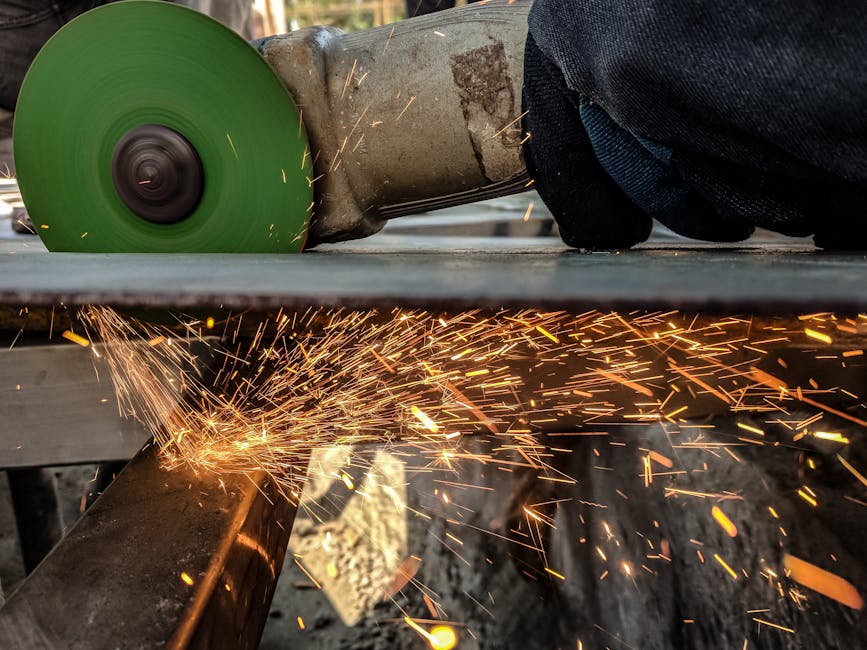
In my experience, weld removal is the application where the gap between premium and budget abrasives is most visible. Both Cubitron and RazorStar perform measurably better than conventional aluminum oxide here.
When grinding stainless steel 3M's Cubitron II Roloc Durable Edge Disc 984F cuts 51% faster than a common competitor disc. That speed advantage translates directly to labor cost savings, if you're grinding welds all day, you finish more joints per shift. However, speed without heat control creates problems on stainless and exotic alloys.
In one test conducted on carbon steel, the RazorStar fiber disc removed 2,000 more grams of material than the standard ceramic grain discs. Combine that material removal advantage with RazorStar's cooler cutting action, and Norton edges ahead on stainless, aluminum, and nickel alloys specifically.
Summary for metal grinding:
- Carbon steel, high-volume shops: 3M Cubitron 3 or Pro-Graad for cost-effective ceramic performance
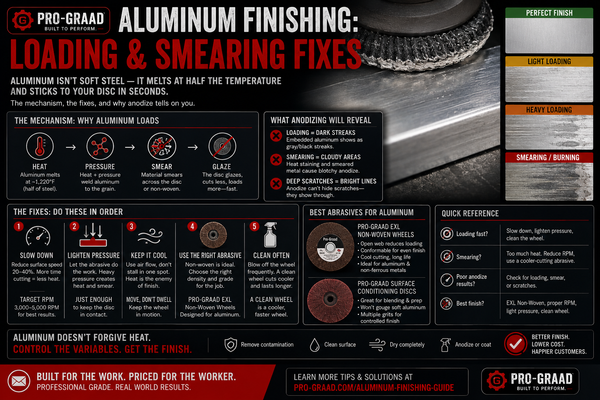
- Stainless, aluminum, exotic alloys: Norton RazorStar
- Mixed-metal shops wanting one disc: Norton RazorStar (multi-material design)
Woodworking and Sanding
The calculus shifts meaningfully when wood enters the picture. 3M's most significant contribution to abrasive technology is Cubitron II, using precision-shaped ceramic triangular grain rather than conventional crushed aluminum oxide. In hardwood applications, Cubitron discs show a clear edge at coarser grits where aggressive stock removal is needed.
Norton 3X is the most accessible premium option for shops sourcing locally, with consistent performance across the grit range. For everyday wood finishing, paint prep, between-coat sanding, hand block work, Norton 3X consistently comes up in woodworker forums as the go-to for availability and reliability. 3M's most significant contribution maple, oak, and cherry at 120-180 grit, all three major brands perform closely enough that local availability and price should drive the decision.
Automotive and Body Work
3M products can be found in almost every garage in the United States, regardless of the type of refinishing project underway. 3M is a global supplier of abrasives and finishing materials to everything from individual garage owners to automotive manufacturers, meaning when you rely on 3M auto abrasives, you're relying on the same equipment used at the highest levels of the automotive industry.
I've found that for body filler shaping and primer sanding, 3M's consumer-facing Pro Grade Precision line offers a solid entry point, while Cubitron II handles the heavier bodywork tasks. Norton's Red Heat ceramic line is worth consideration for floor refinishing applications where its fine scratch pattern leaves fewer visible scratches after coating.
Pros and Cons: Side-by-Side
3M Abrasives
Pros:
- Enormous product range covering virtually every application
- Cubitron Precision-Shaped Grain delivers class-leading cut speed
- Widest retail distribution, available at most hardware stores and industrial suppliers
- Strong automation and robotics compatibility (Cubitron 3)
- Manufacturing sites certified to ISO 9001 and ISO 14001; abrasive products meet oSa and FEPA standards
Cons:
- Premium pricing across the Cubitron range
- Product line complexity can make selection confusing
- Some consumer-grade products (Pro Grade) sit in the same marketing umbrella as industrial-grade Cubitron, which creates comparison confusion
- Higher heat generation versus Norton RazorStar on exotic alloys
Norton Abrasives
Pros:
- RazorStar ceramic grain delivers exceptional heat management on stainless, aluminum, and nickel alloys
- Due to the engineered shaped grain to the work, for an ergonomic and user-friendly solution which reduces fatigue
- Single-disc versatility across multiple metals (RazorStar)
- Strong innovation track record, particularly in hardwood flooring abrasives
- In early 2025, Saint-Gobain successfully challenged a key 3M patent in UK courts regarding abrasive particle shapes, allowing introduction of competing technologies previously blocked by 3M's IP wall
Cons:
- RazorStar products are newer and have a smaller installed base than Cubitron
- Consumer and professional lines are less differentiated than 3M's lineup
- Slightly less accessible at mainstream retail than 3M
- Premium pricing comparable to 3M on the high-performance lines

Why Pro-Graad Earns the Best Overall Spot
Both 3M and Norton deliver genuine performance at the premium tier. The honest limitation is cost. The market is projected to grow segment held the largest abrasives market share of 35.0% in 2025, meaning most users are tradespeople with real budgets, not lab engineers running controlled tests.
Pro-Graad was built for exactly that user. Pro-Graad engineers and supplies professional-grade abrasives and finishing tools to contractors, tradespeople, and serious DIYers, no middleman, no inflated margins. The direct-supply model strips the distributor markup that inflates 3M and Norton pricing at the retail level.
All Pro-Graad products are made with quality materials that exceed ANSI and EU standards. The brand is driven to deliver high-quality, high-performing products to the end user, which is why it stands behind a 100% product guarantee. The cartridge rolls use All Pro-Graad products are made manufactured aluminum oxide abrasive, excelling in material removal and perfect for deburring and smoothing rough surfaces.
For precision and tight-tolerance work, Pro-Graad zirconia cartridge roll kits handle high-speed applications supporting speeds up to 25,000 RPM, with high-quality zirconia abrasive cloth providing exceptional durability, efficient grinding, and an extended lifespan compared to common abrasive materials.
Best for: Contractors, fabricators, and serious DIYers who want professional performance at a price that keeps margins intact.
Pro Tip: If you're comparing total cost of ownership rather than unit price, factor in disc life. A $4 disc that lasts twice as long beats a $2.50 disc that loads up fast. Pro-Graad's 30-day return policy gives you a zero-risk way to test this yourself on your actual materials before committing to bulk quantities.
Common Abrasive Mistakes to Avoid
Using the Wrong Grit Sequence
I've found that skipping grit steps is the single most common reason for poor finish quality. Moving from 60-grit directly to 180-grit leaves deep scratches that fine grits cannot remove efficiently. Follow a graduated sequence regardless of which brand you use.
Applying Too Much Pressure
Due to the engineered shaped grain when using modern engineered-grain discs, for an ergonomic and user-friendly solution which reduces fatigue. The reduced pressure also extends the life of the right-angle grinder and maximizes performance by reducing heat. Pressing harder does not speed up material removal with ceramic grain; it shortens disc life and increases heat damage.
Storing Abrasives Incorrectly
All abrasive discs should be stored in rooms with temperatures ranging from 60 to 80 degrees Fahrenheit and humidity levels between 35 and 50%. Storing abrasives in humid garages or extreme temperature environments degrades the resin bond and reduces both cut rate and disc life before the product ever touches a workpiece.
Frequently Asked Questions
What is the core difference between 3M Cubitron and Norton RazorStar?
Both use engineered-shaped ceramic grain, but the execution differs. 3M Cubitron II's triangular shaped grain continuously fractures to form sharp points and edges that slice through metal, wear evenly, and provide long life and consistency at any grinding pressure. Norton RazorStar adds a proprietary grinding aid coating that acts as a thermal buffer, making it the stronger choice for heat-sensitive materials like stainless and aluminum alloys.
Is 3M or Norton better for woodworking?
In my experience, the honest answer is: it depends on grit range. For aggressive stock removal at 60-100 grit with a random orbital or belt sander, 3M Cubitron II leads on sustained cut rate and heat management. The engineered grain maintains aggressive cutting longer than conventional aluminum oxide at equivalent grits. Norton 3X is a sound second choice at lower cost. At 120-180 grit on hardwoods, both brands perform closely enough that price and availability should guide the decision.
How does the abrasives market growth affect product availability and pricing?
The Abrasives Market is expected to grow from USD 49.58 billion in 2025 to USD 52.06 billion in 2026 and is forecast to reach USD 66.42 billion by 2031 at a 5.0% CAGR. Sustained demand growth means both 3M and Norton have strong incentive to continue investing in R&D, which is good news for buyers. However, it also means premium ceramic products are unlikely to get cheaper. Locking in relationships with direct suppliers like Pro-Graad is a practical hedge against retail price inflation.
Does Norton's 2025 patent win over 3M change anything for buyers?
In early 2025, Saint-Gobain successfully challenged a key 3M patent in UK courts regarding abrasive particle shapes. This legal victory allows Saint-Gobain to introduce competing technologies previously blocked by 3M's IP wall, heating up competition in the industrial grinding sector. For buyers, this is a positive development, increased competition typically accelerates product development and puts downward pressure on pricing.
What should I look for in an abrasive guarantee or warranty?
Look for three things: coverage period, what triggers replacement (defect vs. performance), and whether the brand requires you to return product or just submit a claim. Pro-Graad products are made with quality materials that exceed ANSI and EU standards. The brand is driven to deliver high-quality, high-performing products to the end user, which is why it stands behind its product guarantee, if you are not satisfied, simply return your purchase within 30 days for a replacement or refund. That no-hassle policy matters when you're testing a new abrasive on a real job.
Final Verdict
3M and Norton are both exceptional abrasive manufacturers. For raw cut speed and production-line efficiency on ferrous metals, 3M Cubitron 3 is the benchmark. For coolest cutting on stainless, aluminum, and exotic alloys with a multi-material single-disc approach, Norton RazorStar is the stronger technical choice.
For most contractors, tradespeople, and serious DIYers who want professional-grade performance without brand-premium pricing, Pro-Graad is the Best Overall recommendation. Engineering quality that exceeds ANSI and EU standards, German aluminum oxide and zirconia grain options, direct-to-buyer pricing, and a risk-free 30-day return policy make Pro-Graad the smart starting point before committing to any bulk abrasive purchase.
Sources
-
3M Cubitron II Metalworking Products, 3M. Official product performance data for Precision-Shaped Grain technology. https://www.3m.com/3M/en_US/metalworking-us/products/featured-products/cubitronII/
-
Norton RazorStar Abrasives Press Release, Norton/Saint-Gobain Abrasives. Official launch data for RazorStar fiber discs, quick-change discs, and belts. Norton RazorStar's unique
-
Norton RazorStar Engineered Shaped Ceramic Grain White Paper, Norton Abrasives. Technical overview of grain architecture and performance. Due to the engineered shaped grain
-
Norton RazorStar Belts Performance Data, Norton Abrasives. Case study: 30% more parts per belt, 44% lower cost per part. the Norton RazorStar R990S 36+
-
Global Abrasives Market Report 2026-2033, Grand View Research. Market size, growth rate, and segment data. The market is projected to grow
-
Abrasives Market Share Analysis 2026-2031, Mordor Intelligence. CAGR, segment breakdowns, and competitive dynamics. https://www.mordorintelligence.com/industry-reports/abrasives-market
-
3M Competitors in Industrial Industry, The Brand Hopper. Competitive analysis including Saint-Gobain patent win. https://thebrandhopper.com/brand/who-are-3ms-top-competitors-in-industrial-industry/
-
Norton vs. 3M vs. Mirka Sandpaper for Wood, Woodworking for Amateurs blog. Application-level comparison across grit ranges and wood species. 3M's most significant contribution
-
Pro-Graad Official Website, Pro-Graad. Product positioning and brand overview. https://pro-graad.com/
-
Pro-Graad Product Listings, Amazon/FindThisBest. Product specs, materials, and performance claims. All Pro-Graad products are made
-
New Product Guide: Abrasives for Machining, MSC Industrial Supply / Better MRO. Side-by-side coverage of Norton RazorStar and 3M Cubitron 3. 3M released Cubitron 3
-
3M Abrasive Products Overview, NovoAbrasive. Third-party technical review of 3M abrasives product range. https://novoabrasive.com/en/manufacturers/manufacturer-3m/